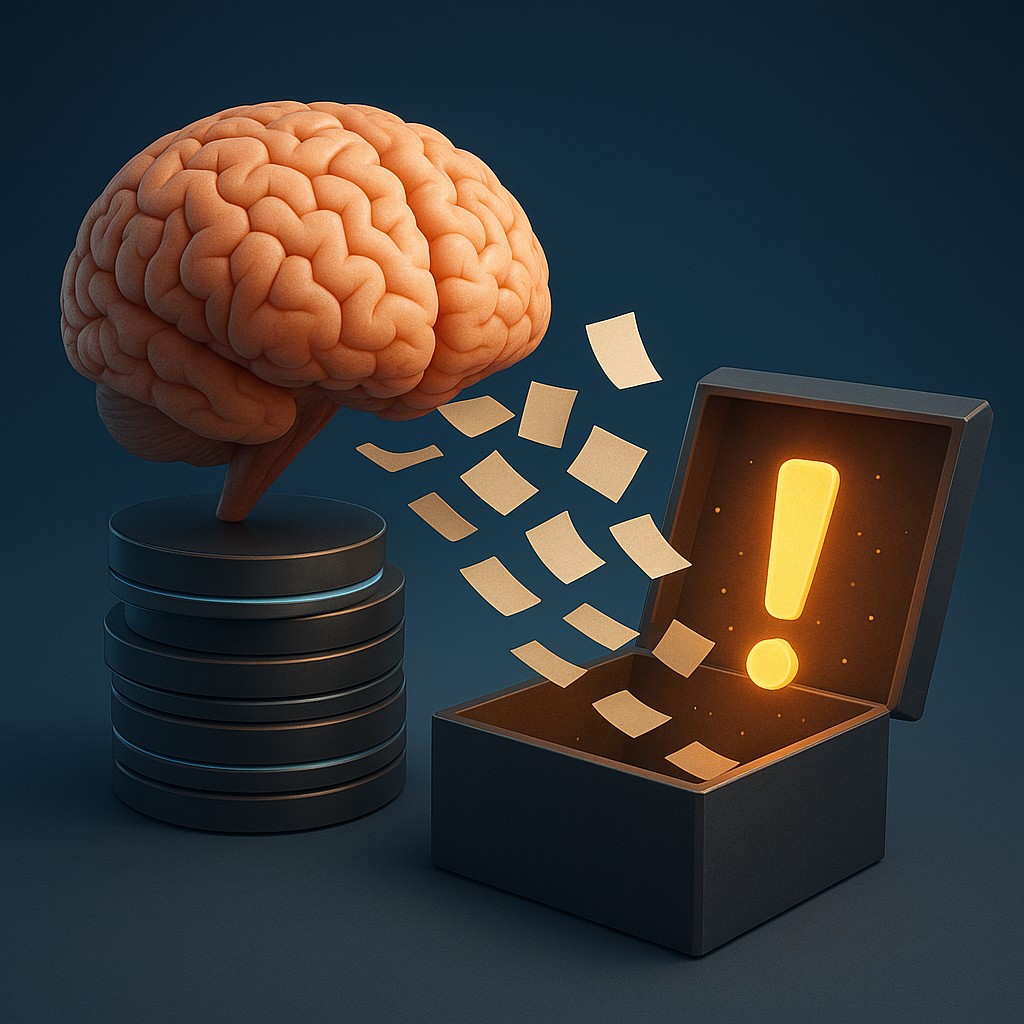
Imagine for a moment that your brain was a high-definition video recorder, capturing every second of your life with perfect clarity. At first, this sounds like a superpower. You would never lose your keys, you would remember every word of every conversation, and you would be a walking encyclopedia of your own existence. However, the reality would be a cognitive nightmare. By the end of a single week, your "hard drive" would be cluttered with millions of useless files: the exact shade of grey on a sidewalk, the repetitive hum of the air conditioner, and the flickering lights of a thousand boring traffic signals. If you remembered everything, you would effectively know nothing, because you would be unable to find the important signals amidst the deafening noise of the trivial.
To prevent this internal clutter, your brain has evolved to be the world's most ruthless editor. It does not exist to record your life; it exists to help you survive the future. Evolution has determined that energy is too precious to waste on storing data that doesn't help you make better decisions. As a result, your biological memory is a "culling machine" that treats boredom as a signal to delete. The brain operates on a fascinating principle of economy: if reality matches your internal map of the world perfectly, there is no reason to write that experience down. You already have the map, so why save a duplicate? Only when the map fails, when reality throws a curveball that violates your expectations, does the brain perk up and start the heavy lifting of long-term storage.
The Prediction Engine and the Power of Surprise
At any given moment, your brain is busy simulating what is about to happen next. This is known as predictive processing. When you walk down a flight of stairs, you aren't consciously identifying every step; your brain has a "staircase model" and predicts that the floor will be exactly where your foot lands. This saves an immense amount of processing power. If the floor is exactly where you expected, the event is marked as low priority. However, if there is a missing step and you stumble, your brain experiences a "prediction error." This error acts like a chemical flare, lighting up your neural pathways and signaling that something important just happened.
These prediction errors are the currency of learning. When reality defies your expectations, it means your internal model of the world is flawed or incomplete. To ensure you don't stumble again, the brain must update its software. It does this by physically tagging the neurons involved in that surprise using specific brain chemicals like dopamine and norepinephrine. These chemicals act as "save" buttons, marking the specific neural sequence for more intensive processing later. This is why you can remember exactly what you were doing during a sudden thunderstorm or a surprise party, but the three hours of routine emails you sent beforehand have vanished into a mental abyss.
The Hippocampus and the Midnight Editorial Meeting
While the initial tagging happens while you are awake, the actual decision of what makes the final cut happens while you are fast asleep. During the day, your hippocampus acts as a temporary staging area, a sort of "drafts" folder for everything you experienced. Once you enter deep sleep, the hippocampus begins to replay these experiences at high speed, firing the neurons in the same sequence they fired during the day. However, it doesn't replay everything equally. It looks for those chemical flares, those moments of "unmet expectations" that were tagged earlier.
This process is a collaborative effort between the hippocampus and the neocortex, the brain's long-term storage vault. During deep, non-dreaming sleep, the brain generates specific electrical rhythms called "sharp-wave ripples." These ripples are essentially the hippocampus screaming important information up to the cortex. If a memory was marked as a prediction error, the brain replays it over and over, strengthening the synaptic connections until the memory is physically woven into the architecture of your brain. Meanwhile, the memories of your "met expectations", the routine, boring, and predictable events, are denied this replay. Without the reinforcement of sleep-based repetition, the neural pathways for those mundane events simply wither away, a process known as synaptic pruning.
Comparing the Predictable and the Perplexing
To understand how the brain differentiates between what to keep and what to toss, it helps to look at how different types of data are treated during the overnight "culling" process. The brain is looking for utility, not sentimentality. It wants to know if an event provides a lesson that can be used to navigate a similar situation in the future.
| Type of Experience |
Mental Model Status |
Brain's Internal Reaction |
Final Fate in Sleep |
| Normal Daily Commute |
Model Confirmed |
"Nothing new here, move along." |
Deleted during pruning. |
| Near-Miss Car Accident |
Model Violated |
"Danger! Update the safety model!" |
Replayed and solidified. |
| Reading a Familiar Book |
Model Confirmed |
"Redundant data detected." |
Details fade; core concept stays. |
| Learning a New Skill |
Model Incomplete |
"High error rate; need more data." |
Strong consolidation. |
| Sitting in a Quiet Room |
Model Confirmed |
"Energy saving mode initiated." |
Total erasure of specifics. |
Why Your Brain Hates Efficiency and Loves Friction
This "unmet expectation" mechanism explains a common paradox in education and habit formation: things that are "easy" are rarely "memorable." If you read a textbook and everything makes perfect sense immediately, you might feel like you are learning, but your brain is actually snoozing. Because it fits perfectly into what you already know, the brain sees no reason to expend the energy required to build new neural bridges. This is the trap of "passive review." It feels smooth and efficient, but because there is no friction or surprise, the brain tags it as low-priority data and deletes it while you sleep.
To combat this, the best learners intentionally create prediction errors. They use "active recall" or "practice testing" to force their brains to realize what they don't know. When you try to remember a fact and fail, you are creating a massive prediction error. Your brain expected to find the information and didn't. That moment of frustration is actually a chemical signal that tells your hippocampus, "This data is missing and it's causing problems! Tag it for high-priority storage tonight!" By introducing "desirable difficulties" into your day, you are essentially pre-ordering the memories you want your brain to keep.
The Architecture of Forgetting as a Survival Strategy
We often view forgetting as a failure of the system, a "glitch" in the human machine. But if we view the brain as a survival engine, forgetting is actually one of its most sophisticated features. By actively deleting the details of met expectations, the brain keeps itself "lean." A lean brain is faster at making connections and more efficient at retrieving truly vital information. If you had to search through a mental filing cabinet containing every sandwich you've ever eaten just to find where you parked your car today, you would be paralyzed by the search time.
Furthermore, this culling process allows for generalization. By stripping away the specific, boring details of multiple similar events, the brain distills them into a "schema," or a rule of thumb. You don't need to remember every time you've ever interacted with a door handle; you just need the general "door handle rule." This abstraction is only possible because the brain is willing to let the specific details of a thousand successful door-openings die. We are the sum of what we have forgotten just as much as what we have remembered. Forgetting provides the space for wisdom to grow, replacing a mountain of raw data with a small, powerful set of operating principles.
Embracing the Error-Driven Mind
Understanding that your brain is a "prediction error" hunter changes how you should approach your daily life and your growth. If you find yourself in a routine where every day feels like a blur, it is because you are living a life of "met expectations." Your brain is doing exactly what it was designed to do: it is navigating a predictable environment and deleting the evidence to save power. To grow, to remember more of your life, and to sharpen your intellect, you must seek out the moments where reality and your expectations collide.
Every time you are surprised, every time you are wrong, and every time you find yourself confused, do not be frustrated. Instead, recognize those moments as the "tagging phase" of your mental development. You are giving your hippocampus the raw material it needs to rebuild you into a smarter, more capable version of yourself overnight. Your brain is not a static library; it is a dynamic, living sculpture, constantly being chiseled by the friction of a world that refuses to be predictable. Embrace the surprises, for they are the only parts of your life that your brain deems worthy of keeping forever.