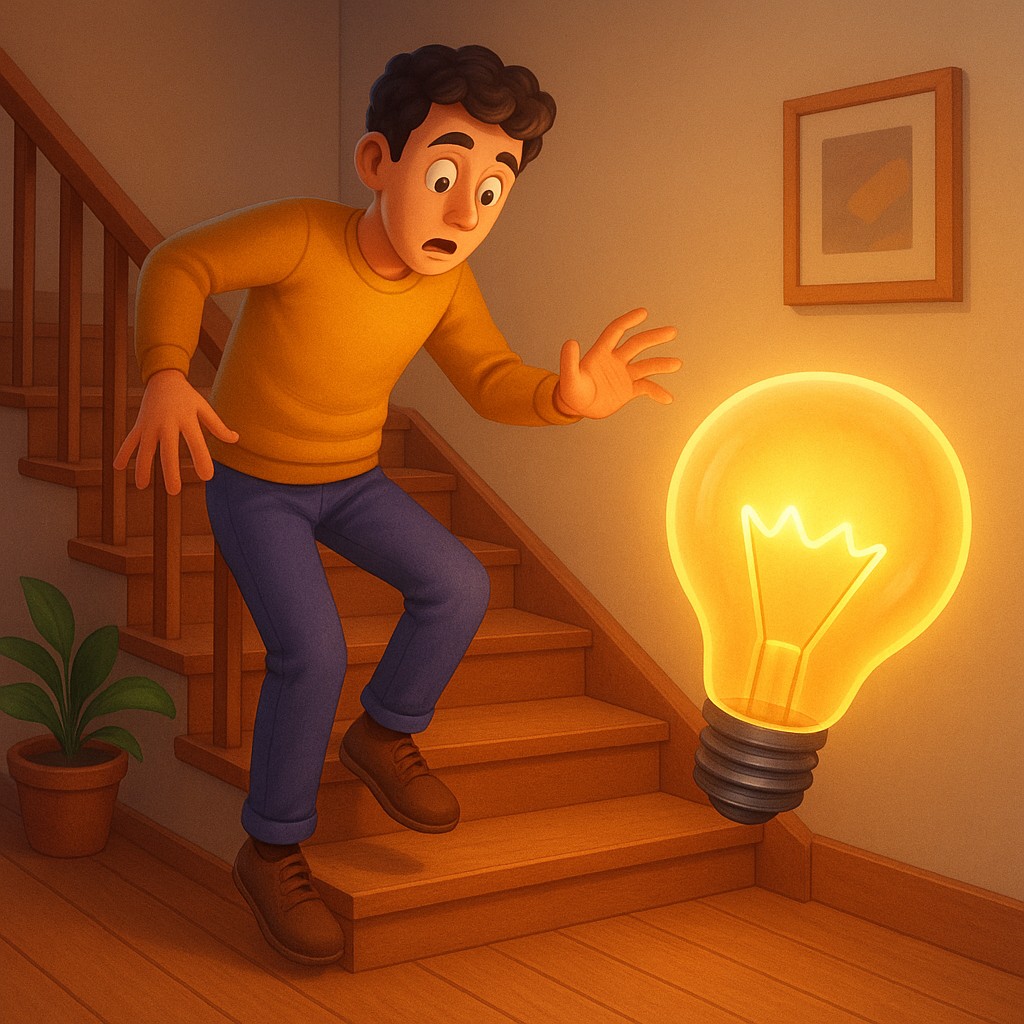
Imagine you are walking down a familiar flight of stairs in your own home. You have climbed these steps thousands of times, so your brain has built a perfect internal map of exactly where every wooden plank sits. As you head down, you aren't thinking about the stairs at all; you are likely wondering what to have for dinner or remembering a joke from a podcast. Your brain is running on autopilot because your expectations usually match reality with perfect precision.
But then, it happens. You expect one more step at the bottom, but your foot hits the floor too soon, or perhaps there is an extra step you didn't realize was there. In that split second, your heart leaps, your foot fumbles, and your entire focus snaps violently back to the present moment.
That jolt of surprise is more than just a physical reflex; it is the fundamental engine of human intelligence. Neuroscientists call this phenomenon Reward Prediction Error (RPE). It suggests that we do not actually learn when things go right. If you complete a task perfectly, your brain essentially says, "Carry on, nothing to see here," and keeps its internal wiring exactly as it was. It is only when there is a gap between what you thought would happen and what actually occurred that the brain "wakes up" and begins the heavy lifting of rewiring itself. Learning, quite literally, is the process of being proven wrong and then figuring out why.
The Math Behind Human Surprise
At the center of this biological masterpiece is a simple calculation that your brain performs roughly every millisecond. The Reward Prediction Error is the difference between the outcome you got and the outcome you expected. If the result is exactly what you predicted, the error is zero, and your dopamine levels remain flat and steady. This "baseline" dopamine state is comfortable, but it is also a state of standing still. In this zone, you are merely performing, not growing. You are relying on old maps, and because those maps worked, the brain sees no reason to spend the massive amount of energy required to build a new one.
However, when things go better than expected (a positive prediction error) or worse than expected (a negative prediction error), the brain undergoes a chemical transformation. A positive error, like finding a twenty-dollar bill in a pair of jeans you haven't worn in months, triggers a surge of dopamine that reinforces that behavior. On the other hand, a negative error, like biting into what you thought was a chocolate chip cookie only to realize it is oatmeal raisin, causes dopamine levels to drop. This dip is just as important as the surge because it signals to your neurons that your current "instruction manual" for the world is out of date and needs an urgent update.
Dopamine: The Brain’s Chief Editor
Common wisdom often describes dopamine as a "pleasure chemical," a type of internal prize you get for winning. Modern neuroscience, however, shows that it serves a much more practical purpose. Dopamine is not about the joy of the reward; it is a "teaching signal" that tracks the gap between expectation and reality. When you run into a prediction error, dopamine neurons in the midbrain fire like high-speed couriers. They carry the message that a change is needed, effectively "tagging" the memory of the mistake so the brain knows exactly which connections to weaken or strengthen.
This explains why we often remember our most embarrassing failures with painful clarity, while our easy successes blur into a foggy memory. When you fail publicly or make a big mistake, the massive prediction error acts like a chemical flare that lights up the event. Your brain treats this as "high-value data" because it reveals a flaw in your strategy for navigating the world. To your gray matter, a mistake is an opportunity to fix a bug in your software. If you never ran into these bugs, your internal software would never improve, and you would stay trapped in a loop of "good enough."
Mapping the Error Landscape
| Type of Outcome |
Prediction Error Status |
Dopamine Response |
Resulting Brain Action |
| Outcome matches expectation |
Zero Error |
Baseline (Steady) |
No change; keep on autopilot |
| Outcome better than expected |
Positive Error |
Surge (Burst) |
Strengthen behavior; "Do this again" |
| Outcome worse than expected |
Negative Error |
Dip (Pause) |
Signal a correction; "Change the plan" |
| Outcome is a total surprise |
High Error |
Massive Spike |
Intense focus; "Build a new map" |
The Energy Cost of Changing Your Mind
If learning is so beneficial, you might wonder why our brains don't stay in "learning mode" all the time. The answer comes down to biological economics. Your brain is an energy hog, consuming about 20 percent of your total calories despite making up only 2 percent of your body weight. Physical restructuring, known as neuroplasticity, is the most expensive thing your brain can do. It requires building new proteins, moving receptors around, and even growing new branches on brain cells. Because of this, the brain is evolved to be a "thrift spender." It will not change its physical structure unless it is forced to by the evidence of a mistake.
This natural laziness is why we often feel a sense of resistance or "mental strain" when we struggle with a difficult new concept. That strain is the feeling of your brain trying to make sense of a massive prediction error. If you are reading a book and everything makes perfect sense, you are likely just confirming what you already know, and very little physical change is happening in your head. True learning feels like a mild form of irritation. It is the sound of your brain's old gears grinding against new, incompatible information. Without that friction, the "cost" of rewiring is seen as too high, and the brain simply ignores the new data.
Designing Your Life for Maximum Friction
Most of us spend our lives trying to avoid mistakes. We want to be right, we want to look smart, and we want things to work the first time. However, if your goal is to master a skill quickly or grow intellectually, this "error-avoidance" strategy is your worst enemy. To learn faster, you must intentionally increase how often you encounter prediction errors. This doesn't mean being reckless; it means working at the "edge of your ability," where you are failing about 15 to 20 percent of the time. This is often called the "sweet spot" for learning, where errors are frequent enough to trigger dopamine signals but not so overwhelming that they cause you to shut down.
Consider two students studying a new language. One student spends hours reading a textbook, nodding along because the grammar rules make sense. The other student tries to have a conversation with a native speaker, constantly fumbling words and being corrected. The first student is experiencing zero prediction error and, as a result, very little brain rewiring. The second student is being hit with a constant stream of errors. Their brain is being told that its "language map" is broken, forcing it to rapidly rebuild and refine its connections. The speaker who stumbles will learn the language months faster than the reader because they embraced being "wrong."
The Illusion of Knowledge and the Comfort of Certainty
One of the greatest obstacles to learning is the "illusion of depth." This is a bias where we believe we understand how something works (like a zipper or a bicycle) until we are forced to explain it in detail or draw it from memory. Only when we fail that task does the prediction error occur, finally allowing us to learn the actual mechanics. This explains why "passive learning," such as watching a documentary or listening to a lecture, is so inefficient. It feels like learning because the information flows smoothly, but because it doesn't challenge your expectations, it rarely sticks.
To fight this, you must turn passive intake into an active "prediction game." Before checking the answer to a problem, or before seeing the result of an experiment, make a firm prediction about what will happen. By committing to a specific outcome, you raise the stakes for your brain. If you are right, you confirm your model. If you are wrong, you create a productive prediction error that forces your neurons to pay attention. Without a prediction, there can be no error; and without error, there is no reason for the brain to update its old files.
Embracing the Gift of Being Wrong
Ultimately, understanding how prediction errors work changes how we view failure. Instead of a blow to the ego, a mistake becomes a biological necessity, the "green light" that tells your brain it is time for an upgrade. We often treat being wrong as a sign of low intelligence, but in neuroscience, the ability to recognize an error and respond to it is the very definition of being smart. The most successful people are not those who make fewer mistakes, but those who have developed a high tolerance for the discomfort of being wrong, knowing that each jolt of surprise is actually a tiny burst of neural growth.
As you move forward, look for the "stairs" you think you know perfectly and find a reason to stumble. Seek out critics who challenge your assumptions and tasks that make you feel slightly out of your depth. When you feel that familiar sting of being wrong, don't shy away from it or make excuses. Instead, take a deep breath and recognize the chemical update currently surging through your brain. You are not failing; you are simply giving your brain the raw material it needs to build a better version of yourself.