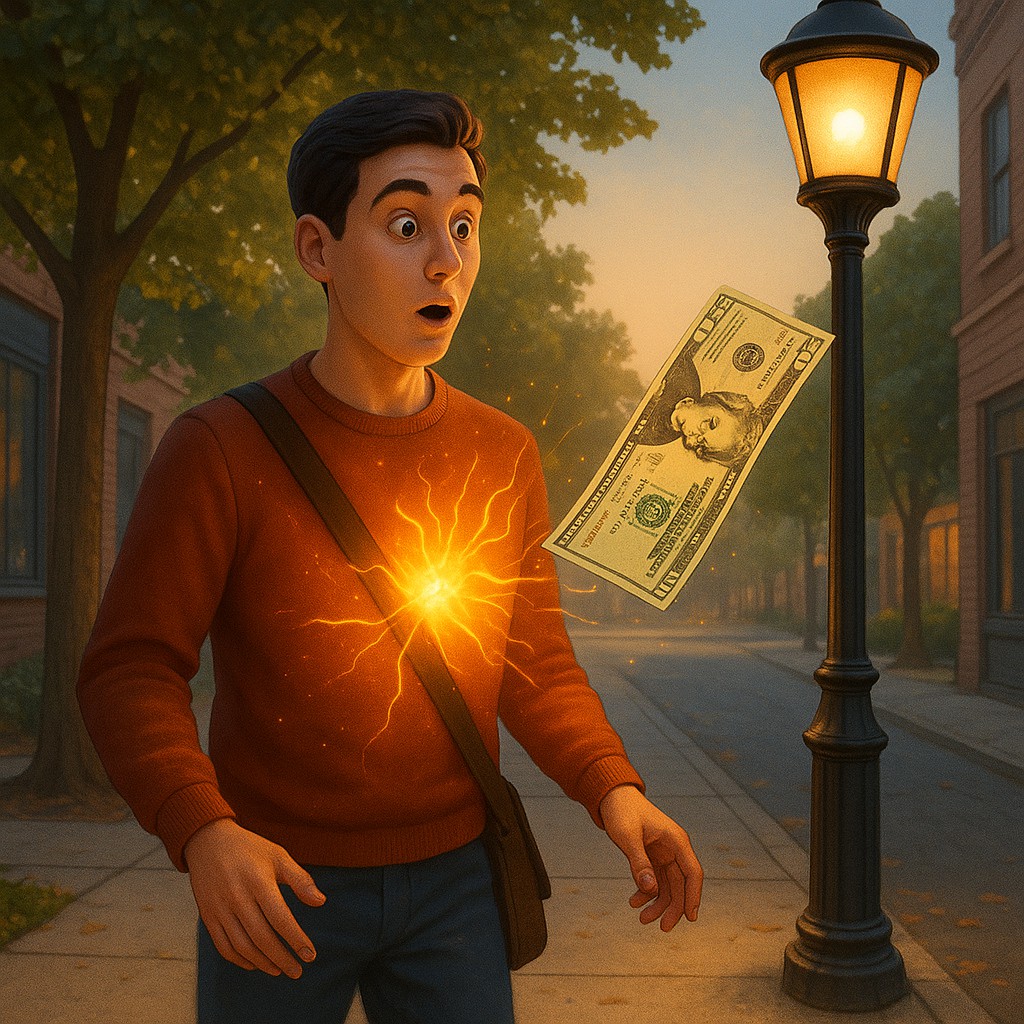
Imagine you are walking down a familiar street on your way to work, a route you have taken a thousand times. You know exactly where the sidewalk is cracked, which shop sells the burnt coffee, and which neighbor has the loud dog. Because everything is exactly as you expect, your brain is essentially on autopilot, ticking along with very little chemical fanfare. But then, you glance down and see a crisp twenty-dollar bill fluttering near a lamp post. Suddenly, your heart dances, your focus narrows, and a wave of genuine excitement washes over you. That surge of electricity isn't just about the money; it is the sound of your brain’s internal chemistry throwing a surprise party because reality just outperformed your expectations.
This phenomenon is governed by a sophisticated biological calculator within your skull that constantly compares what you thought would happen with what actually occurred. Most people think of dopamine as the "pleasure chemical," a sort of biological candy that drops when we win or eat something delicious. In reality, dopamine is much more interested in the future than the present. It is the molecule of anticipation and the engine of learning. When the world delivers exactly what was promised, the dopamine system stays relatively quiet. It is only when there is a "prediction error" - a gap between the expected and the actual - that the brain cranks up the chemical volume, ensuring you pay close attention to whatever just happened.
The Mathematical Heart of Your Desires
To understand why we get bored with the familiar and obsessed with the new, we have to look at the formula the brain uses to navigate the world. Scientists call this Reward Prediction Error (RPE). Think of it as a simple subtraction problem: Reality minus Expectation equals Dopamine. If you expect a five-dollar reward and you get five dollars, the error is zero. Your brain notes that your internal model of the world is accurate, so it doesn't need to waste energy learning anything new. However, if you expect nothing and get five dollars, you have a positive prediction error. This triggers a spike in dopamine that signals to the rest of the brain, "Hey, this was great, remember exactly what we did to make this happen!"
Conversely, there is the sting of the negative prediction error. This happens when you are promised a steak dinner and end up with a lukewarm bowl of porridge. Your dopamine levels don’t just stay at the baseline; they actually drop below their normal firing rate. This feels like a physical "thud" in your mood, a sense of disappointment that teaches you to avoid that specific restaurant or behavior in the future. By using these chemical spikes and dips, your brain is constantly updating its map of the world, trying to figure out where to get the best "bang for your buck." This is why the first bite of a chocolate cake is divine, but the tenth bite feels like a chore; by that point, your brain has predicted the flavor perfectly, and the "error" has vanished.
Why Randomness Is the Ultimate Brain Hook
Modern technology and the entertainment industry have unintentionally hijacked this biological feedback loop to keep us staring at screens and pulling levers. The most addictive experiences in the world are not the ones that guarantee a reward, but the ones that offer rewards on a "variable ratio schedule." This is fancy psychological talk for "maybe you win, maybe you don't." When you scroll through a social media feed, most of the content is mildly interesting or even boring. However, every few swipes, you find a hilarious meme, a shocking news story, or a notification that someone liked your photo. This unpredictability creates a constant state of high-stakes anticipation.
Because you can never perfectly predict when the "good stuff" is coming, your brain stays in a state of high dopamine frequency. Unlike a vending machine, where you know exactly what you get for your dollar, a "mystery box" or a slot machine keeps the prediction error high. Every win is a surprise, and every surprise is a massive dopamine spike. This explains why we can spend hours on an app that mostly makes us feel annoyed; that one "hit" of unexpected joy is enough to keep the machine running. We aren't actually addicted to the content itself; we are addicted to the shimmering possibility that the next swipe will be the one that pays off.
Distinguishing Between Wanting and Liking
One of the most profound realizations in neuroscience is the separation between "wanting" something and actually "liking" it. Because dopamine is the primary driver of Reward Prediction Error, it is heavily involved in the "wanting" phase. It creates the drive, the craving, and the motivation to seek out a goal. However, once you actually achieve that goal, a different set of chemicals, such as opioids and endocannabinoids (the brain's natural pain-relievers and mood elevators), usually take over to provide the sensation of contentment and satisfaction. This is why you might find yourself desperately craving a specific fast-food burger, only to feel strangely empty or underwhelmed once you’ve finished eating it.
The dopamine spike happened during the "hint" of the reward - when you smelled the fries or saw the golden arches. By the time the burger hit your tongue, the prediction was already confirmed, and the chemical rush began to fade. This "dopamine letdown" can lead to a cycle of constant seeking where we chase the next big thing, the next promotion, or the next gadget, under the false impression that finally getting it will make us happy forever. In reality, the brain is designed to return to its baseline as soon as the novelty wears off, so it can be ready for the next unexpected opportunity.
A Comparison of Reward Environments
To better visualize how your brain reacts to different scenarios, it helps to see how the predictability of a situation changes your internal chemistry. The following table illustrates how the brain processes various types of feedback based on the Reward Prediction Error model.
| Situation Type |
Expectation |
Actual Outcome |
Dopamine Response |
Long-term Effect |
| Routine/Habit |
High (You know it's coming) |
Matches Expectation |
Minimal/Baseline |
Boredom and "autopilot" |
| Pleasant Surprise |
Low/Zero |
Better than Expected |
Strong Spike |
Learning and Excitement |
| Disappointment |
High |
Worse than Expected |
Sharp Drop |
Frustration and Avoidance |
| Variable/Random |
Uncertain |
Intermittent Success |
Frequent Spikes |
High Engagement/Addiction |
The Exhaustion of the Expected
This biological reality sheds light on why routine chores and repetitive jobs feel so draining. It isn't just that washing the dishes is physically hard; it is that there is absolutely no prediction error involved. You know exactly how the sponge feels, you know how the soap smells, and you know the dishes will be dirty again tomorrow. Your brain receives zero "learning signals" from the task, so it refuses to allocate much dopamine to it. This makes the task feel "heavy" and unrewarding. We often mistake this lack of dopamine for physical fatigue, but notice how you can feel exhausted by a day of meetings and then suddenly feel "electric" the moment a friend calls with a surprise invitation to a concert.
The "thrill of the hunt" for new information works the same way. When you are researching a topic you find fascinating, every new fact feels like a tiny treasure. Your brain is constantly making small predictions and having them blown away by new data. This keeps you in a high-dopamine state, which increases focus and memory. To make boring tasks more bearable, we often have to artificially introduce prediction error. This is why "gamifying" your life works. If you set a timer to see if you can beat your previous record for folding laundry, you’ve introduced an element of uncertainty. Now, there’s a "win" at stake that isn't perfectly predicted, which can leak a little bit of dopamine back into the system.
Reclaiming Strategy from the Chemical Machine
Understanding the Reward Prediction Error mechanism is like being handed the blueprint to your own motivations. Once you realize that your brain is a "novelty seeker" rather than a "satisfaction seeker," you can start to make more intentional choices. You can recognize that the urge to check your phone for the twentieth time in an hour isn't because there is something important waiting for you, but because your brain is fishing for a dopamine spike. By identifying these loops, you can intentionally break them and redirect that energy toward tasks that offer more meaningful, long-term rewards.
Modern life is designed to provide "cheap" dopamine through constant, unpredictable pings, but these often lead to "wanting" without the "liking." Real satisfaction often comes from the quieter systems of the brain that appreciate the "now." While we can't change our biological wiring, we can curate our environments to minimize the constant pull of low-value surprises. We can save our dopamine for things that actually matter - like the surprise of mastering a new skill or the unexpected joy of a deep conversation. In doing so, we move from being a passenger to being the pilot of our own focus.
The beauty of the human brain lies in its relentless desire to learn and adapt. We are creatures built for the "gap" - that space between what we know and what we are about to find out. While the lure of the unpredictable can lead us toward distraction, it is also the very thing that drives scientific discovery, artistic creation, and the courage to explore the unknown. Embrace the surprise, respect the biological power of the "maybe," and remember that the most rewarding parts of life aren't always the ones you planned for, but the ones you never saw coming.