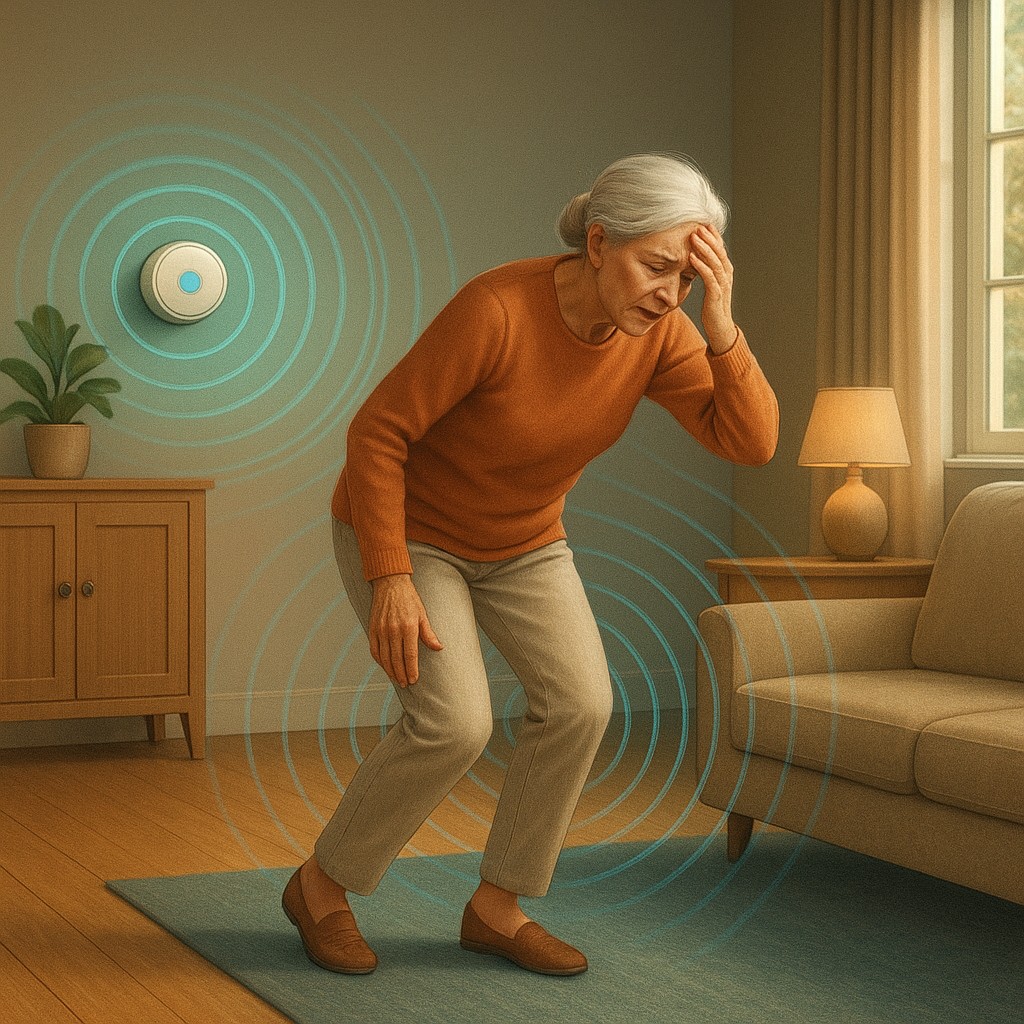
Imagine for a moment that your house is not just a structure of bricks, wood, and drywall, but a living observer that understands exactly where you are and how you move. For decades, the "smart home" was defined by gadgets we could talk to or lights we could dim using a phone. However, as the population ages, the focus of innovation has shifted from simple convenience to a much deeper challenge: how do we keep people safe in their most private moments without turning their homes into high-tech prisons? This tension between safety and privacy is most obvious when it comes to fall detection for the elderly, where the risks are life-changing but the desire for dignity and seclusion remains a top priority.
Traditional solutions to this problem usually fall into two categories, both of which have major flaws. On one hand, there are wearable pendants or watches. These require the user to remember to put them on and, more importantly, to press a button during a moment of intense physical shock. On the other hand, cameras provide constant monitoring but bring the inherent discomfort of being watched in a bedroom or bathroom. A new generation of "ambient sensing" technology is closing this gap by using the physics of pressure and the invisible bounce of radio waves. By turning the room itself into a sensor, we can now detect emergencies through mathematical patterns of force and movement, ensuring help arrives without ever capturing a single image.
The Invisible Observer Under Your Feet
The idea of a pressure-sensitive floor might sound like a high-tech security system from a spy movie, but the engineering behind it is elegant and practical. These systems use "capacitive" or "resistive" sensing - similar to how a smartphone screen works. They typically consist of a thin, modular mat installed beneath the final floor surface, such as laminate, vinyl, or carpet. This layer is embedded with a grid of sensors that act like a giant, low-resolution touchpad for the entire room. Instead of detecting the light touch of a finger, these sensors measure how weight is spread across the floor. When you walk, the system sees a rhythmic sequence of high-pressure points moving in a line, which it recognizes as a normal human stride.
The real breakthrough occurs when the system detects something that is not a footstep. A fall has a very specific physical "signature": a sudden, high-impact force spread over a much larger area than a foot, followed by a total lack of movement. Because the floor maps the room in real time, it can tell the difference between someone sitting in a chair and someone collapsing. A chair creates a concentrated increase in pressure that stays still, while a fall creates a chaotic burst of energy across several sensors. This data is processed on-site by an AI algorithm that identifies the "shape" of the event. This allows the system to send an alert only when the mathematical probability of a fall passes a certain limit.
Reading the Air with Millimeter Waves
While floor sensors are excellent for new buildings or major renovations, another type of invisible sensing uses the air itself to track movement. This is known as mmWave (millimeter-wave) radar. Unlike the radar used to track airplanes over hundreds of miles, these systems are designed for high-precision tracking within a single room. The device sends out low-power radio waves that bounce off everything, including your body. Because human skin reflects these waves well, the sensor can build a "3D point cloud" of your presence. It cannot see your face or the color of your clothes; instead, it sees a shifting cluster of dots that represent your physical size and position in the room.
What makes mmWave radar so effective for healthcare is its ability to detect tiny movements. These sensors are so sensitive that they can often pick up the slight rise and fall of a chest during breathing or the subtle vibrations of a heartbeat. As a person moves through a room, the system tracks their center of gravity. If that center of gravity drops suddenly and stays at floor level, the system recognizes a potential emergency. The software analyzes the speed of the fall and the stillness afterward to determine if the person is likely injured or unconscious. This provides protection even if the person is behind a shower curtain or under a blanket - areas where a camera would be either intrusive or useless.
Comparing the Guardians of the Home
Choosing the right technology requires balancing installation difficulty, cost, and the home's layout. Both pressure-sensitive flooring and radar systems offer a "set it and forget it" approach to safety, where the user does nothing proactive to stay protected. Below is a look at how these technologies compare.
| Feature |
Pressure-Sensitive Flooring |
Radar-Based Gait Analysis (mmWave) |
| Visibility |
Completely hidden under the floor. |
Small device mounted on a wall or ceiling. |
| Installation |
High; requires replacing the floor. |
Low; usually a simple "plug-and-play" setup. |
| Privacy Level |
Absolute; only reads pressure points. |
High; uses coordinate data, not pictures. |
| Accuracy |
High for detecting physical impact. |
High for tracking movement and vitals. |
| Common False Alarms |
Heavy dropped objects, large dogs. |
Fast-moving pets, oscillating fans. |
| Maintenance |
Minimal once installed. |
Occasional software updates. |
The Mathematical Signature of a Fall
To understand how these systems "think," we have to look at the difference between a deliberate action and an accident through the lens of physics. Everything we do at home leaves a data trail. When you walk, your weight creates a pressure peak on the floor that lasts about half a second before shifting to the other foot. If you sit down, your weight moves from your feet to a larger area (the chair), but the chair is a known, stationary object on the room's digital map. A fall, however, is a high-speed event that involves a spike in force several times a person's body weight due to the pull of gravity.
Once this spike happens, the system enters a "confirmation phase." It looks for two things: a lack of vertical movement (the person isn't getting up) and a lack of horizontal movement (the person isn't crawling). In radar systems, the AI can even check for "respiratory distress" by measuring the frequency of chest movements. By combining these factors, the system creates a high-confidence alert. This prevents the "false alarm" scenarios that often cause people to turn off their security systems. Even if you drop a heavy cast-iron pan, the system is smart enough to know that a pan doesn't have a heartbeat and doesn't take up the same space as a human.
Navigating the Limitations of Smart Sensing
Despite how advanced these technologies are, they are not yet perfect. One of the biggest hurdles is "biological noise" in a house. For example, a large dog jumping off a couch can create a pressure pattern very similar to a human fall. Similarly, radar systems can sometimes be confused by highly reflective surfaces like large mirrors or the spinning blades of a ceiling fan, which can create "ghost" movements in the digital map. Engineers are currently working on "multi-sensor fusion," where different types of sensors work together to verify a situation. A floor sensor might ask the radar sensor for a "second opinion" before calling for help.
Another factor is the cost and the work required to set them up. Pressure-sensitive flooring is currently an expensive choice, usually saved for specialized nursing facilities or high-end home renovations for seniors. Radar systems are more affordable but must be placed carefully to avoid "blind spots" caused by heavy furniture or thick walls. Finally, there is the question of data ownership. While these systems do not record video, they do record patterns of daily life, such as how often you wake up at night or how long you spend in the kitchen. Protecting this data from hackers or third parties is the next major challenge in developing truly private smart homes.
The Future of Dignified Care
The move toward non-visual sensors represents a fundamental change in how we think about technology. We are moving away from "surveillance," where a human or an AI watches you, and toward "context," where the environment simply understands and supports your needs. This evolution allows for a world where growing older does not mean giving up the privacy of home life. It turns our living spaces into active partners in our well-being, providing a safety net that is as invisible as the air we breathe.
As these tools improve, the goal is to make them so seamless that we forget they are there. Imagine a home that knows you are safe not because it sees you, but because it feels your presence and understands your rhythm. This technology is not just about preventing accidents; it is about providing peace of mind to families and independence to individuals. By mastering the math of movement and the physics of pressure, we are building a future where the home is not just where we live, but where safety and privacy finally exist in perfect harmony.