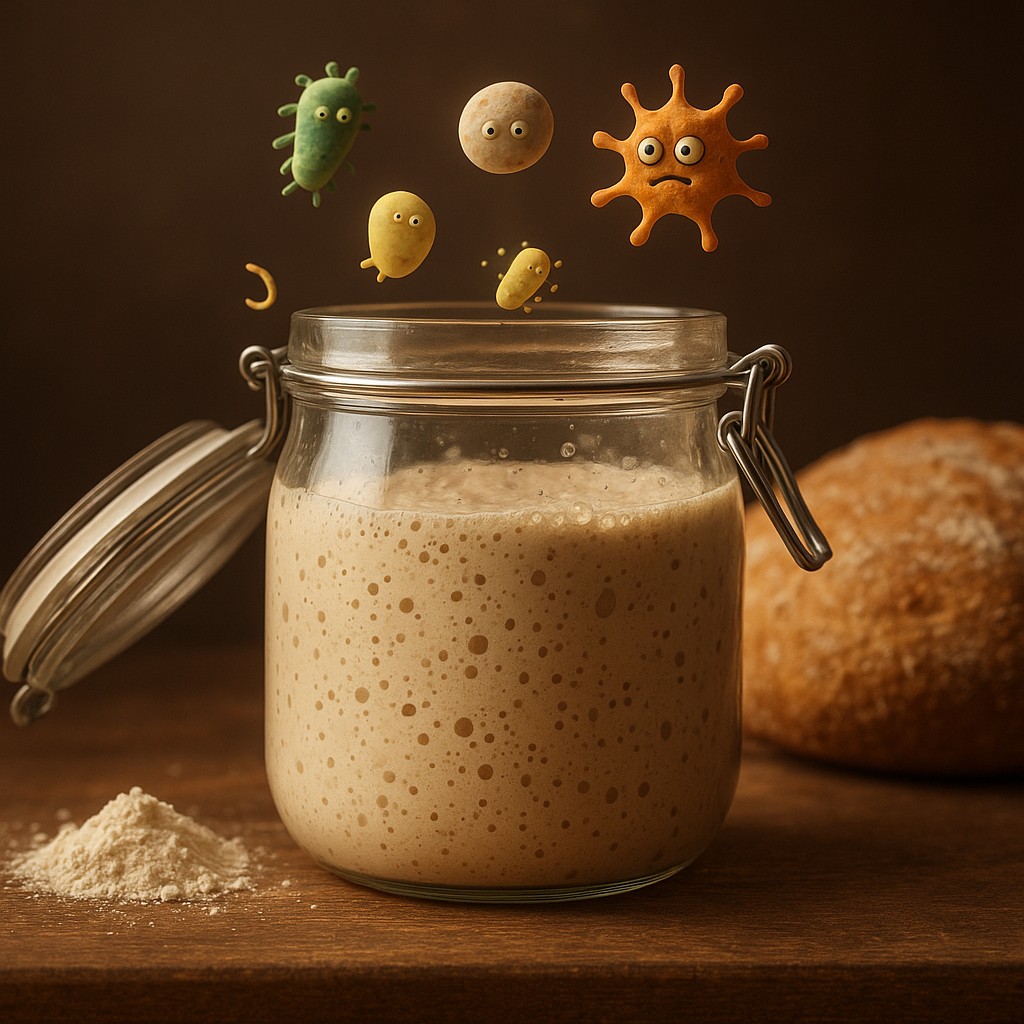
Imagine for a moment that you own a tiny, invisible civilization living in a jar on your kitchen counter. This community isn't made of little people or high-tech machines. Instead, it is a colony of wild yeast and healthy bacteria that have floated through your home's air and clung to grain harvests since the beginning of time. By simply mixing flour and water, you are opening a five-star resort for these microbes. You are inviting them to move in, multiply, and turn basic pantry staples into bubbling, aromatic "liquid gold." Sourdough isn't just a type of bread; it is a natural process humans relied on for thousands of years, long before store-bought packets of commercial yeast were ever a glimmer in a scientist's eye.
The magic of sourdough lies in the balance between complexity and simplicity. While a standard loaf of white bread from the supermarket uses a single strain of yeast engineered for speed, a sourdough starter is a diverse ecosystem. This "wild" approach creates deep, tangy flavors while making the bread much easier to digest. Starting your own sourdough journey feels a bit like getting a pet, because your starter needs regular feedings, a comfortable temperature, and a little bit of your attention. However, once you learn the rhythm of this microscopic dance, you will realize you are no longer just a cook following a recipe-you are the conductor of a living orchestra.
The Invisible Science of Fermentation
To understand why a starter bubbles, we have to look at the chemistry inside the jar. When you mix flour and water, enzymes in the flour begin to break down complex starches into simple sugars. This acts as a "dinner bell" for two main groups of microbes: wild yeast and lactic acid bacteria. The yeast eats those sugars and releases carbon dioxide gas. This creates the physical bubbles that make bread rise. Meanwhile, the lactic acid bacteria produce the acids that give sourdough its famous tang. These acids also protect the starter from "bad" bacteria by making the environment too harsh for intruders to survive.
This partnership is what makes sourdough so hardy. You might hear myths that a starter is a fragile thing that will die if you look at it the wrong way, but the opposite is true. These microbes are survivors. They want to eat and grow, and they have evolved over thousands of years to thrive in all sorts of conditions. When you add flour, you provide fresh food; when you add water, you give them the environment they need to move and interact. The thickness of your starter, the flour you choose, and even the temperature of your kitchen will shape the "personality" of your bread, shifting it from mildly sweet to aggressively sour.
Choosing your flour is your first big decision. While you can use standard all-purpose flour, many bakers prefer whole wheat or rye to get things started. These "unrefined" flours contain more of the original grain, which means they are packed with more wild yeast and nutrients right from the start. Think of whole-grain flour as a high-calorie buffet for your microbes, while processed white flour is more like a light snack. Whichever you choose, the key is consistency and patience. It usually takes seven to ten days for a new microbial community to take over the jar.
A Week of Building from Scratch
The first day is deceptively simple. You take a clean glass jar and mix exactly 50 grams of flour with 50 grams of lukewarm water. It will look like a thick, unappealing paste, and you might see no movement at all for the first 24 hours. This is perfectly normal. On the second day, you might see a few tiny bubbles or notice a slightly fruity smell-or perhaps nothing yet. You will discard half of the mixture and add another 50 grams of flour and 50 grams of water. This "discarding" step is often misunderstood, but it is necessary to keep the acidity balanced and to prevent you from ending up with a gallon of starter by the end of the week.
Around day three or four, things usually get strange. You might see a sudden explosion of bubbles and smell something like stinky cheese or old gym socks. Do not panic and do not throw it away. This is often "false" activity caused by the wrong kind of bacteria. As you continue your daily feedings, the acidity will rise, the "bad" bacteria will die off, and the "good" yeast and lactic acid bacteria will take over. By day five or six, the scent should shift from "stinky" to something like yeasty beer, fresh yogurt, or green apples.
By day seven, you are looking for consistency. A healthy, mature starter should double in size within four to six hours after a feeding. This "doubling" is the gold standard of sourdough health. It proves the yeast is strong enough to lift dough and the structure is sturdy enough to trap gas. If your house is cold, this might take ten days instead of seven. If your home is very warm, it might be ready in five. Always trust what you see and smell more than what the calendar says.
Reading the Signs of Success
As you get to know your starter, you will recognize the different stages of its life cycle. After a feeding, it enters a "rising" phase as it climbs the sides of the jar. When it reaches its highest point and looks curved or "domed" on top, it has reached its peak. This is the perfect time to bake. Eventually, it will run out of food and begin to sink back down, leaving streaks on the glass. If you leave it too long without a feeding, a dark liquid called "hooch" might form on top. This is just alcohol, a byproduct of the yeast, and it is a polite way of your starter saying, "I am hungry, please feed me."
One common myth is that you must feed your starter every single day forever. This is only true if you keep it on the counter at room temperature. If you don't plan to bake every day, you can keep your starter in the refrigerator. The cold acts like a "pause" button, slowing down the microbes' metabolism. In the fridge, a starter only needs to be fed once a week or even once every two weeks. When you are ready to bake, just take it out and give it one or two feedings to "wake it up." It will be back to its bubbly self in no time.
| Starter Phase |
Appearance |
Aroma |
Action Required |
| Just Fed |
Thick paste, no bubbles |
Neutral, like flour |
Wait and let it grow |
| Rising |
Growing volume, small bubbles |
Sweet, milky, or yeasty |
Do not use yet |
| Peak |
Doubled in size, domed top |
Pleasantly tangy, fermented |
Best time to bake! |
| Falling |
Level dropping, bubbles popping |
Strongly acidic or vinegary |
Needs a fresh feeding |
| Hungry |
Liquid "hooch" on top |
Like acetone or vinegar |
Discard and feed immediately |
Moving from Starter to Loaf
Once your starter is active and reliable, it is time to put it to work. Bakers often talk about a "levain" or "preferment." This is simply a small offshoot of your main starter that you prepare specifically for a recipe. By mixing a spoonful of your active starter with the flour and water called for in your bread recipe, you create a fresh, energetic "pre-dough" to do the heavy lifting. This step keeps your main "mother" starter safe in its jar while the levain does the hard work in the mixing bowl.
Making a sourdough loaf requires a long, slow fermentation. Unlike commercial yeast, which can puff up a loaf in an hour, sourdough yeast takes its time. It often needs six to twelve hours of "bulk fermentation" (the first rise) at room temperature. This slow pace is a gift to the baker. During these hours, enzymes pre-digest the gluten and break down phytic acid, making the final bread more nutritious and less likely to cause bloating. You aren't just waiting for the bread to rise; you are waiting for the flavor to develop and the chemistry to reach perfection.
When the dough has doubled and feels airy, you shape it into a ball and let it rest one last time-perhaps even overnight in the fridge. This cold "retarding" phase is a professional secret. The cold slows down the yeast but allows the bacteria to keep working on that sour flavor. When you finally cut the top of the loaf with a blade and drop it into a hot Dutch oven, the heat causes the gases to expand rapidly. This is called "oven spring," and it is the most rewarding part of the process: seeing your hard work turn into a crusty, golden masterpiece.
Living the Zero-Waste Sourdough Life
Beginners often worry about the amount of "discard" created during feedings. It can feel wasteful to throw away flour and water every day. However, "discard" is a bit of a misleading name, as that flour is already fermented and full of flavor. Instead of tossing it, savvy bakers keep a separate jar in the fridge just for discard. While this inactive starter isn't strong enough to make a loaf of bread rise on its own, it is an incredible flavor booster for almost everything else.
Think of sourdough discard as a "secret ingredient" that adds a gourmet touch to everyday recipes. You can stir it into pancake or waffle batter for a light, tangy lift. It makes excellent crackers when mixed with a little butter and herbs. You can even use it in brownies or banana bread to balance the sweetness with a little complexity. Since discard is made of equal parts flour and water, you simply swap out a portion of the flour and liquid in your favorite recipes for the discard. This turns a wasteful habit into a kitchen advantage.
As you get more comfortable, you will find that sourdough is less about rigid rules and more about finding a rhythm that fits your lifestyle. Some people bake once a week, some once a month, and some become the main bread source for their whole neighborhood. This craft connects you to the natural world and human history. There is a deep sense of pride in pulling a steaming, crackling loaf of bread out of the oven and knowing you created it from nothing but air, water, flour, and time.
Embracing the Journey
Your first few loaves might not look like the perfect, symmetrical photos you see on social media. They might be a bit flat, or the crust might be a little dark, or the middle might be too dense. Take a breath and remember that even "failed" sourdough is usually delicious when toasted with a thick slab of butter. Every loaf provides valuable data. You will learn how the dough should feel, how to hear the "crunch" of a perfect crust, and how to recognize the scent of a starter that is ready to perform. You are training your own senses alongside your microbes.
The world of sourdough is vast. There is always something new to try, from wet doughs that challenge your handling skills to adding roasted garlic, rosemary, or toasted walnuts. For now, focus on the magic in your jar. That small, bubbling ecosystem is a reminder that the best things in life cannot be rushed. Use what you’ve learned to nurture your starter, experiment with your first loaves, and enjoy the quiet process of slow fermentation. You are now part of an ancient tradition, and the rewards are as endless as they are delicious.