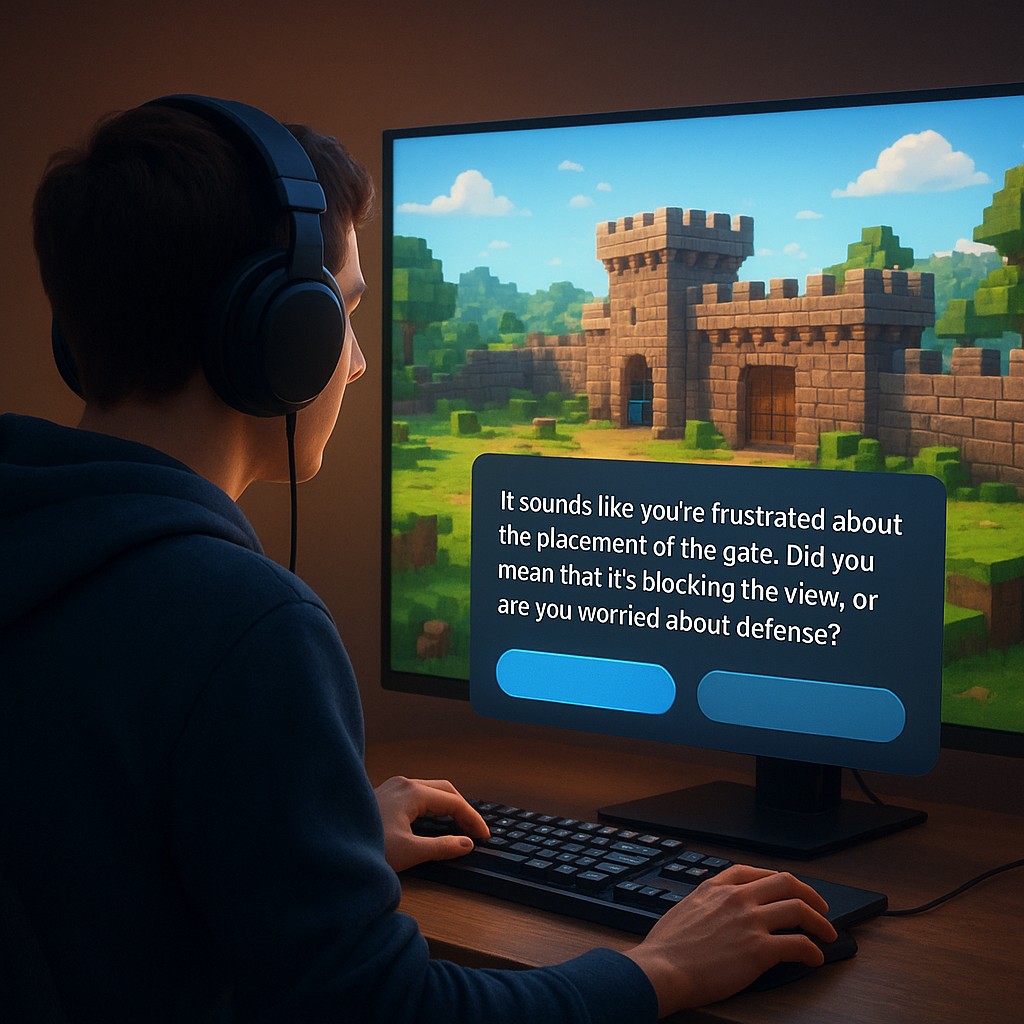
Imagine you are deep in a high-stakes match of a popular online sandbox game. You are building an elaborate fortress with a player from halfway across the world. Suddenly, a message pops up in the chat that looks aggressive or dismissive. In the old days of gaming, this might have triggered a downward spiral of insults, a report that goes nowhere, or a "rage-quit" that ruins the afternoon. However, you notice a small, quiet prompt from the system. It doesn't ban anyone. Instead, it gently asks, "It sounds like you’re frustrated about where the gate is. Did you mean it’s blocking the view, or are you worried about defense?" This is not a human monitor watching over your shoulder, but a new kind of multilingual AI trained in the complex art of pragmatics.
For decades, online moderation was a blunt instrument. It worked like a digital guillotine, dropping its blade whenever it caught a forbidden word. If you called your friend a "beast" because they made a great play, you might get flagged. On the other hand, if you used polite language to systematically insult someone's culture, you might fly right under the radar. The shift we are seeing in current international gaming trials moves away from this "dictionary policing." Instead, the focus is on the social mechanics of how we speak. By looking at intent and cultural differences, these AI mediators try to solve the problem of toxic behavior before it even starts, acting more like a skilled diplomat than a security guard.
Beyond the Dictionary and Into the Brain
To understand how these new AI mediators work, we have to distinguish between semantics and pragmatics. Semantics is the literal meaning of words. If I say, "That’s a nice shirt," the semantics are clear: I am making a comment about your clothes. Pragmatics, however, is the study of how the situation changes the meaning. If I say "That’s a nice shirt" while rolling my eyes after you’ve spilled soup on yourself, the pragmatic meaning is sarcasm. Traditional AI was great at semantics but terrible at pragmatics. It would see the word "nice" and assume the interaction was positive, completely missing the social tension underneath.
The international trials currently underway use Large Language Models (LLMs) that have been specifically "fine-tuned" or trained on gaming conversations. Gaming language is a dialect all its own, filled with slang, shorthand, and high-pressure emotional outbursts. These AI tools look at the "arc" of a conversation rather than items in isolation. They track the speed of the chat, how often people interrupt, and the use of passive-aggressive phrasing. When the system identifies a "pragmatic mismatch," it realizes that two players are actually talking past each other. This often happens in global games where a direct translation might lose the "softness" of the original intent, making a polite suggestion in one language sound like a harsh command in another.
The Cultural Calculus of Global Teams
One of the biggest hurdles in global gaming is that different cultures have different ways of being polite. Some cultures are "high-context," meaning they rely heavily on implied meaning and shared history. Others are "low-context," valuing directness and clarity above all else. When a direct player from Germany meets a high-context player from Japan in a digital sandbox, the German player’s efficiency can be seen as rudeness, while the Japanese player’s subtle suggestions might be ignored entirely. This is where the AI mediator steps in as a cultural interpreter.
Instead of just translating the words, these tools perform what researchers call "sentiment re-alignment." If a player sends a message that is factually correct but sounds harsh, the AI might suggest a friendlier way to phrase it. It acts as a buffer, slowing down the brain's immediate "fight or flight" response by providing a moment of reflection. By offering these neutral rephrasings, the AI helps players stay in the "flow state" or the zone of the game rather than getting distracted by a social conflict. It is a fascinating use of sociolinguistics, where the goal is social harmony rather than just processing data.
| Feature |
Level 1: Keyword Filtering |
Level 2: Sentiment Analysis |
Level 3: Pragmatic Mediation |
| Detection Method |
Blocked words or specific patterns |
Statistical "vibe" (Positive/Negative) |
Intent, context, and conversation flow |
| Reaction |
Immediate mute or ban |
Flagged for a human to check |
Proactive prompts to calm things down |
| Cultural Awareness |
None (Lists for each language) |
Basic (Translates keywords) |
High (Adjusts for cultural directness) |
| Primary Goal |
Punishing bad behavior |
Finding "toxic" chat |
Keeping the social peace |
| Handling Sarcasm |
Usually fails |
Hits or misses |
Highly effective due to context logs |
How to Calm Users with Soft Intervention
How does an AI actually talk down a frustrated teenager in the middle of a medieval siege? These trials use a method called "Cognitive Reframing." When the AI detects a spike in verbal aggression, it doesn't lecture the player. Instead, it offers a "nudge." For example, if a player types a string of angry commands in all-caps, the AI might show a small prompt that says, "It looks like the team is struggling to work together. Would you like to suggest a new strategy or ask for help?" This reminds the player that there are other humans on the other side of the screen.
These systems also use "clarifying questions" to resolve confusion. Ambiguity is the fuel for online fights. If a player says, "Why are you doing that?", it could be a genuine question or a biting insult. The AI mediator can step in by offering the receiver a few ways to interpret the message or asking the sender to be more specific about their goal. By forcing a moment of clarity, the system prevents "hostile attribution bias," which is our natural human tendency to assume someone is being a jerk when we aren't sure what they mean. This shift from policing to communication assistance treats players as partners in a social agreement rather than subjects to be controlled.
Distinguishing Mediators from Game Bots
It is vital to tell these pragmatic tools apart from the "creative bots" we see as Non-Player Characters (NPCs). An NPC is designed to be part of the story; it might give you a quest, fight you, or crack a joke. Their goal is entertainment. In contrast, a pragmatic mediator is a "system-level" tool. It exists outside the game's story. Its only loyalty is to the health of the community and the stability of the social environment. If a mediator starts trying to be funny or creative, it risks becoming another source of annoyance or confusion.
The trials have shown that for these tools to be effective, they must remain "socially invisible" until they are needed. They don't have personalities, and they don't take sides. If they appear too human, players might try to argue with them or trick them. If they appear too robotic, players will ignore them like a "Terms of Service" pop-up. The sweet spot is a professional, helpful tone. Think of it like a digital referee who only blows the whistle when the game is about to fall apart, rather than a commentator who talks over the whole match. Their success is measured not by how much people talk to them, but by how rarely the "report" button is pressed.
The Future of the Digital Town Square
As we move toward larger virtual worlds, the need for these mediators will only grow. We are entering an era where our main social interactions might happen in spaces shared by thousands of people speaking dozens of languages. We cannot hire enough human moderators to watch every corner of these digital empires, and we should not want a world of constant surveillance. Pragmatic AI offers a middle path: a system that empowers players to resolve their own disputes by removing the language barriers that cause them in the first place.
The ultimate goal of these trials is to help gamers become better at working together. By using these tools, players might actually become better communicators in the real world. They may start to recognize what makes them angry or realize when they are being too blunt. It is a bold experiment in using technology to sharpen our most human skill: understanding one another. As you log into your next adventure, remember that the most powerful tool in your pack might not be a legendary sword, but the "smart" olive branch offered by a silent, watchful mediator in the code. Through these innovations, we are building digital spaces where the focus is back on the joy of the game, leaving the toxicity of the past behind.