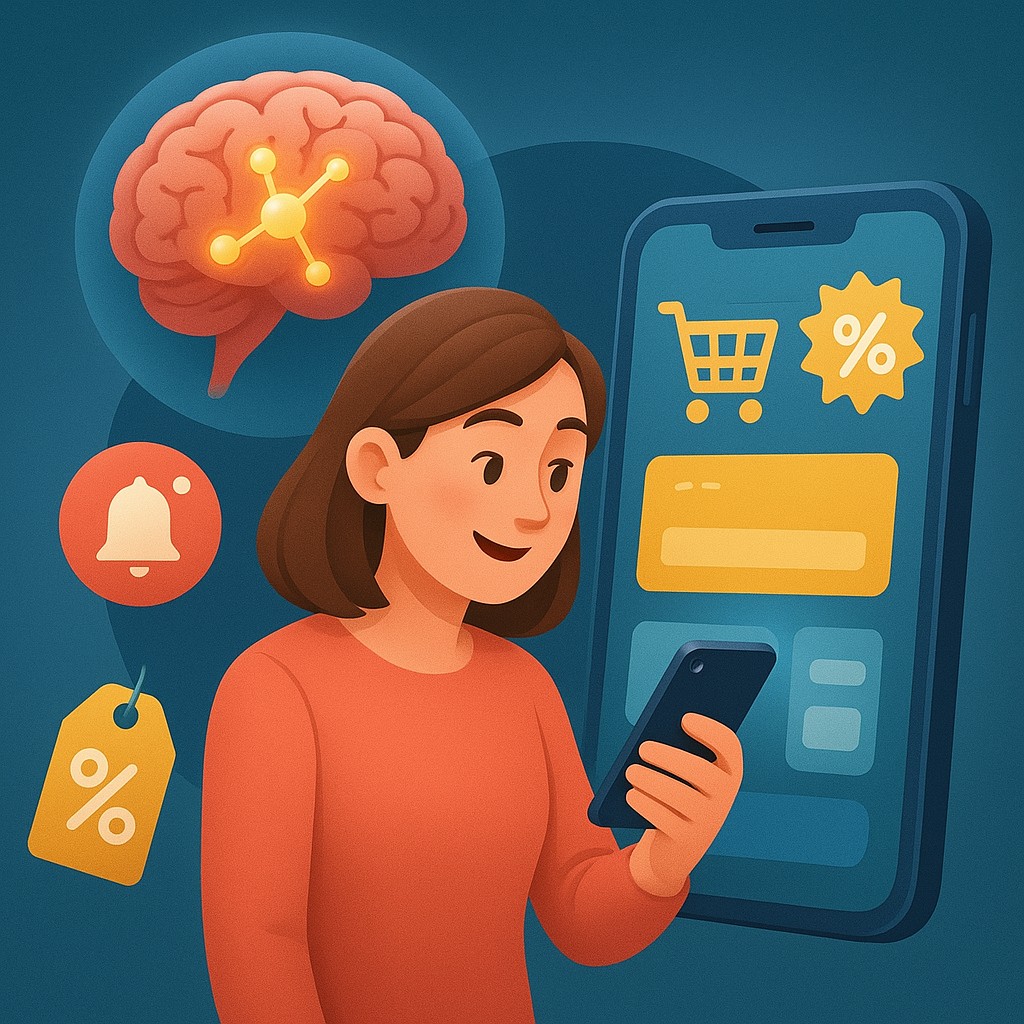
Every time your phone buzzes with a notification from a grocery or clothing app, you might think you are simply getting a bargain. Perhaps it is a "Just For You" 30 percent discount on coffee or a limited-time "Mystery Deal" that appears only after you tap a digital scratch-off. To your conscious mind, this is a smart financial move - a chance to save a few dollars on things you were probably going to buy anyway. In reality, you are participating in a complex psychological experiment. Data scientists have designed these moments to rewire how your brain perceives value. By moving away from predictable, store-wide sales and toward random, individual rewards, retailers have shifted from selling products to managing your brain chemistry.
This shift relies on a basic quirk of human evolution: our brains are not actually designed to seek out rewards, but rather to seek out the prediction of rewards. When a result is a sure thing, like a standard Tuesday morning discount, our brains eventually find it boring. However, when a reward is unpredictable, our internal chemistry shifts into high gear. Retailers now use complex math formulas, or algorithms, to ensure that "winning" a coupon feels earned and exciting rather than expected. This is the world of variable ratio reinforcement. This concept was once confined to smoke-filled casinos and laboratory pigeon cages, but it now lives inside your pocket, determining exactly how much you pay for a gallon of milk.
The Psychology of the Slot Machine App
To understand why a random 40 percent off coupon feels so much better than a permanent low price, we have to look at the work of B.F. Skinner, the father of behavioral psychology. Skinner discovered that the timing of rewards changes behavior more effectively than the reward itself. If a lab rat presses a lever and gets a food pellet every single time, it eventually stops pressing the lever once it is full. However, if the rat gets a pellet only sometimes and at random intervals, it will press that lever until it collapses from exhaustion. This is called a variable ratio schedule. It is the most powerful way to build a habit that is nearly impossible to break.
Modern retail apps have become digital levers. In the past, you might check a Sunday newspaper ad to see what was on sale - a logical task driven by necessity. Today, the randomness of app notifications creates a constant state of tension and excitement. Your brain releases dopamine, a chemical linked to pleasure and motivation, not when you use the coupon, but in the moments before you open the app to see what you "won." Because you never know when the next big deal will hit, you are conditioned to check the app constantly. This is no longer about saving money; it is about the chemical rush of the hunt. Retailers are betting that if they can make the act of checking the app addictive, you will eventually buy things you never intended to purchase just to justify the "reward."
From Mass Discounts to Surveillance Pricing
The old retail model used "High-Low" pricing, where a store would mark up prices and then hold a massive weekend sale for everyone. This was inefficient because it gave discounts to people who were willing to pay full price anyway. Now, we have entered the era of surveillance pricing. By tracking your location, your past purchases, how long you look at a photo of a blender, and even your phone’s battery level, software can determine the highest price you are willing to pay in real-time. Instead of one price for everyone, there is a specific price designed just for you, delivered at the exact moment the computer thinks you are most likely to buy it.
This creates a powerful illusion that you are in control. When you receive a personalized offer, it feels like a secret deal between you and the brand. You feel like a savvy shopper who has outsmarted the system because you have a coupon that your neighbor might not have. In reality, the software has likely calculated that your neighbor is less worried about price than you are, or perhaps they haven't shopped in a week and need a larger "bribe" to come back. The table below shows how the shift from traditional sales to these psychological tactics has changed shopping.
| Feature |
Traditional Weekly Sale |
Modern Variable Rewards |
| Availability |
Same for every customer in the store. |
Tailored to you based on your data. |
| Predictability |
High; shoppers can plan their week. |
Low; designed to trigger dopamine hits. |
| Goal |
Sell products and clear shelves. |
Build addictive app-checking habits. |
| Price Point |
Based on profit margins and math. |
Based on your personal "breaking point." |
| Consumer Feel |
Logical, planned, and practical. |
Emotional, "earned," and like a game. |
The Dopamine Loop and the Death of Logic
When dopamine enters the picture, logic usually disappears. In a standard economic model, a shopper compares prices between two stores and chooses the lower one. However, random rewards bypass this rational process by turning shopping into a game. When you "win" a personalized reward, your brain sees it as a victory. This creates an emotional bond with the app. You stop looking at the actual price of the item and focus only on the size of the discount. You might end up paying five dollars for peanut butter that costs four dollars at the store down the street, but because the app told you that you "saved" two dollars off a fake "original price," you feel like a winner.
This cycle is effective because it plays on our fear of losing out. Once the app gives you a "Just For You" reward that expires in six hours, it creates a sense of urgency. You feel that if you don't use it, you are losing something that belongs to you. This is the "earned reward" effect. Because the coupon was sent specifically to you, your brain treats it like a piece of personal property rather than a generic flyer. The fear of losing that exclusive "win" often overrides the realization that you might not even need the item.
How to Fight Back Against the Algorithm
If the retail world is now a giant psychological experiment, how do we avoid becoming the subjects? The first step is recognizing the difference between a real need and an impulse driven by a dopamine rush. Retailers use "intermittent rewards" because they create the hardest habits to break. If an app stops giving you rewards every time you open it, you will actually stay engaged longer because you are waiting for that next "hit." Understanding that this randomness is a calculated move can help take away the emotional power of the notification.
One of the best ways to fight back is to practice "slow shopping." This means separating the act of seeing a discount from the act of actually buying something. When a notification hits your phone, ask yourself if you were looking for that item five minutes before the phone buzzed. If the answer is no, then the "reward" is simply a tax on your attention. Another strategy is to "starve" the algorithm of data. If you stop clicking on every notification, the AI will often get "desperate" and offer even higher discounts to lure you back. By refusing to play on the app's schedule, you regain control over your wallet and your mind.
As we move toward a future where AI can predict what we want before we even know it, the line between helpful service and manipulation will continue to blur. These apps are masterpieces of engineering, designed to find the "buy button" in your brain. However, the fact that you understand how they work gives you an advantage. By seeing these rewards for what they are - a digital slot machine - you can enjoy the occasional discount without becoming a player in a game designed to make you lose. The next time your phone pings with a "special gift," remember that you are in charge of your own habits. The most powerful "win" is simply putting the phone back in your pocket.