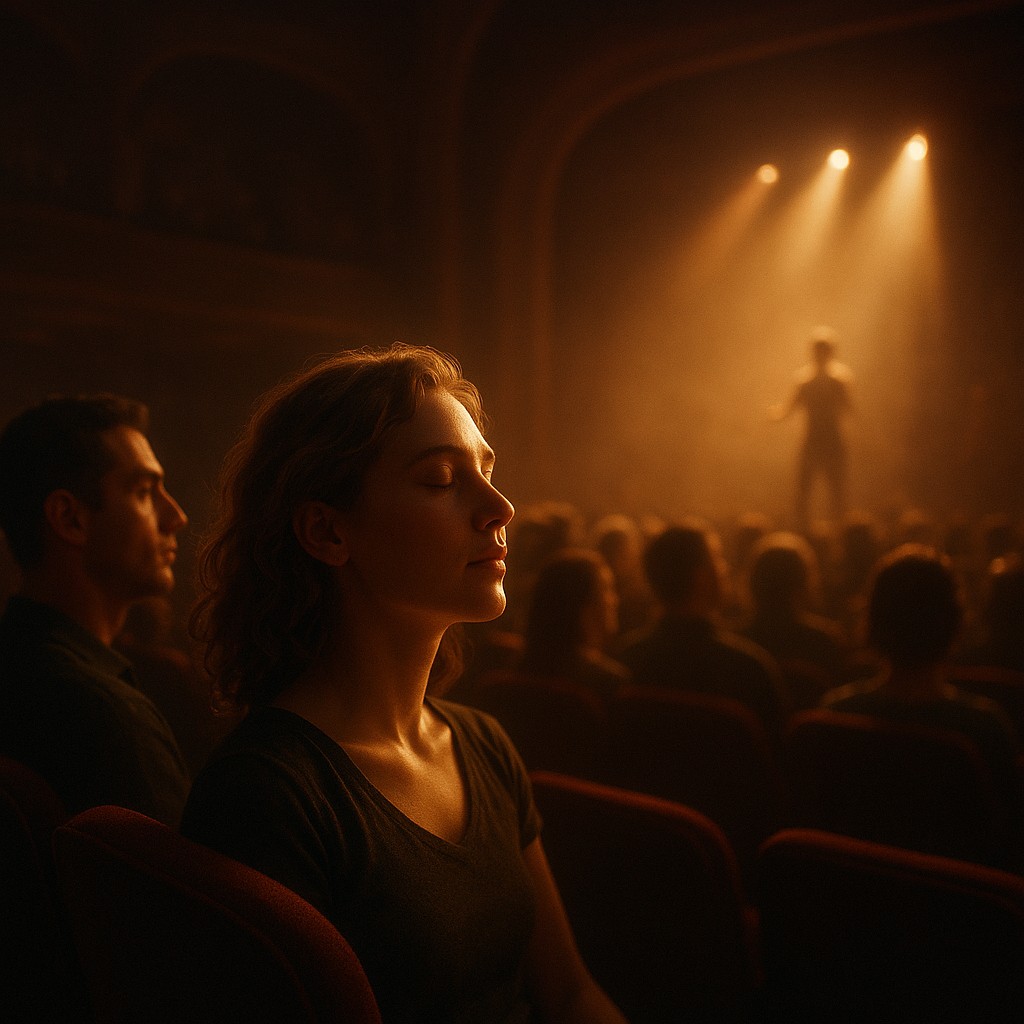
Imagine walking into a dimly lit theater, the air heavy with the scent of old velvet and a sense of expectation. As the house lights dim and the first note rings out or the first line is spoken, something invisible begins to knit the room together. You might think you are just an observer sitting in a chair, but beneath the surface, a silent, rhythmic transformation is taking place. Your heart, which might have been racing as you rushed to find your seat, starts to seek out a new pace. It isn't looking for its own rhythm, but rather the rhythm of the hundreds of strangers sitting beside you - all of them unconsciously tethered to the pulse of the performer on stage.
This phenomenon, often called theater biofeedback or physiological synchrony, is more than just a poetic metaphor for "good vibes." It is a measurable biological reality where the breathing, heart rates, and even the skin conductance (the way skin carries electricity when we sweat) of a crowd begin to mirror one another in real time. This is why a live concert feels electric in a way that a high-definition recording on your sofa simply cannot match. In a theater, you are part of a massive, multi-cellular organism that breathes and beats as one. When the protagonist faces a moment of chilling suspense, the entire room holds its collective breath - not just as a figure of speech, but as a literal, physical fact. This biological loop is the secret engine of human storytelling, turning a group of individuals into a unified community through the power of shared focus.
The Invisible Strings of the Biological Puppet Master
To understand how we become physically unified in a dark room, we have to look at the way our brains process social cues. Humans are built for mimicry, a trait that helped our ancestors survive by allowing them to sense danger or find food quickly by watching others. When we are deeply engaged in a performance, our "mirror neurons" go into overdrive. These specialized brain cells fire both when we perform an action and when we see someone else do the same thing. When an actor on stage gasps in horror, your brain simulates that gasp and your body follows suit. This isn't just empathy; it is a physical echo of what is happening in front of you.
In a University College London study, researchers monitored the heart rates of audience members during a production of Dreamgirls. They discovered that for significant portions of the show, the heart rates of the audience synced up, rising and falling in unison. Interestingly, this did not happen just because the music was fast or slow. The synchrony was driven by the emotional arc of the story. When the narrative reached a moment of intense shared attention, the biological data points merged into a single line. It is as if the performer is a conductor, leading not just the orchestra, but the very internal organs of every person in the room.
This biological handshake is what scientists call "co-regulation." Normally, we manage our own internal states, but in a live setting, we allow the performance to regulate us. This process requires a shared environment and, most importantly, a shared target of attention. This is why the effect vanishes if you spend the show checking your emails. For the biological loop to close, your focus must stay locked on the source. The moment your attention drifts, your heart rate detaches from the group pulse and returns to its own isolated rhythm, effectively "unplugging" you from the collective experience.
The High Stakes of the Live Loop
What makes a live performance fundamentally different from a digital one is the element of reciprocity - the way two things act upon each other. In a movie theater or while watching a clip online, the relationship is one-way. You can cry, laugh, or scream, but the actors on the screen will not change their timing or intensity. In a live setting, however, the performers are also part of the biofeedback loop. A veteran stage actor can "feel" the energy of a room, which is often just a subconscious interpretation of the audience's collective breathing and stillness. If the audience is restless, the actor might speed up their delivery; if the audience is rapt, the actor might stretch out a silence, knowing they have the biological permission to do so.
This creates a high-stakes environment where the artist and the audience are constantly adjusting to one another. Below is a comparison of how different viewing environments impact our physical and emotional connection to the content.
| Feature |
Live Performance |
Recorded Media |
Virtual/Livestream |
| Heart Rate Synchrony |
High; collective peaks and valleys. |
Low; individual responses only. |
Moderate; depends on interaction. |
| Breath Coordination |
Shared holding and releasing of breath. |
Occurs purely by individual reaction. |
Fragmented by home distractions. |
| Mirror Neuron Activation |
Intense; stimulated by 3D presence. |
Moderate; stimulated by visual cues. |
Moderate; lowered by screen barrier. |
| Social Cohesion |
High; creates bonding or "Communitas." |
None; remains an isolated act. |
Low; often feels like a solo activity. |
| Sensory Input |
Full body; includes vibration and air. |
Visual and auditory only. |
Visual and auditory only. |
The "catch" mentioned in the research is that this magic is fragile. It relies on a concept called "shared focus." If the person next to you is whispering or glowing with the blue light of a smartphone, the biological spell is broken. Not only does that person lose the connection, but they act as a "synch-breaker" for those around them. This is why the rules of theater etiquette, which might seem stuffy or outdated, are actually grounded in biological necessity. Silence and darkness aren't just about being polite; they are the necessary conditions for the audience to merge into a single physiological entity.
Narrative as a Biological Glue
We often think of stories as intellectual puzzles or emotional journeys, but they are also a form of social technology. Throughout history, collective rituals - from tribal dances to religious ceremonies - have used physical synchrony to build social glue. When a group of people experiences the same spike in adrenaline and the same calming release at the exact same time, they leave that space feeling a profound sense of kinship. This is why you can walk out of a concert feeling like you "know" the people who were in the mosh pit with you, even if you never spoke a word to them.
This bonding mechanism is known as "Communitas." It is the sense of shared humanity that arises when social structures and individual identities temporarily melt away. In the context of biofeedback, this happens because our bodies have literally been in the same state for two hours. It is hard to feel like a stranger to someone when your hearts have been beating at 120 beats per minute in perfect unison for the last ten minutes. This biological resonance serves as a powerful antidote to the isolation of modern life, reminding our nervous systems that we are part of a larger whole.
Furthermore, different genres of performance trigger different types of synchrony. A classical music concert might lead to a slow, undulating harmony of heart rates, while a high-energy pop concert might create a jagged, high-intensity pulse. Interestingly, research into Javanese gamelan music has shown that when performers improvise together, their physiological synchrony is even higher than when they play a rehearsed piece. This suggests that the more we have to "tune in" to one another to predict what happens next, the more our bodies align to meet that challenge. The unpredictability of live performance actually heightens the biological connection.
Why Your Brain Prefers the Front Row
The intensity of this physical mirroring is often tied to physical proximity and the number of senses involved. While you can be moved by a story on a screen, the "raw data" your brain receives in a live setting is significantly richer. You are not just seeing light on a flat surface; you are seeing the micro-vibrations of a singer's throat, hearing the scrape of a shoe on the floorboards, and feeling the literal air pressure changes created by a loud sound. All these inputs provide more "hooks" for your nervous system to latch onto, making it easier to fall into step with the group.
Misconceptions about this often suggest that you have to "like" the performance to synchronize with it. Surprisingly, the data says otherwise. You can actually be physically synchronized with a performance you are critical of, as long as you are paying close attention. Synchrony is a measure of engagement, not necessarily of pleasure. This means that even a tragic play or a tense thriller can create high levels of biological unity. The goal of theater biofeedback isn't necessarily to make everyone happy, but to make everyone present.
Another common myth is that this effect is purely psychological. Some might argue that we simply "decide" to feel connected. However, heart rate data shows that these changes happen below the level of conscious thought. You don't tell your heart to speed up when the hero is in danger; your autonomic nervous system - the part of the brain that handles automatic functions - does it for you. This underscores the idea that storytelling is a primal, biological function. We are wired to respond to one another's signals, and the theater is simply a laboratory where we amplify those signals to see what happens when we all listen at once.
The Future of Shared Experiences
As we move further into a world dominated by digital interfaces and solo consumption, understanding the value of live, synchronized experiences becomes more vital. We are currently seeing a rise in "immersive" theater and interactive concerts that specifically lean into this biofeedback loop. Some creators are even experimenting with wearable technology that allows performers to see the audience's heart rates in real time, allowing them to adjust the show's pacing based on the literal "pulse" of the room. This takes the concept of a reciprocal loop and makes it visible and intentional.
However, the core of the experience will always remain the same: a group of people, a shared space, and a single point of focus. It is a reminder that in our high-tech world, one of our most sophisticated technologies is our own biology. We have the ability to wirelessly "link" our nervous systems with others just by paying attention to the same story. This biological synchronization is a testament to our deep-seated need for connection and a fascinating explanation for why the performing arts have survived for thousands of years.
Next time you find yourself in a crowded theater or a packed stadium, take a moment to realize that you are not just a spectator. You are a cell in a much larger body, contributing your own rhythm to a massive, collective heart. Embrace the silence, put away the distractions, and let your body follow the lead of the story. In that shared focus, you aren't just watching a performance; you are participating in one of the most ancient and beautiful biological dances known to humankind. There is a profound comfort in knowing that, for a few hours, you don't have to keep time all by yourself.