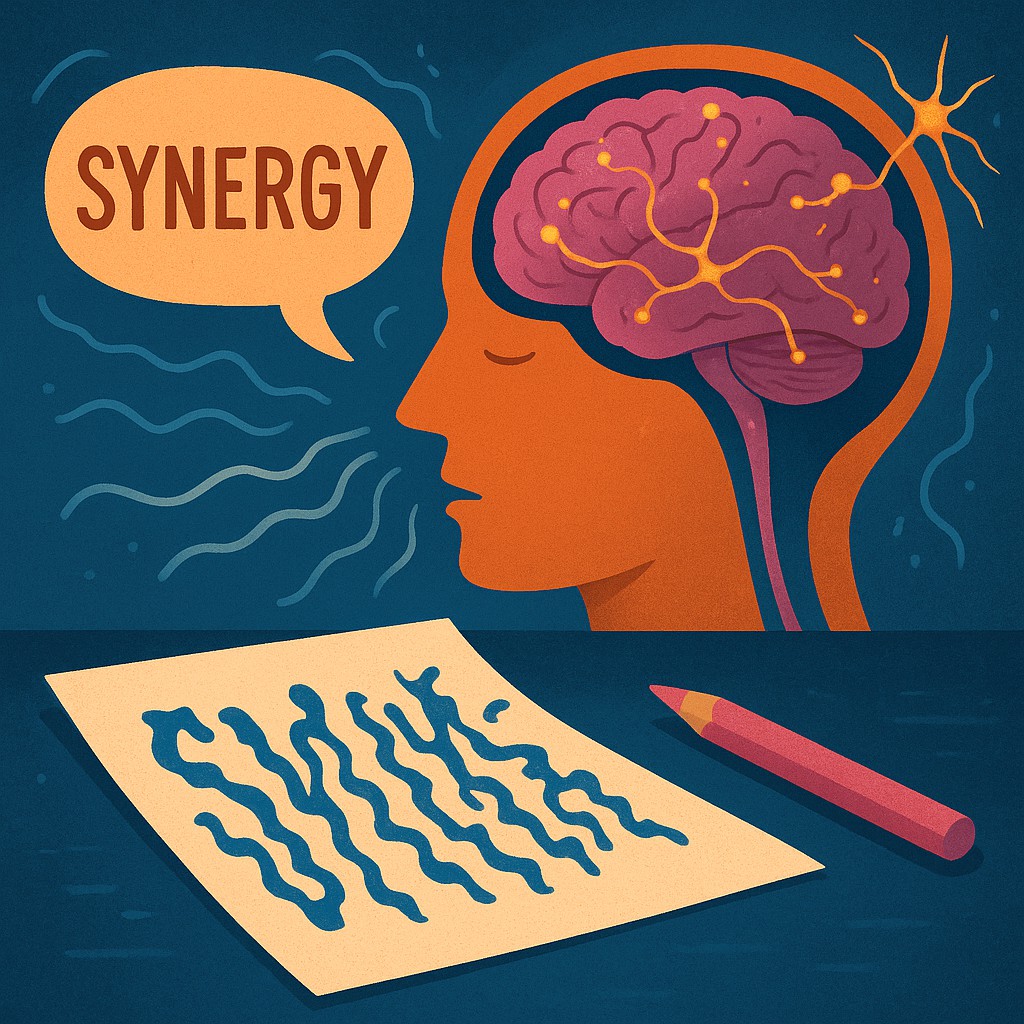
Have you ever sat through a long meeting or a tedious lecture where a single word was used so often it started to sound like an alien transmission? Maybe the word was "synergy" or "deliverables," or even something as simple as "paper." You might have looked down at your notes and stared at the word until the letters seemed to drift apart, transforming from a familiar symbol into a jagged, meaningless squiggle. In that moment, the word lost its power to represent an object or an idea. It became nothing more than a strange vibration in the air or a bit of ink on the page.
This bizarre mental hiccup doesn't mean you are losing your mind or forgetting your native language. It is a very real, common psychological phenomenon that reveals a lot about how our brains build the reality we live in. We often think of language as a hardwired link between a sound and a concept, but that bridge is actually a delicate biological process. When we overload that bridge with too much traffic, it temporarily collapses, leaving us stranded in a world of raw, meaningless sensory data. This experience offers a fascinating look at the "software" of human consciousness.
The Inner Workings of Neural Exhaustion
To understand why a word like "banana" can suddenly turn into gibberish, we have to look at how brain cells, or neurons, communicate. Every time you hear or see a word, a specific cluster of neurons fires in a synchronized pattern. This pattern acts as a biological shortcut that links the sound or shape of the word to its meaning. For example, when you hear the word "door," your brain doesn't just process the sounds; it instantly brings up the concept of a hinge, a handle, and the act of entering a room. This happens so fast that we rarely notice the gap between the sound and the thought.
However, neurons are like athletes; they get tired if they are forced to do the same repetitive motion without a break. When you repeat a word rapidly, say fifty times in one minute, the specific neural pathway responsible for that word’s meaning is forced to fire over and over. After a short burst of activity, these neurons experience what scientists call reactive inhibition. Essentially, they get fatigued and stop responding with the same intensity. While the neurons that handle the "sound" of the word might still be working, the neurons responsible for the "definition" take a temporary nap.
This creates a strange mismatch in your perception. Your ears still hear the word, and the part of your brain that processes noise is still working, but the connection to the mental "filing cabinet" where the meaning is stored has been cut. You are left with the linguistic version of looking at a photograph through a microscope; you can see the individual dots of ink, but you can no longer see the face. This state of meaninglessness lasts only as long as the repetition continues. Once you stop and give your brain a few seconds of silence or a change in topic, the neurons recover, and the bridge between sound and sense is rebuilt.
A Historical Curiosity: Naming the Glitch
While humans have likely experienced this since the dawn of language, it wasn't formally studied until the early 20th century. The term "semantic satiation" was coined in 1962 by Leon James, a doctoral student at McGill University who was fascinated by how the mind filters information. Before James gave it this elegant name, the effect was often called "verbal transformation" or "mental fatigue." James argued that the brain has a limited capacity for processing intense, repetitive information, and "satiation" was his way of describing a mind that had simply had "too much" of a single idea.
James conducted various experiments to prove this wasn't just a trick of the ears, but a fundamental shift in how the brain processes concepts. He used a "semantic differential" scale, which asks people to rate words based on emotional intensity or specific qualities, like "warm" versus "cold." He found that after subjects repeated a word for several seconds, their ratings drifted toward the neutral center of the scale. The word lost its emotional "flavor" along with its dictionary definition. it became socially and emotionally hollow, proving that the fatigue was happening deep within the brain’s meaning-making centers.
Comparing Mental States and Linguistic Glitch
It helps to see where semantic satiation fits into the broader landscape of how our brains handle language. It is often confused with other slip-ups in speech, but it is unique in its cause and its cure. Here is a quick look at how it compares to other common experiences:
| Phenomenon |
What it feels like |
What is actually happening |
| Semantic Satiation |
The word looks or sounds like nonsense. |
Meaning-related neurons are fatigued by repetition. |
| Tip-of-the-Tongue |
You know the meaning but cannot find the sound. |
A temporary block in retrieving the sound of a word. |
| Malapropism |
You use the wrong word that sounds similar. |
A slip in the brain's "filing system" during speech. |
| Spoonerism |
You swap the first letters of two words (e.g., "jelly beans" to "belly jeans"). |
A planning error in the brain's motor area before speaking. |
| Jamais Vu |
A familiar place or word feels totally new or eerie. |
A broad sense of "unfamiliarity" often linked to migraines or fatigue. |
As the table shows, semantic satiation is unique because it moves from a state of knowing to a state of "un-knowing." Unlike the Tip-of-the-Tongue state, where you are searching for a label for a concept you already have, satiation leaves you with the label but robs you of the concept. It is the ultimate "brain fart," but one created on purpose through repetition.
The Practical Side of Abstract Nonsense
While it might seem like a useless party trick, semantic satiation has some interesting practical uses in therapy and marketing. For instance, it has been used in a technique called "negative practice" to help people overcome stutters or specific phobias. By having a patient repeat a "trigger word" or a scary phrase until it undergoes semantic satiation, the emotional weight of that word can be dampened. If a word that normally causes anxiety suddenly sounds like a funny, meaningless squawk, its power over the person fades.
In the world of advertising, semantic satiation is the enemy. This is why good writers avoid overusing a brand name in a single commercial. If you hear a brand name twenty times in thirty seconds, your brain might stop associating that name with a quality product and start hearing it as a rhythmic, annoying noise. Companies want their names to stay "sticky," which means they need to keep your neural pathways fresh. Understanding satiation helps designers and writers find the right amount of repetition without crossing the line into mental exhaustion.
This phenomenon also explains why we find certain songs so annoying after they have been played on the radio too many times. While music involves more than just language, the lyrics in a catchy pop chorus can undergo a version of satiation. The first time you hear the hook, it is meaningful and moving. By the five-thousandth time, the words lose their poetic value and become mere textures of sound. Our brains are designed to crave novelty and meaning; when we are fed the same data too many times, our "meaning-making" software simply shuts down to save energy.
The Fragility of Our Symbolic World
At its heart, semantic satiation is a humbling reminder that our reality is a "construction." We walk through the world assuming that a "tree" is a "tree" because that is its nature. But satiation shows us that the word "tree" is merely an arbitrary sound that our brain has agreed to decorate with meaning. Our brains are constantly working behind the scenes to keep those decorations in place, performing a high-speed translation service every second of the day.
This effect proves that the world we inhabit is not just made of objects, but of our interpretations of those objects. When the "interpretation" hardware tires out, the world changes. A word becomes a noise, a sign becomes a shape, and a concept becomes a blank space. It is a brief, harmless glimpse into what the world might look like if we didn't have the gift of language to organize it. It suggests that our intellectual lives are supported by a nervous system that is constantly refreshing its connections, like a computer screen updating its pixels to show a moving image.
The next time a word starts to look "wrong" or a phrase begins to sound "weird" because you've been working on a document for too long, take a moment to enjoy the sensation. You are experiencing a raw, unedited version of the world. You are witnessing your brain's incredible ability to filter the chaos of the universe into tidy, symbolic boxes, and you happen to have caught one of those boxes while the lid was briefly off. Take a deep breath, look away for a moment, and let your neurons recharge. The world will make sense again in just a few seconds, but you will have gained a secret insight into the invisible machinery of your own mind.