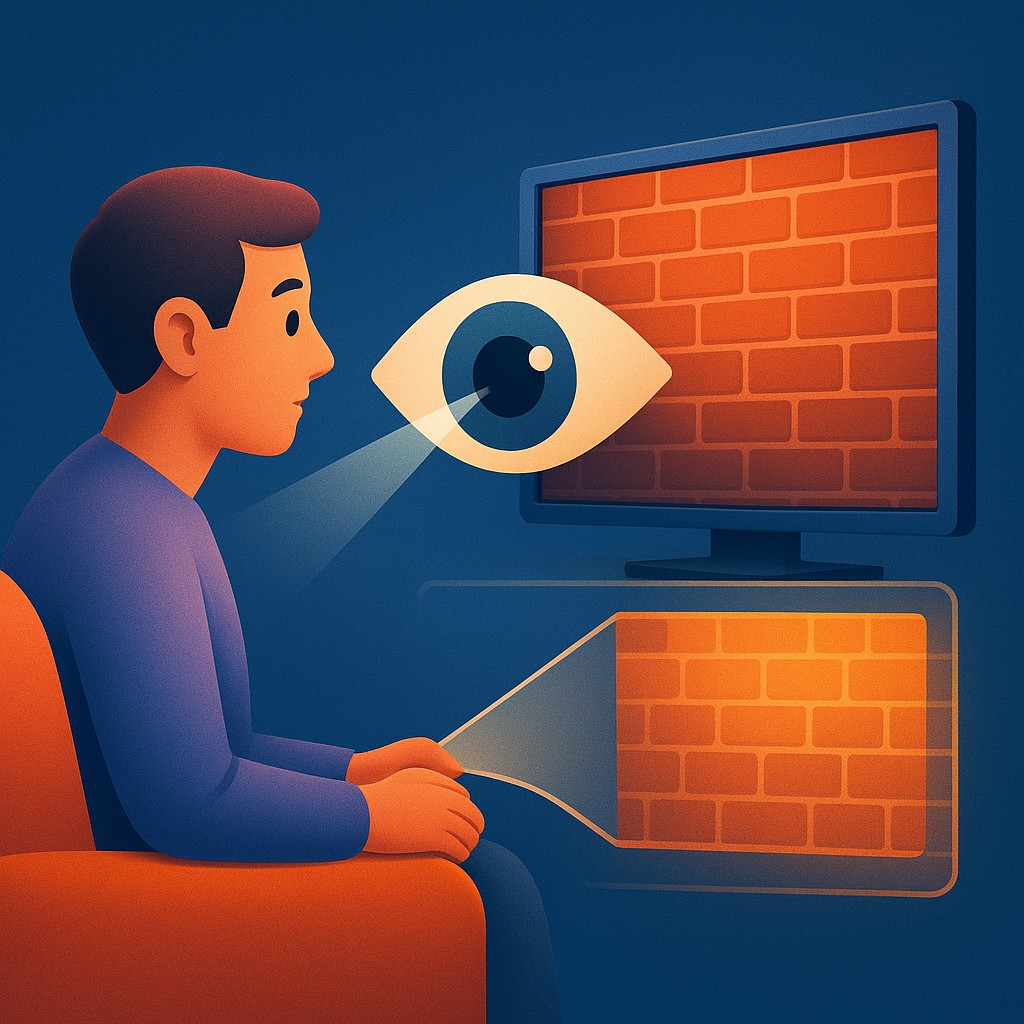
When you settle into your couch to binge-watch a high-definition thriller, you likely assume that every single pixel on your screen is being transmitted with the same level of care. It seems logical: if you pay for a 4K subscription, the streaming service should send a uniform blanket of data representing every blade of grass, every brick in a distant wall, and every pore on the lead actor’s face. In reality, the video playing before you is a masterclass in psychological deception. Your eyes are far less efficient than you think, and engineers have realized they can save massive amounts of money and electricity by simply not delivering details that your brain is guaranteed to ignore anyway.
This invisible revolution is known as perceptual video encoding. By using complex math that mimics the biological limits of the human eye, streaming giants can slash data usage by up to 50 percent without the average viewer noticing a thing. It is a digital shell game where the computer predicts where your pupils will land and keeps that area crisp, while effectively "smudging" the rest of the frame. This shift moves us away from objective quality, where every bit of data is mathematically perfect, toward subjective quality, where the only thing that matters is what you think you see. Understanding how this works requires a look into the strange partnership between computer science and the evolution of human sight.
The Blind Spots of the Biological Lens
To understand how a computer compresses video, we first have to understand how the human face is wired. We often imagine our vision works like a high-resolution camera, capturing a wide, panoramic view of the world in perfect clarity. However, the reality is much more like tunnel vision. The center of your retina contains a tiny, specialized pit called the fovea, which is packed with light-sensitive cells. This area, which covers only about two degrees of your visual field, is the only part of your vision capable of seeing sharp detail. If you hold your thumb at arm’s length, the width of your thumbnail is roughly the size of the area your fovea can see clearly at any given moment.
Everything outside that tiny thumb-sized circle is processed by your peripheral vision, which is surprisingly low-resolution. Your brain compensates for this by darting your eyes around in rapid movements called saccades, "stitching" together a mental image that feels high-definition even though it is mostly a blurred reconstruction. Perceptual video encoding exploits this biological shortcut. If a streaming platform can identify which parts of a movie frame will attract your fovea, such as a speaking mouth or a bright, moving object, it can dedicate the lion's share of its data budget to those areas. Meanwhile, the static background or the dark corners of the screen can be compressed into a blurry soup of pixels. Since your fovea isn't looking there, your brain simply fills in the blanks, assuming the background is just as clear as the foreground.
The Mathematical Art of Strategic Forgetting
Traditional video compression functions like a ruthless organizer trying to fit a whole house of furniture into a small suitcase. It looks for patterns, like a blue sky that stays the same for several seconds. Instead of describing every pixel in every frame, it simply says, "Keep this area blue until further notice." This is known as redundancy, or repeated information. While effective, it treats all information as equally important. Perceptual encoding adds a layer of "saliency" to this process. A saliency model is a mathematical prediction of what is most likely to grab a human's attention.
Modern encoders use machine learning to rank the "importance" of different regions within a video. For example, in a football game, the ball, the players' jerseys, and the scoreboard are high-saliency areas. The green grass of the field, despite taking up 70 percent of the screen, is low-saliency. By identifying these regions, the encoder can apply a "variable bit rate" within a single frame. This means the ball might be sent with a very high amount of data to prevent motion blur, while the grass is heavily compressed. This isn't just about saving space; it is about spending a limited "data budget" where it will provide the highest emotional and visual impact for the viewer.
Comparing Traditional Encoding to Perceptual Logic
The shift from standard compression to perceptual systems marks a major change in how we define "good" video. In the past, engineers relied on scores that compared the compressed video to the original file pixel-by-pixel. If they didn't match perfectly, the score went down. Perceptual models use a system called VMAF (Video Multi-Method Assessment Fusion), which was pioneered by Netflix. VMAF doesn't care if the pixels match the original exactly; it cares if a human being would notice the difference.
| Feature |
Traditional Encoding |
Perceptual Encoding |
| Primary Goal |
Mathematical accuracy to source |
Visual satisfaction for the viewer |
| Data Distribution |
Spread evenly across the frame |
Focused on "interesting" objects |
| Background Detail |
Constant (unless unchanging) |
Heavily reduced and simplified |
| Efficiency |
Moderate; struggles with complex scenes |
High; saves up to 50% bandwidth |
| Potential Failure |
All-over blurriness or "snow" |
Localized glitches in ignored zones |
The Prediction Engine and the Sudden Glitch
While this technology is incredibly efficient, it relies entirely on the accuracy of its prediction model. The "brain" of the streaming service is essentially guessing where you are looking. Most of the time, humans are predictable. We look at faces, we look at text, and we look at moving objects. However, if you are a viewer who likes to look at the "wrong" part of the screen, the illusion can shatter. Have you ever been watching a movie and noticed that, while the hero's face looks perfect, the stone wall behind them looks like a blocky, moving mess of gray squares? That is a perceptual encoding failure.
This often happens in action-heavy scenes where there is too much movement for the math to track. If the model incorrectly identifies a fast-moving car as the focus but ignores a secondary character's reaction in the corner, the viewer who chooses to watch that character will see "macroblocking," or digital blocks. This is the digital equivalent of a magician’s trick being exposed because someone in the audience looked at the hand that wasn't supposed to be doing the magic. As these models become more sophisticated, they are being trained on millions of hours of eye-tracking data to ensure their "guesses" about human curiosity are almost never wrong.
From Flat Screens to Immersive Realities
The ultimate evolution of this concept is found in Virtual Reality (VR), where the stakes are much higher. In VR, the demand for data is massive because the screens are inches from your eyes and the resolution must be incredibly high to prevent motion sickness. This has led to the development of "Foveated Rendering." High-end VR headsets now include infrared cameras inside the goggles that track exactly where your pupils are pointing in real-time.
Instead of predicting where you might look, the system knows exactly where you are looking. It renders the pixels in the dead center of your gaze in incredible detail while letting the edges of the screen drop to a fraction of that quality. This happens so fast, measured in milliseconds, that as you move your eyes around the virtual world, the high-definition "spotlight" follows you perfectly. You feel as though the entire world is rendered in perfect detail, when in reality, 90 percent of the scene is a blurry, low-res landscape that only sharpens up the moment you try to catch it in the act.
Navigating the Trade-Offs of Invisible Tech
There is a fascinating irony in the fact that the more advanced our technology becomes, the more it relies on the "imperfections" of our biology. We are building massive server farms and sophisticated computer networks just to figure out how to do less work. Yet, the environmental and economic benefits are hard to ignore. Streaming accounts for a significant portion of global internet traffic. By reducing the data load of every video without sacrificing the viewer’s experience, we are making the internet "lighter" and more accessible to people with slower connections.
This method also changes how content is produced. Cinematographers and colorists now work with the knowledge that their art will be filtered through these perceptual lenses. If a director wants an entire frame to be crystal clear, they have to compose the shot in a way that tells the computer it is important. We are entering an era where the bridge between what is captured by a camera and what is seen by a human is no longer a straight line, but a smart filter that understands human attention better than we do.
The next time you find yourself captivated by a high-stakes scene in your favorite show, take a split second to look away from the action. Glance at the dark corner of the room or the texture of the carpet in the background. You might catch a glimpse of the digital scaffolding holding the image together. This technology reminds us that our perception of the world is not a perfect recording, but a curated experience. By understanding the limits of our own eyes, we have unlocked a way to share the beauty of the world using only half the effort, proving that sometimes, the best way to see more is to realize how much we are already missing.