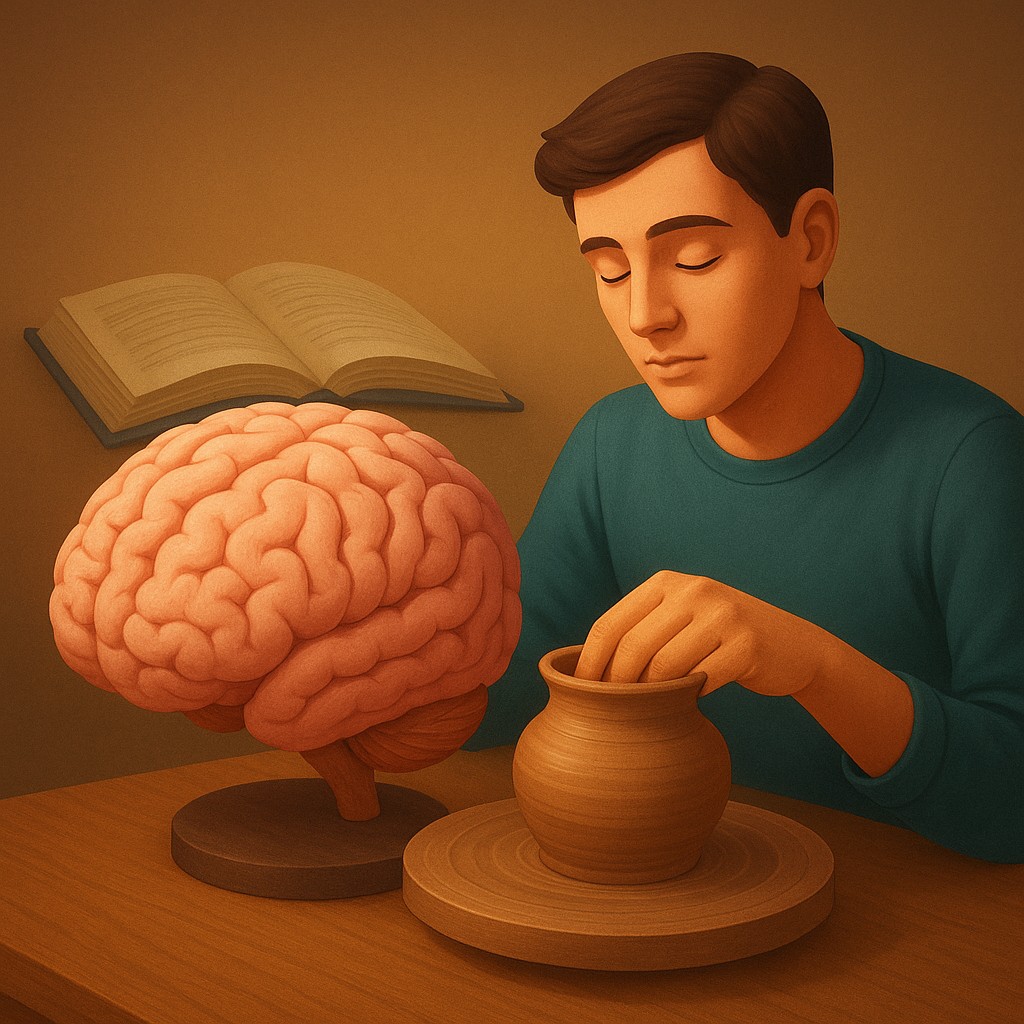
Imagine you have just finished a grueling session of learning a complex piano piece or mastering a tricky bit of coding syntax. Your first instinct, driven by the frantic pace of modern life, is likely to slam your laptop shut or jump off the piano bench to immediately check your email, scroll through social media, or head into a meeting. We tend to treat our brains like digital processors that can switch tabs instantly without losing data. However, biology tells a different story. Your brain is not a solid-state drive; it is more like a master potter working with wet clay. If you bump the pedestal the moment the sculpture is finished, the details blur and the structural integrity of the work collapses before it has a chance to set.
Current neuroscience suggests that the most critical period of learning does not actually happen while you are staring at a book or practicing scales. Instead, the magic occurs in the tiny, seemingly empty pockets of time immediately following intense effort. In these quiet moments of "wakeful rest," the brain performs a high-speed miracle of data management. By rushing into the next stimulus, we accidentally sabotage our progress, overwriting the neural blueprints we just worked so hard to draft. Understanding how to protect these fragile "quiet zones" is the difference between a mind that retains everything and one that feels like a leaky bucket.
The High-Speed Replay in the Hippocampus
When we learn something new, the information is initially fragile, living in a temporary state within the hippocampus. To turn that fleeting experience into a permanent skill, the brain must commit it to long-term storage in the neocortex. Scientists using magnetoencephalography (MEG) - a tool that maps brain activity by recording magnetic fields - have discovered that during those brief windows of rest after a task, the hippocampus does not just sit idle. It begins to "replay" the neural firing patterns associated with the skill you just practiced. This is not a slow, frame-by-frame recap. The brain actually accelerates the footage, running through the sequence at up to 20 times the original speed. It is as if your mind is binge-watching its own performance on fast-forward to ensure the pattern is etched deep into the circuitry.
This rapid-fire repetition is a mechanism for synaptic strengthening. Every time the "video" of your practice session loops in the background, the synapses - the connections between brain cells - involved in that specific task grow a little more robust. This process, known as consolidation, requires a low-noise environment to be effective. If you immediately flood your brain with new, unrelated information, such as news headlines or a text thread, the hippocampus is forced to drop its current replay to process the incoming data. By denying yourself five minutes of "nothingness," you are essentially hitting the "cancel" button on a background download that was almost complete.
How Sensory Interference Disrupts Your Progress
The reason why a quick glance at your phone is more damaging than staring out a window lies in the concept of sensory interference. Our brains are incredibly sensitive to new, meaningful input. When you look at a landscape or sit in a quiet room, your visual and auditory systems are in a low-power state. This allows the internal processing systems to dominate the brain's resources. However, when you engage with a screen, your brain must decode language, recognize faces, and react to emotional triggers like a shocking headline or a funny meme. This creates a bottleneck where the new data competes for the same neural pathways being used for consolidation.
Think of it as a physical workspace where a craftsman is trying to glue two delicate pieces of wood together. The glue needs time to bond. If a group of tourists marches through the workshop, bumping the table and asking questions, the craftsman has to stop what he is doing to manage the crowd. By the time the room is clear, the glue has dried unevenly and the bond is weak. In the brain, these "tourists" are the digital notifications and mental pivots that break the focus required for the hippocampus to talk to the cortex. To prevent this, we have to treat the five minutes after learning as a sacred "do not disturb" period for our neurons.
The Distinction Between Rest and Distraction
It is easy to confuse "taking a break" with "wakeful rest." In everyday language, taking a break might mean watching a video or playing a quick game. In the world of cognitive science, those are just different forms of work. True wakeful rest is defined by a lack of goal-directed behavior. It means sitting in a chair, walking down a hall without looking at a device, or making a cup of tea in silence. During these periods, your mind might wander, and that is perfectly okay. Mind-wandering is a natural state that often helps with "offline" processing, allowing the brain to connect new information with existing memories in creative ways.
The following table helps distinguish between activities that support memory consolidation and those that actively disrupt it by introducing heavy mental loads.
| Activity Category |
Type of Engagement |
Impact on Consolidation |
| Wakeful Rest |
Staring out a window, sitting quietly |
High Enhancement: Maximizes hippocampal replay. |
| Low-Stimulus Task |
Folding laundry, watering plants |
Moderate Support: Minimal interference with memory. |
| Information Intake |
Reading news, scrolling social media |
High Interference: Overwrites current neural traces. |
| Cognitive Pivoting |
Switching to a different difficult task |
Severe Interference: Causes you to forget previous info. |
| Environmental Noise |
Listening to podcasts or talk radio |
Moderate Interference: Decoding speech competes for resources. |
Decoding the Mechanism of Neural Synthesis
The biological cost of learning is quite high. Neurons require significant energy to build the proteins necessary for new synaptic connections. When we are "in the zone," we burn through our immediate chemical resources to maintain focus. The rest period acts as a recovery phase, but more importantly, it offers a window for "temporal compression." Because the replay happens 20 times faster than the real-world action, a five-minute rest can theoretically provide the equivalent of 100 minutes of additional practice through internal mental repetition alone.
This phenomenon explains why some people seem to "sleep on a problem" and wake up with the solution, or why a pianist might struggle with a passage one afternoon and find it effortless the next morning. While sleep is the ultimate form of consolidation, these "micro-rests" during the day serve as the first line of defense. They stabilize the memory long enough for it to survive until the deep-cleaning and long-term filing processes of the nighttime sleep cycles can take over. Without this initial stabilization, the information might be lost before you even get to bed.
Strategies for Protecting Your Mental Gaps
Implementing this "nothingness" strategy requires a conscious rejection of the cultural obsession with optimization. Most people feel guilty if they are not productive every minute, but we must redefine what productivity looks like. Productivity is not just the act of taking in information; it is the act of keeping it. If you spend an hour studying and zero minutes resting, you might retain 40% of the material. If you spend 50 minutes studying and 10 minutes in silent reflection, your retention could jump significantly higher. The 10 minutes of "nothing" actually produced more "learning" than 10 more minutes of reading.
To apply this, try the "5-Minute Buffer" rule. After any intense bout of focus, set a timer for five minutes and do absolutely nothing. Do not check your phone. Do not talk to a colleague. Do not even plan your dinner. Just sit and exist. If you find it difficult to sit still, engage in a mindless physical activity like walking to a water fountain very slowly or simply watching the way light hits a wall. These gaps are not empty space; they are the moments where your brain is doing its most sophisticated architectural work.
Misconceptions About Multitasking and Memory
A common myth is that we can prime our brains for more learning by switching topics frequently to stay fresh. While some variation is good for preventing boredom, "interleaving" - or mixing different subjects - still requires those tiny gaps between them. If you jump from calculus directly into French poetry, the French vocabulary acts as "retroactive interference" for the math formulas you just processed. The brain tries to start the replay of the calculus, but the French input arrives and demands immediate attention, causing the math patterns to fade.
Another misconception is that listening to "lo-fi beats" or background music does not count as input. For some, music can help block out distracting environmental noise, but for the most effective hippocampal replay, silence is usually superior. The brain's goal during the gap is to reduce the total number of external signals it has to process. Every rhythm or melody is a pattern the brain has to track, even if only subconsciously. When you are trying to cement a specific, difficult new skill, the "sound of silence" provides the cleanest canvas for those high-speed neural replays.
The Evolutionary Root of the Quiet Mind
Why is our brain designed this way? From an evolutionary perspective, constant vigilance was a survival requirement, but so was the ability to learn from a single dangerous or beneficial encounter. After a high-stakes event, like a narrow escape from a predator or finding a hidden food source, an animal benefits from a period of relative calm to process what just happened. If the animal were immediately thrust into another life-or-death struggle, the first lesson might be lost. We have inherited this architecture. We are wired to learn in "pulses" - bursts of intense observation followed by periods of internal reflection.
In our modern environment, we have successfully optimized for the bursts but have almost entirely eliminated the reflection. We have constant access to novelty at our fingertips, which keeps our brains in a state of perpetual input. This leads to a sense of mental exhaustion despite not doing much physically. By reclaiming the post-focus gap, we are returning to a more natural, biological rhythm of skill acquisition. We are giving our hippocampi the breathing room they evolved to expect.
Transforming the Way You Work and Learn
Applying the science of wakeful rest does not just make you a better student or professional; it changes your relationship with time. It turns the "empty" moments of your day from something to be feared or filled into something to be cherished. The time spent waiting for a bus, standing in line for coffee, or sitting in a quiet office after a meeting is no longer wasted time. It is consolidation time. When you shift your perspective to see these gaps as an essential part of the learning process, the urge to reach for your phone begins to vanish.
You will likely find that you feel less mentally drained by the end of the day. Much of our fatigue comes not from the work itself, but from the constant switching and the lack of closure for our neural circuits. Giving your brain the "nothingness" it craves allows it to finish its tasks, clear its cache, and prepare for the next challenge with a clean slate. You are essentially giving yourself the gift of a more organized, efficient, and capable mind, one five-minute gap at a time.
Embrace the silence that follows your hardest efforts. When you finish your next big project or finally understand a difficult concept, do not rush to the next thing. Lean back, take a breath, and let the "wet ink" of your memory dry. Your hippocampus is waiting for the signal to start its high-speed replay, and all it needs from you is a few minutes of peace to turn your hard work into a permanent part of who you are. The most productive thing you can do for your brain right now might just be absolutely nothing at all.