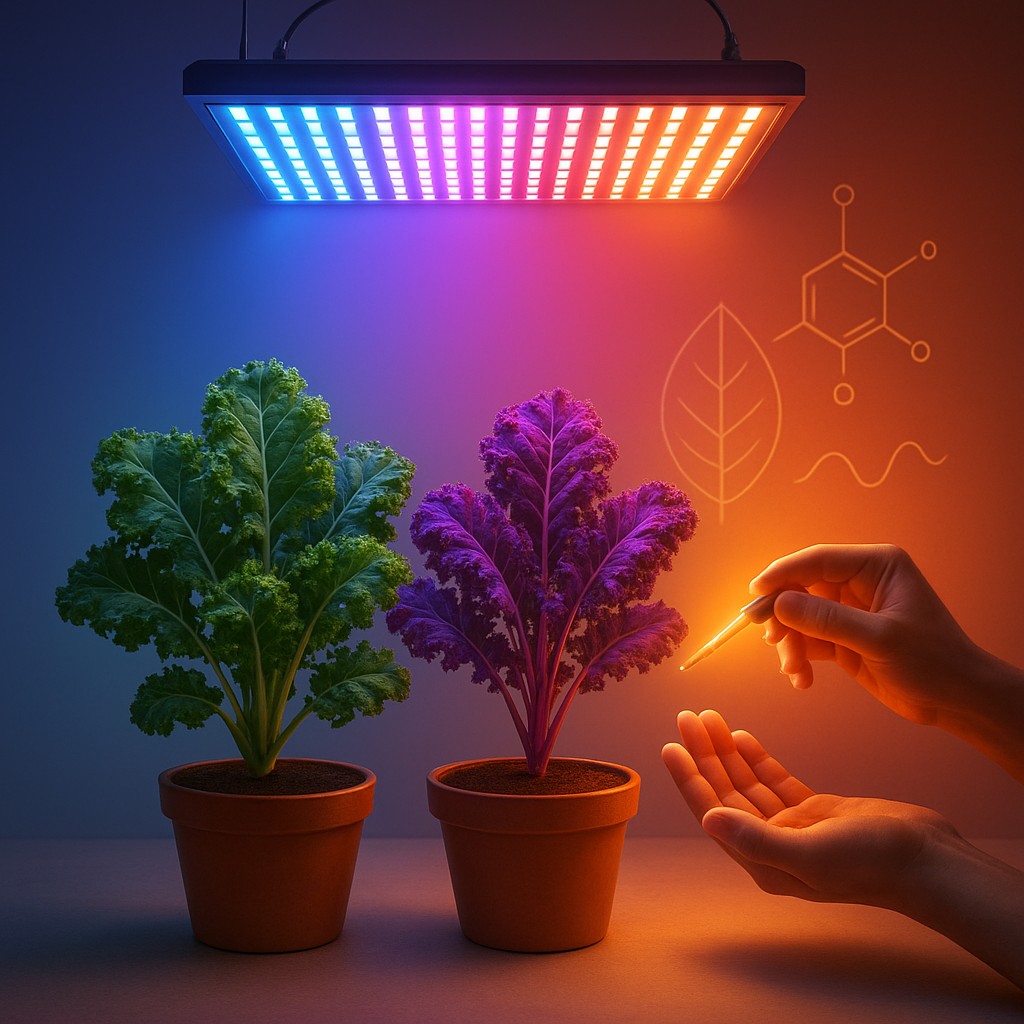
Imagine walking into a grocery store and finding two identical bunches of kale. One is earthy and mild, perfect for a smoothie. The other is sharp and peppery, with the kind of complex flavor you would expect in a high-end restaurant salad. In the past, achieving these differences required different seeds or soil from across the globe. Today, however, these two radically different flavors might come from the exact same batch of seeds, grown in the same facility. The only difference is the specific color of light they "bathed" in during their final days of growth. We are entering an era where farmers are no longer just growers; they are conductors of a biological orchestra, using light as a baton to fine-tune the chemical makeup of our food.
This shift moves away from the "bigger is better" philosophy of the industrial age and toward a deeper mastery of plant biology. By swapping the sun for specialized LED panels, indoor vertical farmers have learned to communicate with plants in their own language. Plants do not just use light for food through photosynthesis; they also use it as data to understand their environment. When a farmer changes a "light recipe" by switching between ultraviolet, blue, red, and far-red wavelengths, they are essentially hacking the plant’s internal operating system. This isn't genetic engineering in the traditional sense. Instead, it is about using environmental cues to unlock the dormant potential already hidden in a plant's DNA.
Understanding the Botanical Software
To understand how light recipes work, we have to stop thinking of plants as passive green objects that just sit there. Instead, think of a plant as a sophisticated chemical factory that constantly monitors its surroundings to decide which products to manufacture. Because plants cannot run away from a predator or find shade when it gets too hot, they have evolved a range of sensors called photoreceptors. These sensors, such as phytochromes and cryptochromes, are calibrated to detect specific colors of light. When triggered, they send signals to the plant's genes, telling them to change how the plant grows, how it tastes, and even how many vitamins it produces.
This process is known as photomorphogenesis. It is different from photosynthesis, which is how plants turn light into energy (sugar). If photosynthesis is the engine that keeps the plant running, photomorphogenesis is the steering wheel. By adjusting the light spectrum, farmers can tell a lettuce leaf to grow wider to catch more rays, or tell a basil plant to start producing more aromatic oils. On a traditional outdoor farm, the sun provides a "full spectrum" of light that the farmer cannot control. In a vertical farm, the "sun" is an array of LEDs that can be adjusted like the volume and bass on a stereo system. This allows for the creation of custom produce that meets specific culinary or nutritional standards.
The Chemistry of Stress as a Flavor Tool
One of the most fascinating parts of light recipes is the use of "intentional stress." We often think of stress as a bad thing, but in the plant world, a little hardship can lead to greatness. When a plant is hit with high doses of blue or ultraviolet light, its sensors see this as a sign of intense, potentially damaging solar radiation. To protect itself, the plant begins to produce secondary metabolites. These compounds are not strictly necessary for survival, but they act as a botanical sunscreen or chemical shield. In humans, we often call these compounds antioxidants, such as anthocyanins and polyphenols.
These protective compounds give many vegetables their punchy bite, bitterness, or color. For example, if you blast red oak leaf lettuce with extra blue light toward the end of its life, it will turn a deep, vibrant crimson and develop a more complex, bitter flavor. The plant thinks it is defending itself from the sun, but in reality, it is creating a more nutrient-dense and flavorful product for our dinner plates. On the other hand, if a farmer wants a sweeter, more tender leaf, they might use more red light, which helps cells expand and sugars build up. This ability to "sculpt" flavor through light means we can grow gourmet greens even in the middle of a city.
Decoding the Spectrum
Each color in a light recipe serves a specific function, much like different ingredients in a kitchen. While red and blue are the most common colors used indoors because they are the most efficient for growth, other "colors" play vital supporting roles. Even light that is invisible to humans, such as far-red or ultraviolet-A, can have a massive impact on the final crop. Farmers spend years researching the "sweet spot" for each plant, as a recipe that makes strawberries sweeter might make spinach taste like cardboard.
| Wavelength |
Role in Plant Development |
Effect on Final Product |
| Blue (400-500nm) |
Opens pores (stomata) and boosts chlorophyll. |
Increases nutrients and sharpens flavor or bitterness. |
| Red (600-700nm) |
Main driver for energy and leaf expansion. |
Encourages faster growth and higher sugar content. |
| Far-Red (700-800nm) |
Triggers the "shade avoidance response." |
Signals the plant to grow taller and flower earlier. |
| Green (500-600nm) |
Reaches deeper into the plant canopy. |
Keeps the bottom leaves of the plant healthy. |
| UV-A/UV-B |
Triggers the production of protective pigments. |
Makes colors more vibrant and boosts antioxidant levels. |
By mixing these colors in different amounts at different times, a farmer can create a very specific result. This is often done in stages. A "starter recipe" might use lots of red light to build a strong foundation and large leaves. Then, a "finishing recipe" might add a spike of blue light in the last three days before harvest to "ripen" the flavor and lock in nutrients. This level of control is impossible in traditional farming, where the grower is at the mercy of the weather, the season, and the local climate.
The Economic Challenges of Digital Sunlight
If light recipes are so effective, you might wonder why every head of lettuce isn't already grown under a purple glow. The answer comes down to money and physics. Creating "digital sunlight" takes a lot of energy. Even though LED technology has become much more efficient, the amount of electricity needed to power thousands of lights for 18 hours a day is massive. When you add the cost of cooling systems needed to clear away the heat those LEDs generate, the price of a vertical salad can be much higher than one grown in a field.
Furthermore, these light recipes are not one-size-fits-all. A recipe that works for a variety of kale from the 1800s might not work for a modern hybrid version. This means vertical farming companies must invest heavily in research, essentially acting as biology laboratories. They have to map out how every single variety reacts to light. There is also a "light ceiling" to consider. At a certain point, giving a plant more light doesn't make it grow faster; it just wastes electricity. Finding the tipping point where light creates the most value without breaking the bank is the main challenge for modern indoor farms.
Misconceptions About Indoor Lighting and GMOs
When people hear that farmers are "manipulating" plants with light, they often think of Genetic Modification (GMOs). However, there is a big difference. GMOs involve changing the actual DNA code of the plant, often by adding genes from different species. Light recipes, by contrast, are a form of "precision epigenetics." They don't change the code; they just change which parts of the existing code the plant decides to read. It is the difference between rewriting a book and simply highlighting different chapters for the reader to focus on.
Another common myth is that indoor-grown food is "less natural" or less nutritious because it doesn't see the sun. In reality, light recipes can produce food that is much more nutrient-dense than outdoor produce. Because outdoor plants face unpredictable weather and poor soil, they don't always reach their full potential. Indoor plants, given a "perfect day" every single day and finished with a nutrient-boosting light recipe, can contain higher concentrations of vitamins and minerals. The lack of a "natural" sun doesn't matter to the plant; it only cares about getting the specific light particles it needs to thrive.
The Future of the Digital Harvest
As we face a future where the climate is less predictable and cities continue to grow, the ability to grow food anywhere and at any time becomes a matter of global security. Refining light recipes is the key to making vertical farming more than just a niche market for expensive herbs. We are moving toward a reality where "terroir" - the idea that food tastes like the soil it grew in - is being joined by "techno-terroir," where flavor reflects the farmer's creative use of light.
The next time you bite into a piece of produce that feels exceptionally vibrant, remember that you might be tasting a carefully crafted sequence of light. We are no longer limited by the seasons or the geography of our ancestors. Instead, we are learning to use the light spectrum to bring out the very best that nature has to offer. This marriage of biology and technology is about more than just efficiency. It is about rediscovering the hidden potential in the plants we have lived alongside for thousands of years, and finally giving them the "perfect day" they need to show us what they can really do.