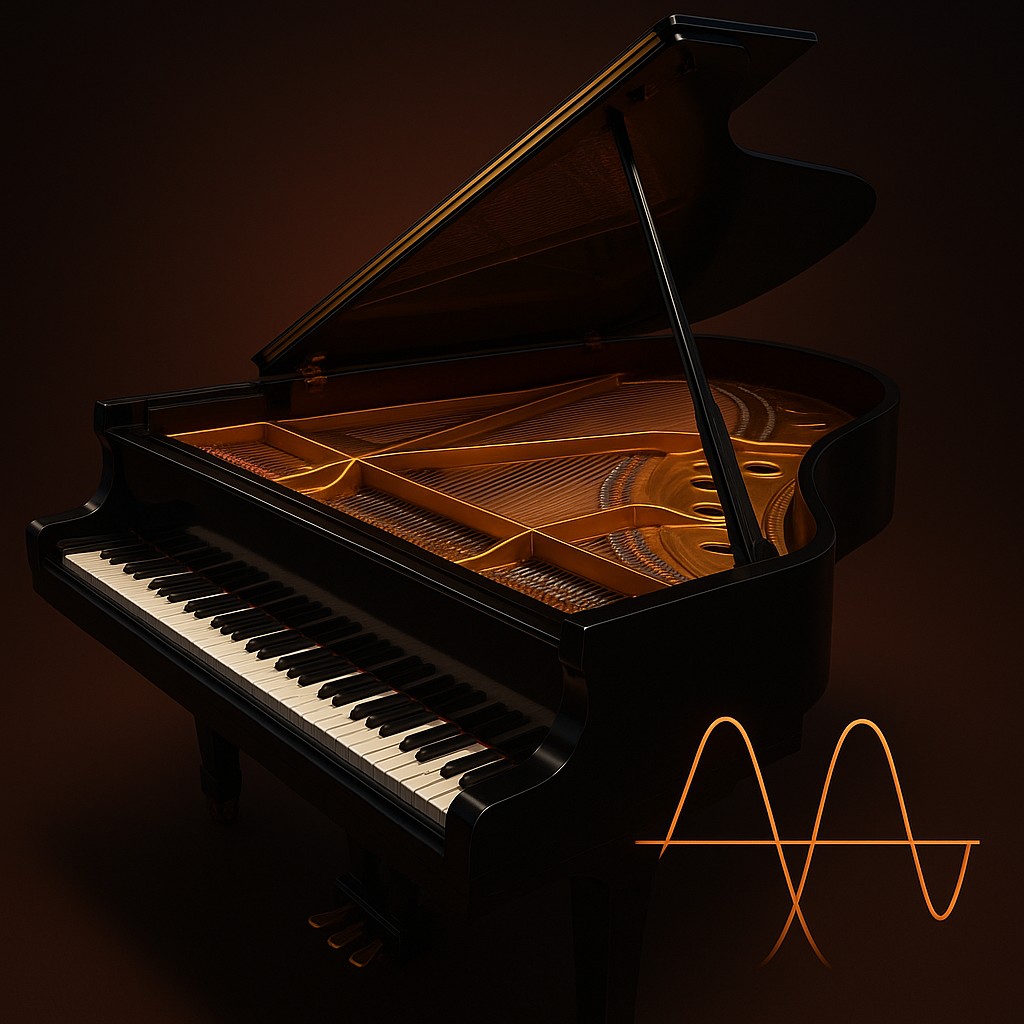
When you sit down at a polished grand piano and strike a celebratory C-clord, the sound that washes over you feels like the very definition of mathematical perfection. We often imagine that the majesty of the instrument comes from a rigid adherence to the laws of physics, with a series of strings vibrating at the exact frequencies dictated by the sterile numbers of a textbook. In this mental model, a master tuner is a sort of sonic accountant, meticulously checking off Hertz values (the number of vibrations per second) against a pre-ordained list of "correct" pitches. We assume that if we looked at the tuner’s electronic display, every note would hit a perfect zero, signaling that the instrument is finally in sync with the universe.
The reality, however, is much stranger and far more human. If you were to tune a piano using nothing but a high-precision frequency generator and a physics degree, the result would be an unmitigated disaster that sounded "sour" to any listener. The piano is a physical object made of wood, cast iron, and, most importantly, thick steel wire. These materials have a stubborn personality that refuses to follow the simplified equations we learn in grade school. To make a piano sound harmonious, a technician must intentionally tune it "wrongly." They must stretch the notes away from their theoretical ideals, engaging in a delicate dance of deception to satisfy the quirks of the human ear and the stiffness of metal strings.
The Myth of the Perfect String
In the idealized world of physics, a musical string is a weightless, infinitely flexible line under tension. When you pluck or strike this imaginary string, it vibrates at a fundamental frequency (the main note you hear) and a series of "harmonics." These harmonics are supposed to be perfect whole-number multiples of the fundamental. For example, if a low string vibrates at 100 Hz, its second harmonic should be exactly 200 Hz, its third 300 Hz, and so on. In this theoretical vacuum, these harmonics align perfectly with the notes higher up the keyboard. This alignment is what creates the "consonance," or sweetness, we associate with Western music.
However, real-world piano strings are not weightless or infinitely flexible. They are made of high-tensile steel, and the lower strings are often wrapped in heavy copper to add weight without making them impossibly long. Because of their thickness and material, these strings have a quality called "stiffness." When a stiff string vibrates, it doesn't just bend simply at its ends; it resists bending near the points where it is attached. This resistance acts like an extra bit of tension, which has a curious effect on the overtones.
This phenomenon is known as inharmonicity. Instead of the second harmonic being exactly twice the frequency of the main note, it ends up being just a tiny bit sharper, perhaps 2.001 times the frequency. By the time you get to the higher harmonics, the "sharpness" has compounded. These overtones are the "ghost notes" that ring out alongside the main pitch, and they are essentially the DNA of the piano’s tone. Because the strings are physical objects with varying thicknesses, they refuse to behave like the math says they should.
The Ghost in the Machine
To understand why this matters for a tuner, we have to look at how we perceive harmony. When you play two notes an octave apart, your ear expects them to blend seamlessly. For this to happen, the first overtone of the lower note needs to match the main frequency of the higher note. If the low note is a C2 and the high note is a C3, they will only sound "pure" if those two frequencies align perfectly. If they don't, you hear a rhythmic pulsing known as "beating," which sounds like the note is wobbling or "wowing."
Because of inharmonicity, the low C2 has an overtone that is slightly sharper than it "should" be. If we were to tune the higher C3 to its mathematically perfect frequency, it would clash with that sharp overtone from the C2. The result is a gritty, unpleasant vibration. To fix this, the tuner must "stretch" the C3 note, tuning it slightly sharp so that its main pitch matches the sharp overtone of the C2 below it. This process ripples across the entire keyboard. To keep the whole instrument sounding pleasant, the high notes are pushed increasingly sharp, and the low notes are pulled increasingly flat.
The following table compares the theoretical world of physics with the practical reality of a professional piano tuning:
| Feature |
Theoretical Tuning (Pure Physics) |
Practical Piano Tuning (Stretched) |
| String Behavior |
Perfectly flexible, no internal resistance |
Stiff steel wire with internal resistance |
| Overtones |
Exact whole-number multiples (2x, 3x, 4x) |
Sharp "inharmonic" overtones (2.01x, etc.) |
| High Notes |
Tuned to exact frequency (e.g., 4186 Hz) |
Tuned sharp to match overtones |
| Low Notes |
Tuned to exact frequency (e.g., 27.5 Hz) |
Tuned flat to match high overtones |
| Resulting Sound |
Sterile, dead, or jarring to the ear |
Brilliant, resonant, and harmonious |
The Railsback Curve and the Personality of Steel
If you were to graph how much a well-tuned piano deviates from a theoretical "perfect" pitch, you wouldn't see a straight line. Instead, you would see a graceful, S-shaped curve known as the Railsback Curve. Named after O. L. Railsback, who first measured these deviations in the 1930s, the curve shows how the extreme ends of the piano must move away from the center. The lowest bass notes might be tuned as much as 30 or 40 cents flat (a "cent" is 1/100th of a half-step), while the highest treble notes can be 30 cents sharp.
The amount of stretching required is not a fixed law; it depends entirely on the physical makeup of the piano. A massive nine-foot concert grand has long, thin strings relative to its pitch, which means they are more flexible and have lower inharmonicity. Consequently, a concert grand requires less octave stretching. In contrast, a small "spinet" or upright piano has short, thick strings to fit inside its compact cabinet. These strings are incredibly stiff and produce wildly sharp overtones, requiring the tuner to stretch the octaves significantly more to make the instrument playable.
This is why a professional tuner doesn't just use a standard guitar tuner and call it a day. A high-end electronic tuning device (ETD) designed for pianos actually "samples" several notes across the keyboard first. It measures the unique inharmonicity of that specific set of strings and then calculates a custom Railsback Curve for that individual instrument. Even if you have two pianos of the same model from the same factory, they will likely require slightly different tunings because no two strings are identical at a microscopic level.
The Human Element of Discordant Harmony
There is a profound philosophical lesson hidden in the way we tune pianos. It reminds us that "perfection" is often a matter of context rather than adherence to an abstract rule. If we insist on mathematical purity, we end up with a sound that humans perceive as tense and wrong. It is only by embracing the "imperfection" of the physical material and leaning into the "error" that we achieve a result that feels right to our souls.
Interestingly, this stretching also contributes to the "brilliance" of a piano. By tuning the high notes slightly sharp, the instrument gains a shimmering quality that helps it cut through an orchestra. If the high notes were tuned to their "correct" frequencies, they would sound dull and "flat" when played alongside the complex, overtone-rich notes of the middle register. We have effectively trained our ears to hear a stretched, "incorrect" scale as the gold standard of musical beauty.
Furthermore, the tuner’s job involves a great deal of artistic compromise. Every time they stretch an octave to make it sound pure, they might be slightly throwing off a fifth or a fourth. Tuning a piano is essentially a grand game of "moving the rug." You pull it in one direction to cover a spot, and a tiny bit of floor shows elsewhere. The tuner’s skill lies in distributing these tiny discrepancies so evenly across the 88 keys that the human ear cannot detect them, leaving only the impression of a perfectly balanced whole.
The Harmony of Compromise
When you next hear a piano, whether it is a battered upright in a jazz club or a pristine Steinway in a concert hall, remember that the harmony you are hearing is a carefully constructed lie. It is a masterpiece of engineering that accounts for the stubbornness of steel and the quirks of human biology. The instrument is, in a very literal sense, "out of tune" with physics so that it can remain "in tune" with us.
This realization transforms the piano from a mechanical box into a living collaboration between science and art. It teaches us that rigidity is often the enemy of beauty and that the most resonant systems are those that allow for a little bit of "stretch." Just as the piano tuner finds balance by deviating from the norm, we often find our best results by adjusting our expectations to fit the reality of the materials we are working with. So, take inspiration from the Railsback Curve: sometimes, being slightly "off" according to the textbook is exactly what is required to be perfectly in harmony with the world.