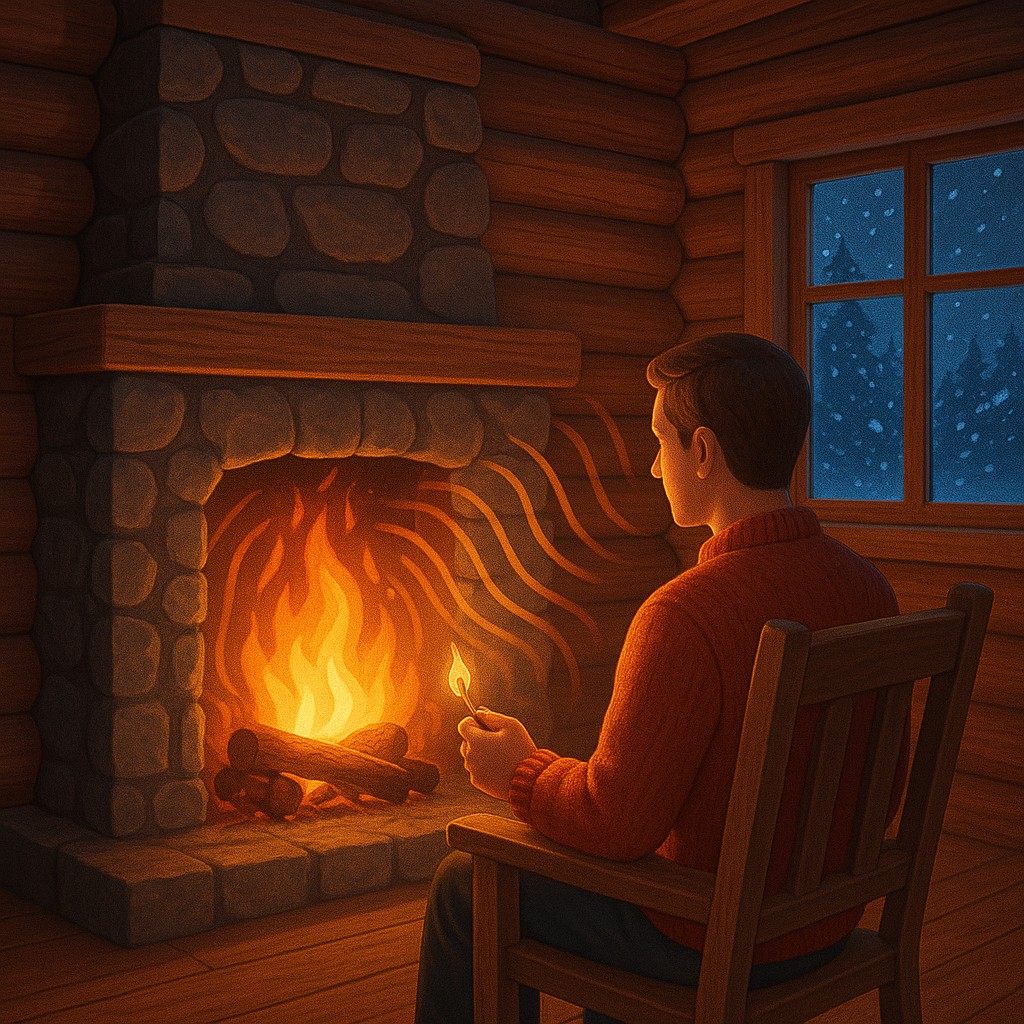
Imagine you are sitting in a log cabin in the dead of winter. The temperature outside is biting, and the wind howls against the glass. You strike a match and set a fire in the hearth. Within seconds, your face feels the familiar, prickling heat of the flames. You pull your chair closer, feeling the warmth seep into your sweater, even though the air around your ankles feels like it flew straight in from the Arctic. You have just experienced the silent, high-speed world of radiant energy.
Most of us grow up assuming that heating a room is exactly like heating a pot of water on a stove. We imagine the fire acts like a heater blowing hot air, churning the atmosphere around until every corner of the room reaches a balmy temperature. However, if you have ever stood in front of a fireplace, you know that the air temperature is effectively a sideshow. The real magic happens through a process that requires no medium to travel through, moving from the burning log to your skin at the speed of light.
The Invisible Messenger of Thermal Energy
To understand why a fireplace makes you feel toasty while the room remains drafty, we have to stop thinking about heat as a "thing" that fills a room like smoke. Instead, think of heat as a vibration. Every object with a temperature above absolute zero is in a constant state of atomic jiggling. When you burn wood, you are accelerating these vibrations to a frantic pace. This extreme movement releases energy in the form of electromagnetic waves, specifically infrared light.
Unlike convection, which relies on the physical movement of air molecules to carry heat, radiation is independent of the air. These infrared photons travel in straight lines across the room, ignoring the currents, drafts, and stagnant pockets of air in their path. When these invisible light beams strike your skin or a piece of furniture, the energy is absorbed and converted back into molecular vibration. This is why you feel the heat the moment the log catches fire, long before the room has experienced any measurable temperature change.
The air between you and the fireplace is essentially transparent to these rays. You can prove this easily by standing in a sunbeam on a snowy day. The sun is millions of miles away through the freezing vacuum of space, yet your skin warms up instantly. A fireplace works on that exact same principle, scaled down to the size of your living room. The hotter the embers, the shorter the wavelength of the infrared light, and the more intensely you feel that deep, penetrating warmth.
The Convection Problem and the Chimney Paradox
While radiation is a masterclass in efficiency, the humble fireplace is actually a rather chaotic system. Because a fire requires a constant supply of oxygen to keep burning, it creates a powerful chimney effect. The heat of the fire causes air molecules to expand, become less dense, and rise rapidly up the flue. In many traditional masonry fireplaces, this process is so aggressive that it creates a negative pressure zone in your living room, sucking cold air from every window crack and door gap to replace the air being whisked away.
This is where the distinction between convective and radiant heating becomes binary and harsh. Convection, which is the process of trying to warm the air in the room, is largely an uphill battle for a fireplace. Because the chimney acts as a massive exhaust pipe, most of the warm air generated by the combustion process is literally flying out of your house. You are effectively paying a premium in firewood to heat the night sky.
This is the great irony of the hearth. You feel warm because you are standing in the direct line of sight of the glowing embers, but the moment you step away, the room may feel colder than when you started. You have essentially created a localized "sun" in your room that cannot overcome the massive heat loss caused by the chimney ventilation requirements. It is a brilliant, primitive piece of technology that prioritizes the proximity of the user over the comfort of the entire space.
Evaluating Methods of Heat Transfer
To make sense of how we warm our homes, it helps to categorize these processes by how they interact with objects. We generally categorize heating into three buckets: conduction, convection, and radiation. Understanding these buckets is the key to mastering your indoor climate and stopping the constant struggle with the thermostat.
| Method |
Mechanism |
Typical Home Example |
Medium Required |
| Conduction |
Direct physical contact |
A thick wool blanket |
Solid matter |
| Convection |
Movement of fluid or gas |
Central furnace vents |
Air or liquid |
| Radiation |
Infrared light waves |
Fireplace or sunlight |
None |
By looking at this table, you can see why the fireplace feels so distinct compared to a modern forced-air system. A forced-air furnace is a convection machine. It works by churning a massive volume of air through a heat exchanger and pushing it through vents. It is excellent at warming a whole house, but it feels hollow compared to the deep, penetrating warmth of a radiant heat source. Radiation warms your biological tissues directly, which our nervous system interprets as a more primal and satisfying type of heat.
Why Your Intuition Fails the Thermostat Test
We often have a distorted view of heating because of the ways our bodies sense temperature. We do not actually possess sensors for "air temperature." When you walk into a room and claim it is "cold," you are actually sensing the rate at which your body is losing heat to the surfaces around you. If the walls are cold, they are radiating your body heat away, and you feel cold, even if the air is technically warm.
This is a profound insight for anyone trying to stay comfortable. A fireplace keeps you warm by out-radiating the cold surfaces. It creates a "warmth bubble" that acts as a buffer between your skin and the cold walls. You aren't just heating the air; you are effectively blinding your sensors to the chill of the room by flooding them with intense radiant energy. Once you realize this, you stop obsessing over the air temperature and start thinking about the directional flow of energy.
If you want to maximize efficiency, modern heating strategies often mimic this radiant approach. Underfloor heating systems, for example, turn your entire floor into a giant, low-temperature radiator. Instead of warming the air and letting it float to the ceiling where nobody is, these systems radiate energy upward to where you are standing. It is a sophisticated, technologically advanced version of that same primal experience you get from sitting in front of a crackling fire, without the chimney sucking all your money into the sky.
Debunking the Myth of Warm Air
One of the most persistent myths in home comfort is that if you turn the thermostat up, the room will eventually become comfortable. But if you have cold drafts or inefficient insulation, you are simply spending more energy to create a temperature differential. You are heating the air just for it to escape through a leak. The air might register a higher number on a thermometer, but you will still feel uncomfortable because the radiant loss to the cold surfaces remains constant.
Instead of fighting the air, think like an engineer of light. You want to control the exchange of thermal energy through surfaces. This is why a heavy rug on a cold floor or thick curtains on a window does more for your comfort than cranking up the heat. You are blocking the radiant heat loss of your body to those cold surfaces. When you combine this with a radiant heat source like a fireplace or a modern infrared panel, you align your home with the laws of physics rather than fighting a war against the wind.
The next time you find yourself shivering in a room with a fireplace, don't walk over to the thermostat. Walk over to the fire. Sit within the line of sight of the embers, bask in that golden glow, and appreciate the fact that you are feeling energy that has traveled across empty space just to reach you. By shifting your focus from the air you breathe to the waves that strike your skin, you move from being a victim of winter to being a master of your own local climate. You are now warm, not because of the furnace, but because you have mastered the art of gathering the light.