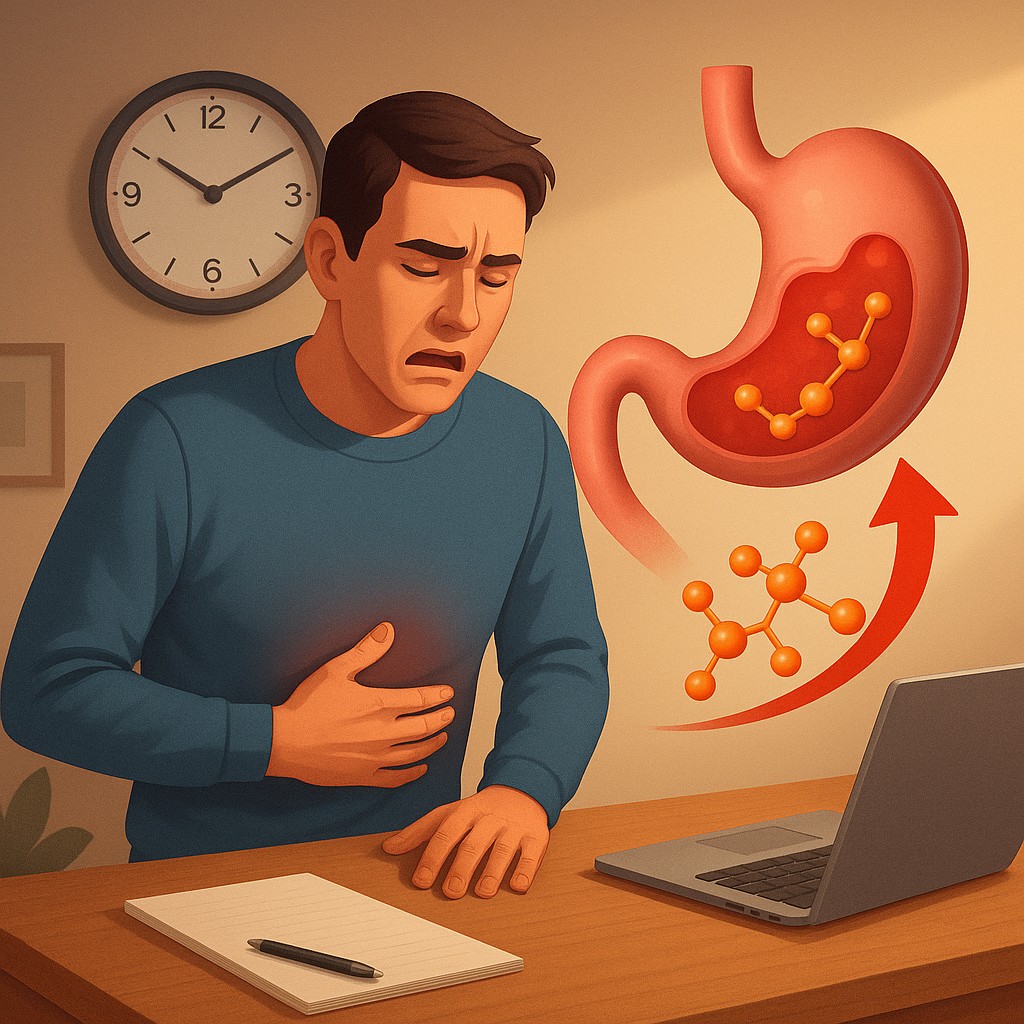
Imagine you are sitting at your desk, focused on a project, when a sudden wave of hunger hits you. It is so intense that your stomach feels like it is physically collapsing. You glance at the clock and see it is exactly 12:00 PM. You might assume your body is running out of fuel, like a car with a "low gas" light flashing. You might even feel a slight growl or a hollow sensation, confirming your suspicion that you are on the brink of starvation. However, if you ignored that feeling for an hour and pushed through your work, something curious would happen. By 1:15 PM, the hunger would likely vanish, even though you have not eaten a single calorie.
This phantom hunger is a clever illusion created by your endocrine system, the network of glands that manage your hormones. Your stomach is not actually a fuel gauge that measures how many grams of protein or fat you have left. Instead, your body relies on a sophisticated, predictable hormonal pulse. It acts more like a programmed alarm clock than a physical sensor. This internal alarm is triggered by a hormone called ghrelin, often nicknamed the "hunger hormone." When we think we are feeling a physical need for food, we are often just experiencing a scheduled chemical release that our own habits have created.
The Pavlovian Bell in Your Bloodstream
To understand why you feel hungry at the same time every day, we have to look at how ghrelin works. Ghrelin is produced mainly in the stomach and small intestine, but its job is to talk to the hypothalamus, the brain's control center. For decades, many thought the stomach produced ghrelin simply because it was empty. The idea was that if food was not stretching the stomach walls, the organ would pump out hunger signals. We now know the reality is much more complex and, frankly, a bit more manipulative.
Ghrelin is a highly "entrainable" hormone, meaning it learns your schedule and prepares your body for the expected meal. If you have eaten lunch at noon every day for the last two years, your brain anticipates the work of digestion. It begins releasing ghrelin around 11:45 AM to increase stomach acid and jump-start gut movement. It is essentially "pre-heating the oven" for the food it expects is coming. This is why you feel ravenous at your usual mealtime even if you had a massive, 2,000-calorie breakfast just a few hours earlier. The sensation you feel is not a lack of energy; it is the physical feeling of your body preparing for a habit.
Distinguishing Biological Need from Habitual Want
Scientists generally put hunger into two categories: homeostatic hunger and hedonic hunger. Homeostatic hunger is the true biological drive to get energy. This system tries to keep your body in balance by signaling when your actual energy reserves, like blood sugar or fat cells, are running low. If you were stranded on a desert island for three days, you would be experiencing homeostatic hunger. It is a slow, persistent, and increasingly urgent demand for survival.
Hedonic hunger, on the other hand, is driven by the brain's reward centers and surroundings. This is the "hunger" you feel when you see a pizza commercial or walk past a bakery. Ghrelin bridges these two worlds because it is heavily influenced by timing and outside cues. When your ghrelin levels spike because of a habit, you are experiencing a form of conditioned hunger that mimics a real physical need. This explains why people who try intermittent fasting, or eating only during specific hours, often find the first few days difficult. After about a week, they no longer feel hungry during their fasting window. Their ghrelin pulses have simply rescheduled themselves to match the new eating pattern.
| Feature |
Homeostatic Hunger |
Hedonic/Scheduled Hunger |
| Main Driver |
Actual energy deficit (low fuel) |
Habits, timing, and sensory cues |
| Main Hormone |
Leptin (low levels) and Ghrelin |
Ghrelin (anticipatory pulse) |
| Timing |
Gradual increase over many hours |
Sharp spikes at usual mealtimes |
| Sensation |
General fatigue, persistent urge |
Intense "stomach growling", sharp cravings |
| Resolution |
Requires eating calories |
Usually fades within 60-90 minutes |
The Ghrelin Wave and the Art of Waiting
One of the most helpful things to realize about your biology is that hunger does not just keep building. We often assume that if we are hungry at noon, we will be twice as hungry at 2:00 PM and four times as hungry by dinner. In reality, hunger comes in waves. Because ghrelin is a scheduled pulse, it will rise, peak, and then inevitably fall, whether you eat or not. Studies showed that in people who fasted for several days, ghrelin levels did not rise forever. In fact, levels often stayed lower than they were on the first day because the body eventually stopped expecting a scheduled meal.
When that noon-time hunger hits, your body is performing a Pavlovian response. Just as Pavlov's dogs learned to drool at the sound of a bell, your stomach "growls" at the sight of a clock or the smell of coffee in the breakroom. If you can wait out the wave, you will find that the intense discomfort goes away. This happens because the brain realizes the expected food is not arriving and stops the ghrelin release to save resources. Understanding this allows you to view hunger as a suggestion rather than a command. It is the body saying, "I am ready if you are," rather than, "I am dying if you don't."
When the Clock Breaks: Sleep and Chronic Hunger
While our schedules do a great job of training our hunger hormones, one major factor can throw the entire system into chaos: lack of sleep. The link between sleep and appetite is a well-proven area of science. Two main hormones play a "tug-of-war" here: ghrelin, which makes you want to eat, and leptin, which tells your brain you are full. In a healthy, well-rested person, these two stay in a delicate balance.
When you are chronically short on sleep, your body enters a state of mild stress. From an evolutionary perspective, if you were awake when you should have been sleeping, it probably meant you were in a high-stress situation that required more energy. As a result, lack of sleep causes ghrelin levels to skyrocket and leptin levels to drop. This creates a "double whammy" where you feel hungrier than usual all day, and the food you do eat feels less satisfying. In this state, the ghrelin pulse is no longer a scheduled event; it becomes a constant, high baseline. You feel like you are always searching for high-calorie snacks because your brain is convinced it needs extra energy to survive the "emergency" of staying awake.
Navigating Your Internal Landscape
Learning to manage these hormonal tides can fundamentally change your relationship with food. Many people spend their lives as slaves to the noon and 6:00 PM bells, never realizing their discomfort is a product of their own biological programming. By recognizing that hunger is often a temporary, habit-based signal, you gain mental clarity. You can start to ask yourself: "Am I actually low on energy, or is it just noon?"
This does not mean you should ignore your body's needs or stop enjoying your meals. Instead, it means you can take back control. You can choose to eat because you want to nourish your body or enjoy a social event, rather than because a hormonal pulse forced your hand. You can experiment with shifting your "ghrelin clock" to better suit your lifestyle, or use the knowledge of the "one-hour wave" to stay focused during a busy afternoon. Once you realize the bell is just a sound, you no longer have to react every time it rings.
The next time you feel that sharp, demanding pang of hunger, try to look at it with scientific detachment. Imagine the ghrelin molecules moving through your system, performing the task you trained them to do over months and years of habit. Smile at the precision of your own internal clock, take a few deep breaths, and watch as the tide of hunger slowly recedes. You are not a victim of your stomach; you are the architect of your own rhythms, capable of mastering the cues that once seemed so uncontrollable.