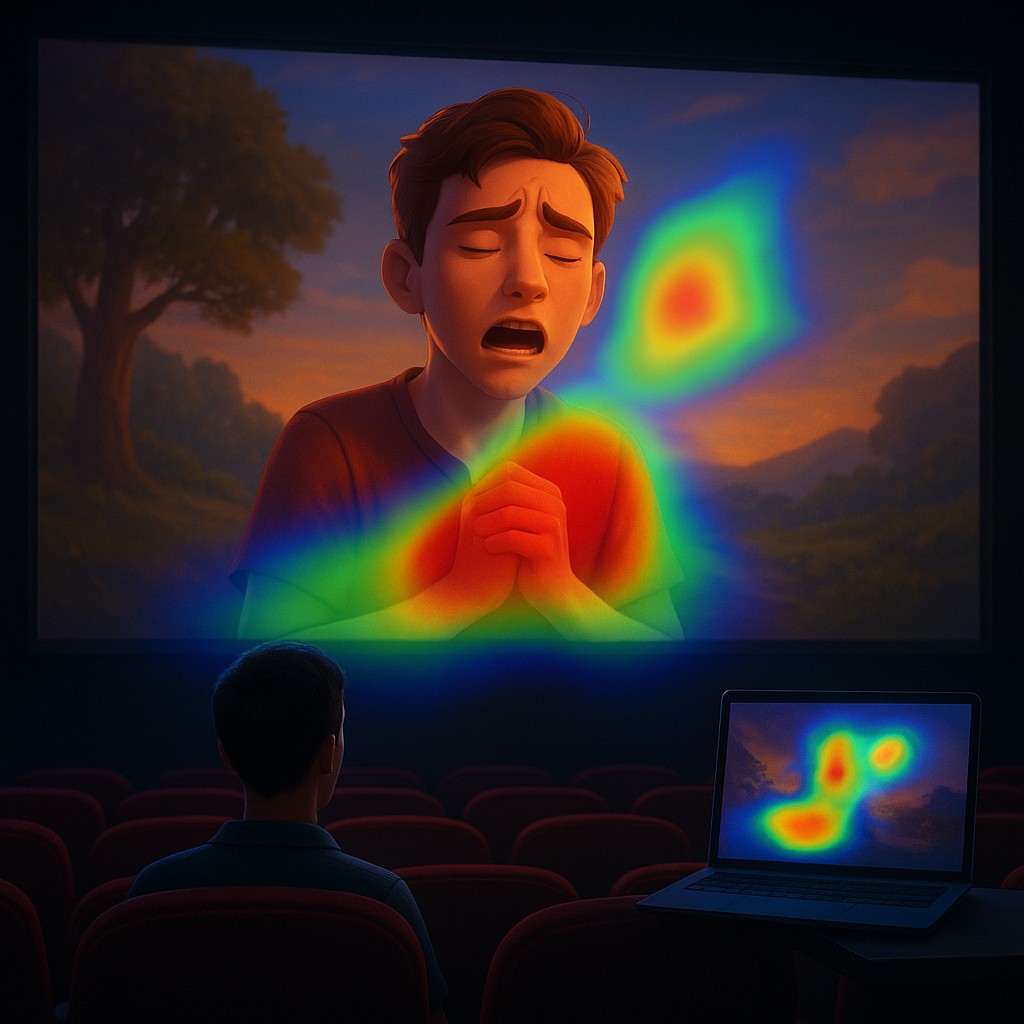
Imagine sitting in a dark theater, your eyes fixed on a towering screen as an animated hero pours their heart out during a vulnerable, climactic moment. To you, it feels like a seamless emotional journey shaped by the magic of storytelling. Behind the scenes, however, data scientists and editors may have spent weeks analyzing exactly how your pupils dilated and precisely which pixel held your gaze during that very second. While we like to think of cinema as a subjective art form driven by "gut feeling," modern animation has become a high-stakes laboratory where human biology decides what stays on the screen and what ends up in the digital trash bin.
This process goes beyond making sure the colors look pretty or the jokes land. It is a rigorous scientific interrogation of human attention known as engagement heatmapping. Major studios are moving past traditional focus groups, where people often give vague, polite, or dishonest feedback. Instead, they use infrared sensors to track the minute movements of your eyes, creating a thermal-style map that reveals exactly where your focus stays and where it begins to slip away. If your eyes wander to a detailed tree in the background while the lead character is having an epiphany, the studio sees it as a failure of visual hierarchy. Often, this leads to drastic cuts or expensive re-animations.
The Biology of the Wandering Eye
To understand why studios are obsessed with your pupils, we have to look at the mechanics of human vision. Our eyes are naturally drawn to high contrast, motion, and faces - a primal instinct left over from ancestors who needed to spot predators in the brush. In filmmaking, this is called bottom-up processing, where visual stimuli control your attention. When an editor does their job well, they achieve "attentional synchrony," where 90 percent of the audience looks at the exact same spot at the same time. It is a form of collective hypnosis that allows a story to move forward with maximum impact.
However, "focal drift" occurs when a scene's design competes with the story's intent. If an animator spends five hundred hours detailing the shimmering scales of a dragon in the background, they might accidentally create a visual magnet that pulls the viewer's eye away from the character's facial expressions. Heatmapping data reveals this drift instantly. When a map looks like a scattered mess of dots rather than a concentrated hot spot on the intended focus, it signals that the audience is confused or disengaged. This is often when a director realizes that a "boring" scene is not lacking in plot, but is suffering from a cluttered visual composition.
Precision Editing Through Data Maps
In the past, animation scenes felt slow if the pacing of the dialogue or the length of the shots was off. Editors relied on their intuition, or an "internal clock," to decide when to cut to a new angle. Today, engagement heatmapping identifies the precise frame where a viewer’s interest begins to fade. By visualizing gaze patterns, editors can see if a shot lasts three seconds too long. If the data shows that the audience has already processed the visual information and is looking at the edges of the frame for something else, the editor knows it is time to move on.
This data-driven approach has changed how deleted scenes are born. Rather than cutting a sequence because the dialogue is weak, studios might cut it because the heatmaps show a total lack of clustering. If the audience is looking everywhere, they are effectively looking at nothing. This leads to "tightening," a process where the visual complexity of a scene is stripped back to force the viewer to focus on the essential emotional beats. It turns the editing room into a surgical suite where data identifies the dead weight in a film, ensuring that every second is optimized for the highest level of engagement.
Measuring Meaning Beyond the Gaze
While tracking where someone looks is a powerful metric, it is only one piece of the puzzle. Studios are increasingly looking at pupillary responses and fixation duration to understand the quality of that attention. A viewer might look at a character because they are moving erratically, which is a reflex, or because they are deeply invested in the character's emotional state, which is engagement. By combining eye-tracking with biometric data, such as heart rate or skin conductance, film teams can distinguish between visual noise and narrative resonance.
| Metric |
What it Measures |
Studio Action |
| Attentional Synchrony |
Percentage of audience looking at the same spot simultaneously. |
If low, the scene is likely too cluttered or lacks a clear focal point. |
| Fixation Duration |
How long a viewer dwells on a specific visual element. |
Long durations on background assets suggest they are distracting from the plot. |
| Saccadic Velocity |
The speed at which the eye jumps between different points. |
High velocity can indicate viewer fatigue or confusion. |
| Focal Drift |
The gradual movement of gaze away from the intended narrative center. |
Signals a loss of engagement; often leads to scenes being shortened or cut. |
This table shows the shift from qualitative feedback - "I didn't like the ending" - to quantitative diagnostics - "The audience's eyes drifted at the 42-minute mark." It allows creators to pinpoint the exact moment a film loses its grip. If a character design consistently fails to hold the gaze during close-ups, it might lead to a late-stage redesign of their eyes or mouth to make the performance more readable and sticky to the human eye.
The Conflict Between Art and Efficiency
The rise of engagement heatmapping has its critics. There is a delicate balance between a film that is perfectly paced and one that feels clinical or manufactured. Many directors argue that some of the greatest moments in cinema occur when the eye is allowed to wander, discovering small details that build the world organically. If every scene is edited to eliminate focal drift, we risk creating a cinematic language so focused on efficiency that it loses the breathing room required for atmosphere and immersion.
Furthermore, there is the "average viewer" problem. Heatmapping tends to optimize for the majority, which can lead to a flattening of artistic style. If a studio sees that a bold, avant-garde background causes the audience's eyes to wander more than a standard background, they might feel pressured to play it safe. This creates a feedback loop where films start to feel the same because they are tuned to the same biological triggers. The challenge for the next generation of animators will be to use this data to enhance their vision, rather than as a leash that restricts creativity to the most predictable patterns of human biology.
Mastering the Visual Hierarchy
For those interested in the craft of storytelling, understanding these principles offers a new perspective on how we consume media. Every time you watch a modern blockbuster, you are participating in a grand experiment in human attention. The filmmakers have used light, shadow, color, and movement to steer your gaze along a pre-ordained path. Learning to recognize these visual anchors can make you a more conscious viewer, allowing you to see the invisible hand of the editor as they pull your focus across the screen.
Ultimately, the goal of engagement heatmapping is to bridge the gap between the creator's intent and the viewer's experience. When an animator pours their soul into a character and a data scientist confirms that the audience is looking exactly where that soul is being expressed, the technology serves as a bridge. Precision in editing does not have to mean a lack of heart; it can mean ensuring that the heart of the story is never missed by a wandering eye. By mastering the science of attention, creators can ensure that their most important messages are delivered with such clarity that the audience cannot help but look exactly where they are told.
As you move through the world of visual media, pay attention to where your own eyes land. Notice when you feel the urge to look away from the center of the screen, or when a sudden flash of color in the corner of your vision pulls you out of a moment. That sensation is the very thing that multi-billion-dollar studios are spending millions to monitor and manage. We are entering an era where the stories we love are built around the way our bodies work, turning the act of watching a movie into a profound, data-verified dance between the screen and the eye.