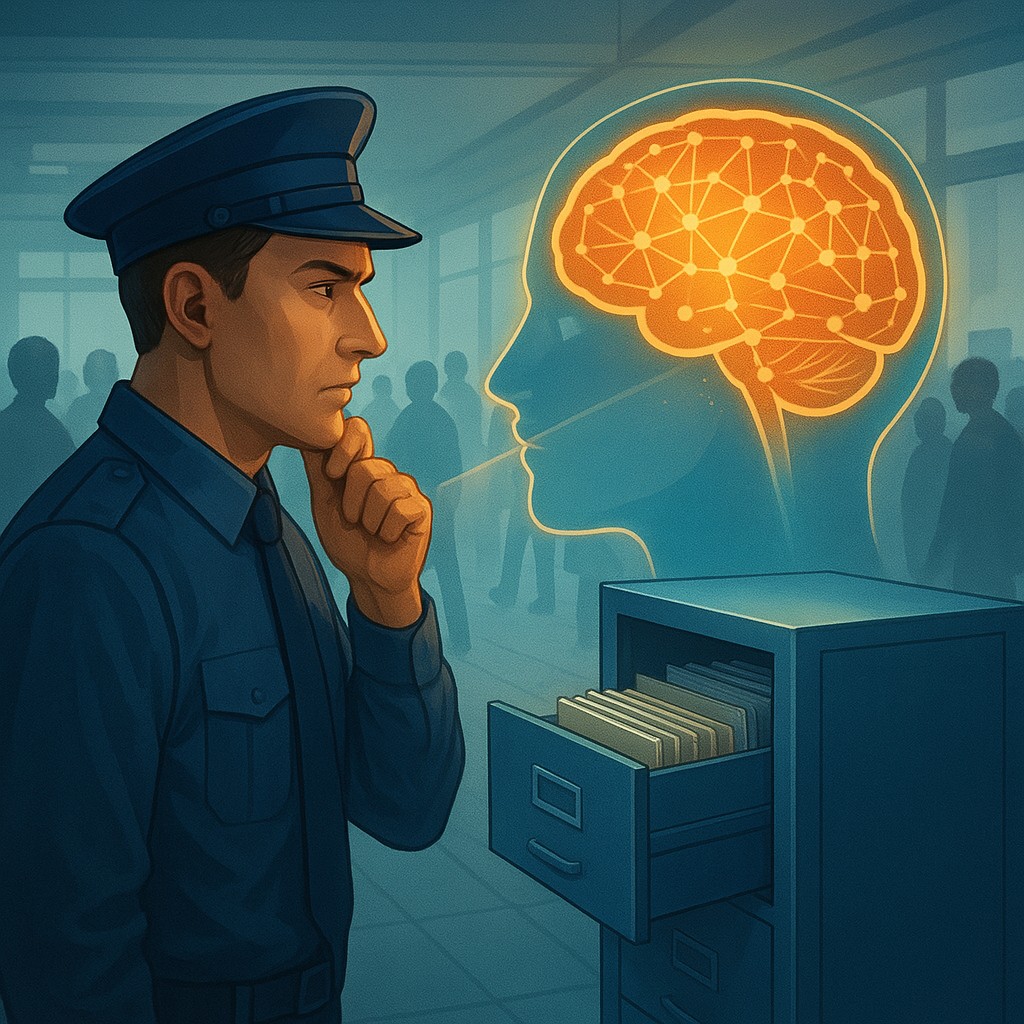
Imagine you are standing in a crowded airport, watching a veteran security officer scan the moving line of passengers. Thousands of people shuffle past, yet the officer suddenly freezes, focuses on one traveler, and steps forward. They can’t quite explain why at first, but they "know" something is off. This isn't psychic energy or a lucky guess. Deep within the officer’s brain, a massive biological database is running a high-speed search. This database has cataloged years of posture, eye contact patterns, and walking rhythms. In less than a second, the officer’s mind flagged a subtle deviation that most of us wouldn't notice even if we stared for an hour.
This phenomenon is what we casually call a "gut feeling," but in the world of cognitive science, it has a much more impressive name: expert intuition. It is the ability to make high-stakes decisions in the blink of an eye without going through a conscious, step-by-step logical process. While it feels like magic to the person experiencing it, expert intuition is actually the ultimate form of data processing. It is the result of thousands of hours of deliberate practice that have reorganized the very way the brain stores and retrieves information. By understanding how this "wizardry" actually works, we can learn when to trust our own instincts and, more importantly, when to ignore them.
The Architecture of the Mental Library
Most people assume that memory is like a giant filing cabinet where we store isolated facts, such as the capital of France or a sourdough recipe. However, for an expert, memory is more like a highly interconnected web of "chunks." A chunk is a collection of information that has been bound together into a single, meaningful unit. Think about how you read the word "apple." You don't see the letters A, P, P, L, and E and then sound them out like a toddler. You see the entire shape and recognize it instantly as a single concept. This is because "apple" is a chunk in your mental library.
Experts do this with incredibly complex scenarios. When a Grandmaster looks at a chessboard, they don't see thirty-two individual pieces. They see "Italian Game, Main Line, Variation 5." They are seeing groups of pieces that function together as a tactical unit. Research suggests that while a novice might struggle to remember where five random pieces are placed on a board, a Grandmaster can glance at a game in progress for three seconds and reconstruct the positions of twenty-five pieces with near-perfect accuracy. They aren't smarter in a general sense; they simply have a superior library of chunks that allows them to process the board as a few large blocks of information rather than dozens of tiny ones.
This chunking process is the engine behind what we call intuition. When an expert encounters a problem, their brain doesn't start from scratch. It scans the current environment for patterns that match their stored chunks. If a match is found, the brain serves up the "expected" solution or the next logical step before the person has even finished describing the problem. This is why a seasoned mechanic can hear a car engine for two seconds and say, "Your fuel map is running lean," while a beginner is still looking for the hood latch. The sound of the engine is a recognized chunk that points directly to a known cause.
The Cognitive Shortcut of High-Speed Recognition
To understand why experts bypass slow reasoning, we have to look at the two systems our brains use to think. Psychologists often refer to these as System 1 and System 2. System 1 is fast, automatic, and emotional. It’s what you use to drive your car on a familiar route or to realize someone is angry just by looking at their face. System 2 is slow, effortful, and logical. You use it when you are doing your taxes or trying to remember where you parked in a massive shopping mall. System 2 gets tired very quickly, but System 1 can run all day without breaking a sweat.
Intuition is essentially an elite version of System 1. Usually, System 1 is prone to basic errors because it loves shortcuts. However, after years of intense training, experts "train" their System 1 to handle incredibly complex tasks that used to require heavy System 2 effort. A junior doctor might have to sit down and list every symptom, check a manual, and rule out five different diseases to reach a diagnosis. A veteran physician, however, has seen those symptoms clustered together hundreds of times. Their System 1 recognizes the "face" of the disease immediately.
This recognition process is so fast that it often creates a sense of "knowing without knowing how." The expert feels a tug or a nudge toward a specific answer. This isn't because the answer came from nowhere, but because the brain's internal search engine returned a 100% match so quickly that the conscious mind didn't have time to see the search results. This allows experts to function under extreme pressure, such as in emergency rooms or cockpits, where there simply isn't time for a slow, System 2 debate.
Identifying the Environment for Reliable Instincts
Not all intuition is created equal. You might have a "strong feeling" about which horse will win a race or which stock will double in price next month, but unless you are a professional scout or a high-frequency trader, that feeling is likely just a guess in a fancy outfit. For intuition to be valid and reliable, two very specific conditions must be met: the environment must be "kind," and the feedback must be immediate.
A "kind" environment is one that is stable and predictable. Physics is a kind environment; the way a ball bounces today is the way it will bounce tomorrow. Chess is a kind environment because the rules never change. Medicine is largely a kind environment because human anatomy follows consistent patterns. In these worlds, patterns repeat. If you see Situation A followed by Result B enough times, your brain is justified in building a rule around it. These are the domains where expert intuition thrives and should be trusted.
Conversely, "wicked" environments are those where the rules change constantly, or where there are no clear patterns at all. The stock market, political forecasting, and long-term weather patterns are classic wicked environments. In these fields, "experts" often have intuition that is no better than a coin flip, yet they remain highly confident in their "gut." This is because their brains are trying to find patterns where none exist. Because the environment doesn't provide consistent feedback, the brain never learns the correct chunks.
| Feature |
Kind Environment (Trust Intuition) |
Wicked Environment (Use Analysis) |
| Predictability |
High; rules are stable and repetitive. |
Low; rules change or are non-existent. |
| Feedback |
Rapid, clear, and easy to understand. |
Delayed, noisy, or non-existent. |
| Example Field |
Anesthesiology, Chess, Firefighting. |
Macroeconomics, Hiring, Betting. |
| Cognitive Basis |
Valid pattern matching. |
Overconfidence and bias. |
| Best Strategy |
Trust the "snap" judgment. |
Use checklists and data models. |
The Dangers of Silent Recognition and Overconfidence
One of the most fascinating and terrifying aspects of intuition is that the brain doesn't come with an "accuracy meter." A feeling of total certainty can accompany a brilliant insight, but it can also accompany a total hallucination. This is particularly common when an expert moves from a domain where they are skilled into a domain where they aren't. A world-class surgeon might feel the same level of intuitive confidence when picking a restaurant or choosing a spouse, but their surgical expertise doesn't translate to those areas.
Furthermore, intuition can be sabotaged by recent events, a phenomenon known as the "availability heuristic." If a pilot recently read an article about a specific type of engine failure, they might intuitively "know" that a strange vibration in their plane is that exact failure, even if a simple sensor check would prove otherwise. Because the information was fresh in their mind, it felt like a pattern match, even though it was just a coincidence.
To combat this, true experts use a "dual process" approach. They listen to their intuition to generate a starting point, but they then use System 2 to verify it. This is why a great detective might have a "hunch" about a suspect but then spends weeks looking for physical evidence to back it up. They use the shortcut to find the direction, but they use the slow road to reach the destination. Recognizing that intuition is a suggestion, not a command, is the hallmark of a master.
Deliberate Practice and the Path to Mastery
How does one actually build this superpower? It isn't enough to just do a job for twenty years. You can drive a car for two decades and still be a mediocre driver. Expert intuition requires "deliberate practice," a specific type of training where you are constantly pushing just beyond your comfort zone and receiving immediate feedback on your performance. This feedback is the "glue" that binds information into chunks.
Without feedback, you are just practicing your mistakes. If you guess the outcome of a situation but never find out if you were right, your brain cannot refine its internal library. This is why weather forecasters, who get clear feedback every 24 hours, generally have excellent intuition for short-term rain, while clinical psychologists, whose patients might not show results for years, often struggle to develop reliable "snap" judgments about long-term outcomes.
To build your own expert intuition, you must seek out environments with high-frequency feedback. If you want to be a great negotiator, don't just negotiate; record your sessions, analyze what worked, and try to predict the other person's next move. Every time you are wrong, your brain performs a tiny "software update." Over time, these updates accumulate until you no longer need to think about the rules. You become the rules. You move from "doing" the task to "being" the expert who simply knows.
Embracing the Power of Your Internal Algorithm
The next time you see an expert make a miraculous call, don't dismiss it as a lucky break or a mystical gift. Instead, appreciate it for what it truly is: a monument to human learning. It is the end result of a brain that has been painstakingly sculpted by experience, organized into elegant templates, and optimized for speed. This ability to pack a lifetime of knowledge into a single heartbeat is one of the most sophisticated feats our biology can perform.
As you move through your own career and life, pay attention to the "pings" of your intuition. Treat them with curiosity rather than blind faith. Ask yourself if you are operating in a "kind" environment where patterns repeat, and whether you have had enough feedback to justify your confidence. By respecting the mechanics of how your brain patterns the world, you can transform a vague "gut feeling" into a precision tool. You have the capacity to build a mental library so vast and so well categorized that the impossible becomes instant, and your instincts become your most reliable guide.