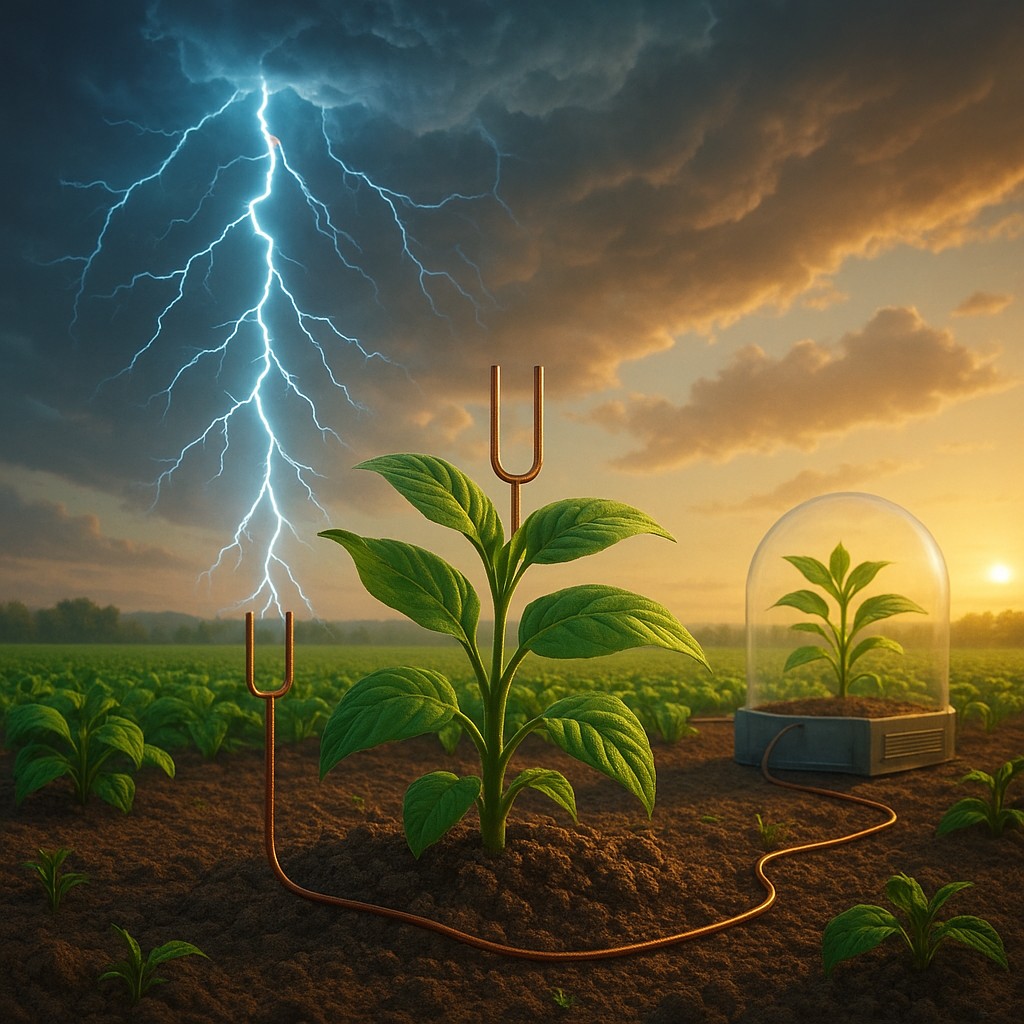
For years, we have treated the farm like a giant, slow-moving chemistry set. We test for nitrogen, dump lime to fix the pH, and balance phosphorus levels as if the soil were a hungry mouth that only thrives on a diet of synthetic additives. While this focus on chemicals has certainly helped us produce more calories, it often overlooks a vital fact: every plant is a living antenna. Farmers have long noticed that after a heavy thunderstorm, crops explode with a vibrant green growth that seems much stronger than what a simple watering should produce. While some of this comes from nitrogen created by lightning, a growing body of research suggests that the electricity in the atmosphere itself may play a much bigger role in plant health than we ever realized.
This is the world of electro-culture, a field moving out of the fringe and into the serious light of modern agricultural labs. The core idea is simple yet groundbreaking: instead of just managing atoms in the dirt, we can manage the flow of electrons. Researchers are using basic tools like copper antennas or buried wires to catch the natural voltage that exists between the earth and the sky. They are finding ways to jump-start a plant’s metabolism without using a single pound of urea fertilizer. This shift moves us from seeing a farm as a stagnant chemical site to seeing it as a live electrical circuit, where the right spark can wake up nutrient pathways that have been dormant for decades.
The Invisible Current Connecting Soil to Sky
To understand how electro-culture works, we have to recognize the massive battery we live inside. Our planet has a negative charge, while the upper atmosphere is positively charged. This creates a vertical electric field that exists even on a perfectly sunny day. Typically, this field measures about 100 to 150 volts per meter near the ground. Most plants grow right in the middle of this field and have spent millions of years evolving to interact with it. Scientists are now studying how "passive" antennas, usually made of copper or zinc, can concentrate this atmospheric electricity and pipe it down to a crop’s roots.
The process centers on the movement of ions, which are simply atoms or molecules with an electrical charge. Most of the nutrients a plant needs, such as potassium, calcium, and magnesium, stay in the soil as positively charged ions. When an antenna creates a subtle electrical pull in the dirt, it acts like a tiny magnet, drawing these nutrients toward the root hairs. This is not about shocking a plant with high-voltage electricity, which would kill it. Instead, it creates a gentle "electrical breeze" that helps minerals move naturally. When ions move more efficiently, the plant spends less energy hunting for food and more energy growing leaves, flowers, and fruit.
Upgrading the Cellular Engine Through Ion Signaling
If the soil is the circuit board, the plant’s internal cells are the processor. Plants do not have nervous systems like humans, but they use something very similar: electrical signaling. When a bug attacks or a drought hits, a plant sends quick electrical pulses through its tissues to trigger its defenses. Electro-culture techniques seem to tap into this system by stimulating "voltage-gated" channels in the plant's cell walls. These channels act like small security gates that only open when they detect a specific electrical charge.
When these gates open, the plant can soak up water and minerals much faster. Studies on Arabidopsis thaliana, a common plant used in labs, show that low-voltage fields can speed up the mitochondria, which are the powerhouses of the cell. A faster metabolism means the plant grows quicker, finishes sooner, and often develops a thicker cuticle-the waxy outer layer of the leaf that guards against pests. By mimicking the electrical charge of the air after a storm, we are essentially telling the plant's cells to shift into high gear.
Distinguishing Science from Folklore and Misconceptions
As with any technology that sounds a bit like magic, electro-culture has its share of myths. It is important to separate high-voltage "electrocultivation," which uses power outlets to create intense fields, from the "passive" atmospheric systems gaining popularity today. Some old theories claimed that sticking a copper rod in the ground would double your harvest overnight. While copper is a great conductor, modern research shows that the direction, height, and material of the antenna are what actually matter. You cannot just drop a penny in a pot and expect a giant beanstalk.
Another common mistake is thinking electro-culture can replace healthy soil. Electricity is a catalyst, not a food. If your soil has no organic matter or minerals, no amount of electricity will help because there are no ions left to move. Think of it like a turbocharger on a car; the turbo makes the engine more efficient, but you still need gas in the tank to move. The goal of modern trials is to see if these electrical methods can lower our need for fertilizer by making the nutrients already in the ground easier for the plant to use.
A Comparison of Traditional and Electric Agricultural Inputs
To understand how this fits into farming, it helps to compare the traditional chemical method with the new energetic model. While they can work together, they represent two very different ways of looking at the land.
| Feature |
Chemical Agriculture (Status Quo) |
Electro-Culture (Emerging) |
| Primary Driver |
Synthetic nutrients (NPK) |
Ion movement and atmospheric charge |
| Environmental Impact |
Risk of runoff and acidic soil |
Tiny physical footprint; no chemical residue |
| Speed of Action |
Fast but temporary |
Slow and steady through the growing season |
| Soil Biology |
Can hurt soil microbes if overused |
Mainly affects the physical movement of ions |
| Equipment Cost |
High, repeated costs for sprays |
Initial cost for antennas; very low upkeep |
| Mechanism |
Adding physical matter to the system |
Realigning natural energy forces |
Harvesting the Wind of Electrons
Researchers are currently testing two main ways to use this technology. The first is the "Lakhovsky Coil," an open-ended copper loop placed around the base of a tree or plant. These coils are designed to catch ambient radio frequencies and create a localized field that protects the plant from stress. While the data is still coming in, early reports from vineyards suggest these coils may help vines fight off fungus by boosting the plant’s natural immune signals.
The second method uses tall, mast-like antennas connected to galvanized wires buried about six inches underground. These masts act like lightning rods in slow motion, pulling a positive charge from the air and spreading it through the roots of an entire row of crops. Because the current is so weak, humans and animals can't feel it, but to a microscopic root, it is a major signal from the environment. One of the most exciting parts of this system is the potential for "precision energetics," where specific voltages could be tuned to help a crop fight off a local pest or survive a sudden freeze.
The Future of the Energetic Farm
We are on the edge of a new era where the farm is no longer a silent chemical factory, but a vibrant, living landscape. If these trials continue to succeed, the results could be life-changing. We might see a world where the heavy tractors used to spray tons of fertilizer are replaced by simple, permanent structures that harvest the air we breathe. This isn’t just about growing bigger tomatoes; it is about bringing our food systems back in line with the natural laws of the planet.
By learning the electrical language of plants, we can support life with a much lighter touch. It requires us to be more than just technicians; it asks us to observe the subtle forces that have ruled the earth for ages. When you look at a field or a small garden, try to imagine the invisible threads of energy connecting every leaf to the sky. The next big revolution in farming might not come from a new lab-made molecule, but from the simple hum of the atmosphere, waiting for us to finally plug in.