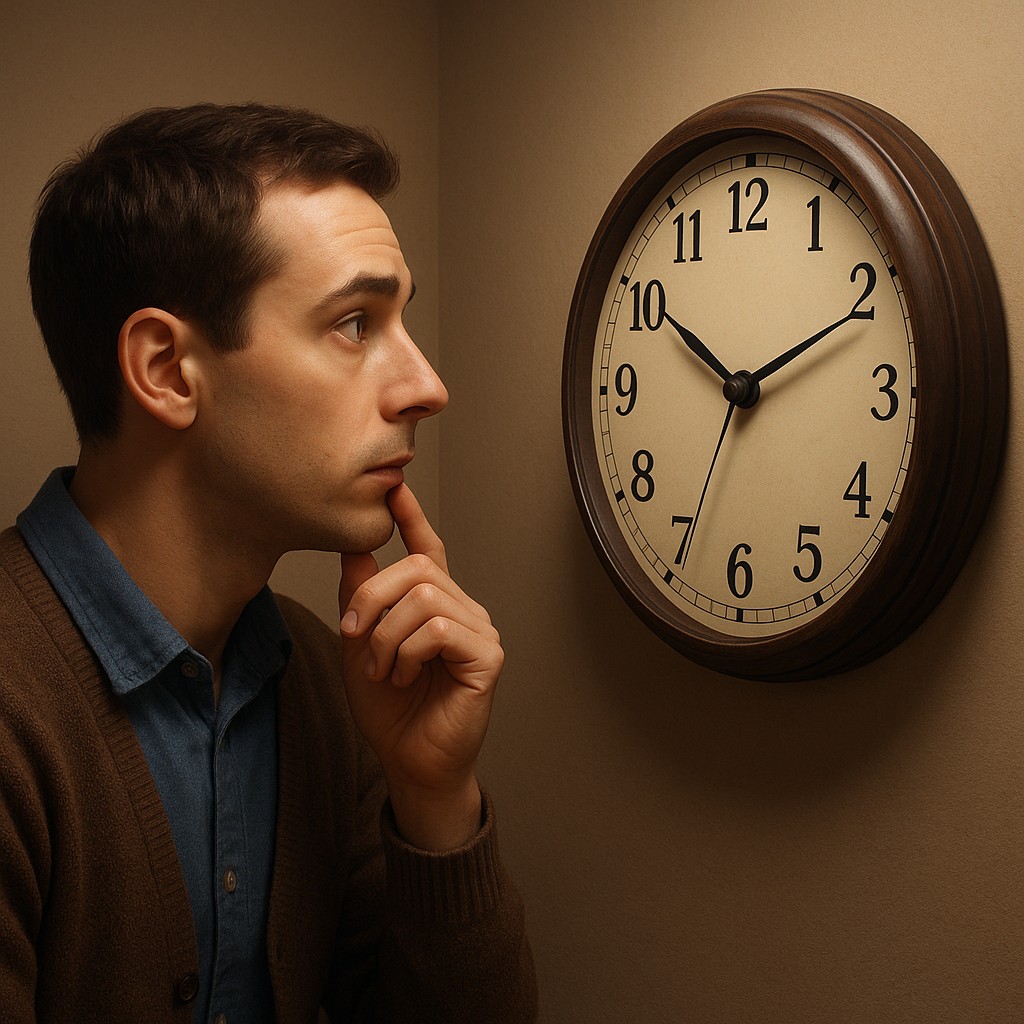
Imagine you are sitting in a quiet room, perhaps at a doctor’s office or a library, where the only sound is the rhythmic, mechanical heartbeat of an analog clock. You decide to check the time, glancing quickly at the second hand as it sweeps across the dial. For a fleeting moment, something impossible happens: the second hand seems to freeze. It hangs there, suspended in a moment of defiance against the laws of physics, before finally twitching forward to the next notch. You might brush it off as a trick of the light or a dying battery, but you have actually just experienced a momentary glitch in how your brain perceives reality.
This phenomenon, known as the "stopped-clock illusion" or chronostasis, is not a failure of your eyes, but rather a masterpiece of mental editing. Your brain is a masterful storyteller that prioritizes a smooth narrative over raw, messy data. Every time you shift your gaze, your brain effectively chops out a segment of time and replaces it with a "pre-rendered" image to hide the blur of movement. You are living in a world that is constantly being photoshopped in real time. For a few milliseconds every day, you are technically a time traveler, experiencing the present as if it started slightly earlier than it actually did.
The Mechanical Jump of the Human Eye
To understand why time seems to stand still, we first have to look at the physical limits of our biological hardware. Unlike a high-end cinema camera mounted on a steady stabilizer, our eyes do not move smoothly when they scan a room. Instead, they perform what neuroscientists call "saccades." These are rapid, jerky jumps that occur several times every second. If your brain actually processed the visual information during these jumps, your life would look like the most nauseating "shaky cam" footage from a low-budget horror movie. Everything would be a smear of indistinguishable colors and shapes as your retinas whipped across the landscape.
To protect you from this dizzying reality, your brain employs a tactic called saccadic suppression. Essentially, the moment your brain sends the command to move your eye muscles, it also hits the "mute" button on your visual processing center. During that jump, which lasts anywhere from 20 to 200 milliseconds, you are functionally blind. Because these jumps happen so frequently, you are actually "in the dark" for a significant portion of your waking life. If you added up every jump you make in a single day, you would find that you spend about 40 minutes to an hour in total darkness, existing in a series of tiny blackouts that you never even notice.
The Seamless Edit of Reality After a Move
Now, 40 minutes of blindness per day sounds like a terrifying way to live. If our brains simply left those gaps empty, our vision would feel like a strobe light at a dance club, full of disconnected snapshots. This is where the brain’s creative department steps in. To maintain the illusion of a continuous, stable world, the brain performs a trick called temporal extension. When your eye finally lands on its new target, the brain takes the first clear image it receives and "stretches" it backward in time to fill the gap created by the eye movement.
Imagine a film editor who realizes there is a one-second hole in a movie. Instead of leaving a black screen, the editor takes the very next frame and pulls it back to cover the hole. When you look at the clock, your brain sees the second hand at the "12" position. It then realizes you were blind for a tenth of a second while your eyes moved. To fix this, it tells your conscious mind, "You have been looking at that '12' for the last 1.1 seconds," even though you have only actually seen it for 1.0 second. This "back-dating" of visual information is why that first second always feels unnaturally long. Your brain is lying to you about when you started looking at the object to make sure there are no holes in your memory of the event.
Why We Do Not Notice the Stitching
You might wonder why we do not notice this constant tinkering in other areas of life. The reason the clock is the perfect laboratory for this illusion is because it provides a precise, rhythmic pulse. Most of the things we look at are still or move in unpredictable ways. When you glance at a coffee mug, your brain performs the same time-stretch, but because the mug isn't moving, you have no way of knowing that the first moment you looked at it was artificially lengthened. There is no "tick" to give the game away.
The clock acts as a biological whistleblower. Because we have an internal expectation of how long a second should last, the brain's attempt to fill the visual gap becomes obvious. This phenomenon is a subset of a broader neurological concept known as "chronostasis," which covers various ways our perception of time can be distorted by our own movements or sensory inputs. It is a reminder that "time" as we experience it is not a direct recording of the universe, but a highly processed simulation designed for survival and stability.
Distinguishing Rapid Jumps from Smooth Tracking
It is important to note that this "editing" only happens during those rapid, jerky jumps. Your brain treats different types of eye movements with different sets of rules. If you are watching a bird fly across the sky or following a tennis ball during a match, your eyes perform "smooth pursuit." In this mode, your eyes are locked onto a moving target, and the brain does not need to block the visual feed because there is no jumpy blur to hide.
| Feature |
Saccadic Movement (Jumps) |
Smooth Pursuit (Tracking) |
| Movement Style |
Rapid, sharp jumps from point A to point B. |
Slow, continuous tracking of a moving object. |
| Visual Feed |
Temporarily blocked (Saccadic Suppression). |
Active and continuous throughout the movement. |
| Time Perception |
Prone to chronostasis (the "stopped-clock" effect). |
Generally accurate and steady. |
| Common Example |
Scanning a page of text or glancing at a clock. |
Watching a car drive past or a bird in flight. |
| The "Glitch" |
The first moment appears stretched or frozen. |
No flickering or frozen moments. |
The Survival Advantage of a Stable World
From an evolutionary standpoint, this level of deception is actually a massive advantage. If our ancestors had to deal with a visual field that blurred and smeared every time they scanned the treeline for a predator, they would have been much slower to react. By "deleting" the blur and "filling in" the gap with the most recent relevant information, the brain ensures that the world remains a solid, dependable place. It prioritizes the stability of objects over the absolute accuracy of the timeline.
This mechanism also helps us stay oriented in space. If the brain did not link the "new" image with the "old" time gap, we might feel a constant sense of motion sickness or confusion as we moved our eyes. The brain’s ability to "backfill" the image ensures that when your eyes land, your internal map of the world is already updated and ready for action. You aren't just seeing the world; you are experiencing a polished, high-definition broadcast that has been edited for maximum clarity and safety.
Correcting Myths About Visual Perception
A common misconception is that the human eye behaves like a digital camera, capturing frames at a set rate, such as 60 frames per second. In reality, the eye and brain do not work on a frame-based system at all. Our visual system is a complex network of "change detectors." When nothing changes, the brain actually starts to tune out the information. The stopped-clock illusion is proof that our sense of time is a construction produced by the brain, rather than a direct measurement of the environment.
Another myth is that our "peripheral vision" is as detailed as our central vision. This isn't true; our central vision (the fovea, or the center of the retina) is the only part of the eye capable of high-detail processing. This is exactly why we have to jump our eyes around in the first place. We are constantly moving our high-resolution "spotlight" around to build a full image of our surroundings. The stopped-clock illusion is just the price we pay for having a high-resolution central sensor and a brain that refuses to show us the "behind the scenes" work of moving that sensor around.
The Theater of the Mind
The next time you catch a clock standing still, don't think of it as a mistake. Instead, recognize it as a rare glimpse into the complex machinery of your own consciousness. We often think of our senses as windows to the world, but they are more like a team of editors, artists, and directors working tirelessly behind a curtain. They take the chaotic, fragmented pulses of light hitting your retinas and weave them into a magnificent, seamless tapestry.
Understanding the stopped-clock illusion changes how you perceive your own reality. It teaches you that what you "see" is often a clever guess, and what you "feel" as time is a flexible, living thing. You are not a passive observer of the world; you are an active creator of it. Every blink, every glance, and every heartbeat is a testament to the incredible processing power of the human brain, turning the messy static of the universe into a beautiful, coherent story. Embrace the "glitch" - it is the only reason the world makes sense at all.