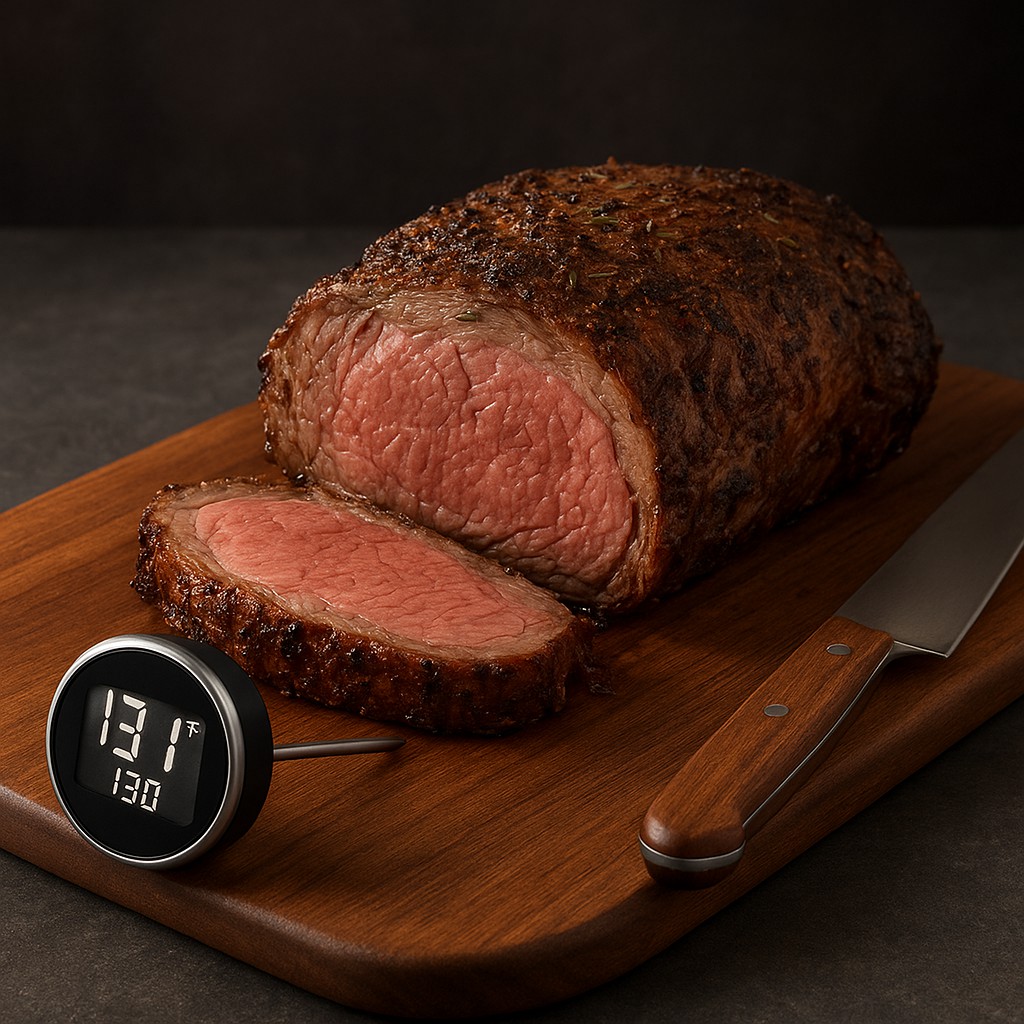
Imagine you have just spent three hours carefully preparing a prime rib roast. You followed the recipe to the letter, watched the oven temperature like a hawk, and finally pulled that glistening, herb-crusted masterpiece out of the heat the second your digital thermometer hit the target. You are ready to carve, certain that a perfect medium-rare center is waiting for you. Yet, ten minutes later, as you slice into the meat, you aren't greeted by a warm pink center, but by a dull, overcooked gray. You feel cheated by your tools and your own eyes, wondering how a roast that looked perfect ten minutes ago could ruin itself while simply sitting on a cutting board.
The culprit isn't your oven or a broken thermometer. It is a relentless law of physics known as carryover cooking. It is the culinary version of a car coasting uphill after you take your foot off the gas. Even though the heat source is gone, the energy already stored inside the food keeps moving, shifting and vibrating through the fibers of the meat. Understanding this invisible migration of heat is what separates a lucky home cook from a consistent, confident chef. It is the final, silent stage of the cooking process that most people ignore, yet it is likely the most important step in getting the texture just right.
The Invisible Migration of Heat
To understand why food keeps cooking after it leaves the pan, we have to look at what is happening at the molecular level. When you roast a chicken or sear a steak, the heat moves from the outside in. The surface of the meat is hit by the intense energy of the oven air or the scorching metal of the skillet. This causes those outer layers to reach temperatures far higher than the final goal for the center. In a 400-degree oven, the crust of your roast might be pushing 300 degrees, while the very center is still a cool 100 degrees. This creates a massive temperature gap, a kind of thermal pressure where the heat is desperate to find a balance.
Once you take the meat away from the heat, that intense energy on the outside doesn't just vanish. While some heat escapes into the room, a large portion keeps traveling toward the colder center. This is "conductive heat transfer" in its purest form. The molecules on the outside are vibrating wildly, and they bump into their calmer neighbors further inside, passing that energy along. Because the center of the meat is so much cooler than the surface, it acts like a sponge, soaking up the leftover heat from the outer rings. This process continues until the temperature across the entire piece of meat begins to level out, often raising the core temperature by a surprising amount.
Predicting the Heat Spike
The amount of carryover cooking you can expect isn't a fixed number; it depends on the laws of physics. Size and density are the main drivers here. A thin skirt steak has very little mass and a lot of surface area, meaning it loses most of its heat to the air almost instantly. On the other hand, a massive Tomahawk ribeye or a whole Thanksgiving turkey has a dense core and a huge amount of hot exterior meat. These larger items act like thermal batteries, holding onto so much energy that they will push the internal temperature upward for twenty minutes or more after they leave the oven.
The cooking temperature also plays a major role in how much the internal heat will climb. If you are roasting a brisket "low and slow" at 225 degrees, the heat difference between the outside and the inside of the meat is relatively small. In this case, you might only see a three-degree rise while the meat rests. However, if you are blasting a roast at 450 degrees to get a dark crust, the exterior is much hotter than the interior. This steep cliff in temperature creates a more aggressive move toward the center, potentially spiking the internal temperature by ten or even fifteen degrees. Professional cooks learn to pull food early by watching not just the current temperature, but the intensity of the heat they are using.
Mastering the "Early Pull"
Since we know the temperature will rise, the logical fix is to stop cooking before the food actually looks "done." This is known as the "early pull," and it takes a bit of courage if you aren't used to it. It feels wrong to take a chicken out of the oven when the thermometer reads 155 degrees if you know the safe target is 165 degrees. However, if that chicken is a whole bird, that ten-degree gap is exactly what carryover cooking will fill while the bird rests on the counter for fifteen minutes. Pulling it at 165 degrees almost guarantees a final result of 175 degrees, which is the point where breast meat starts to taste like dry cardboard.
The following table provides a general guide for how much the temperature will rise based on the size of the food and the cooking method. Keep in mind that these are estimates, and factors like whether the meat has a bone in it can also change how fast heat moves.
| Food Type |
Cooking Method |
Estimated Temp Rise |
Recommended Pull Temp |
| Small Steaks / Chops |
High Heat Searing |
3 to 5 degrees |
125°F for Medium-Rare |
| Large Roasts / Whole Birds |
Standard Roasting |
7 to 10 degrees |
120°F (Beef) / 155°F (Poultry) |
| Dense Vegetables (Squash) |
High Heat Roasting |
5 to 7 degrees |
Just before fork-tender |
| Casseroles / Lasagna |
Baking |
5 degrees |
When edges are bubbling |
Why Resting Keeps Meat Juicy
While carryover cooking is usually discussed in terms of temperature, it is also tied to "resting" the meat. For years, people thought resting allowed the muscle fibers to relax and soak up juices. While modern science suggests the "soaking up" part might be an exaggeration, resting is still vital because it lets the temperatures balance out. When you cut into a steak right after it leaves the pan, the outer layers are still under high heat stress and the center is still getting hotter. This creates high pressure that forces juices out of the fibers the second the knife breaks the surface.
By letting the carryover process finish, you are essentially letting the meat reach a state of peace. As the temperature evens out, the internal pressure drops, and the proteins become less tight. This means that when you finally slice into the roast, the moisture stays inside the meat cells rather than flooding the cutting board. Furthermore, carryover cooking ensures the heat is spread evenly. Without it, you might have a roast that is overcooked on the edges and raw in the middle. With it, you get beautiful, edge-to-edge color, which is the mark of a great chef.
Common Mistakes and Myths
One of the biggest myths about carryover cooking is that it only applies to meat. In reality, any dense food follows this law. Large potatoes, thick cauliflower steaks, and even heavy cakes keep baking after they leave the oven. If you have ever pulled a tray of cookies out when they looked "just right," only to find them hard and crunchy twenty minutes later, you have seen carryover baking in action. The heat in the baking sheet and the dough itself finished the job on the counter. To get soft, chewy cookies, you must remove them while they still look slightly underbaked.
Another mistake is "tenting" food too tightly with foil. While a loose piece of foil can keep a roast from cooling too fast in a drafty kitchen, wrapping it tightly can trap too much steam and make the temperature shoot up past your control. This can lead to a "runaway" effect where the temperature climbs much higher than you wanted, and the crust loses its crispiness. The goal of resting is to let the heat move inward at a natural pace, not to create a mini-sauna that steams the outside of the food.
Thinking Like a Chef
To truly master carryover cooking, you need to start including the "counter time" in your total cooking time. If a recipe says a roast takes sixty minutes, you should think of it as forty-five minutes of active heat and fifteen minutes of carryover. This shift in perspective changes how you handle every meal. You stop just watching a timer and start managing energy. You begin to notice the smell of the browning fat and the way the meat pushes back against a gentle poke. You use these signs along with your thermometer to find the perfect moment to turn off the flame.
Embracing this hidden phase of cooking is an act of trust in physics. It requires the discipline to walk away when the job is "almost" done, knowing that the laws of nature will finish the work for you. When you master the timing of the early pull, your dinners will be juicier, your textures will be better, and your stress in the kitchen will vanish. You are no longer fighting the heat; you are working with it, using the very energy that cooks your food to perfect it in the quiet moments before it hits the plate. Burners and ovens are powerful tools, but the silent move of leftover heat is the secret ingredient in every legendary meal.