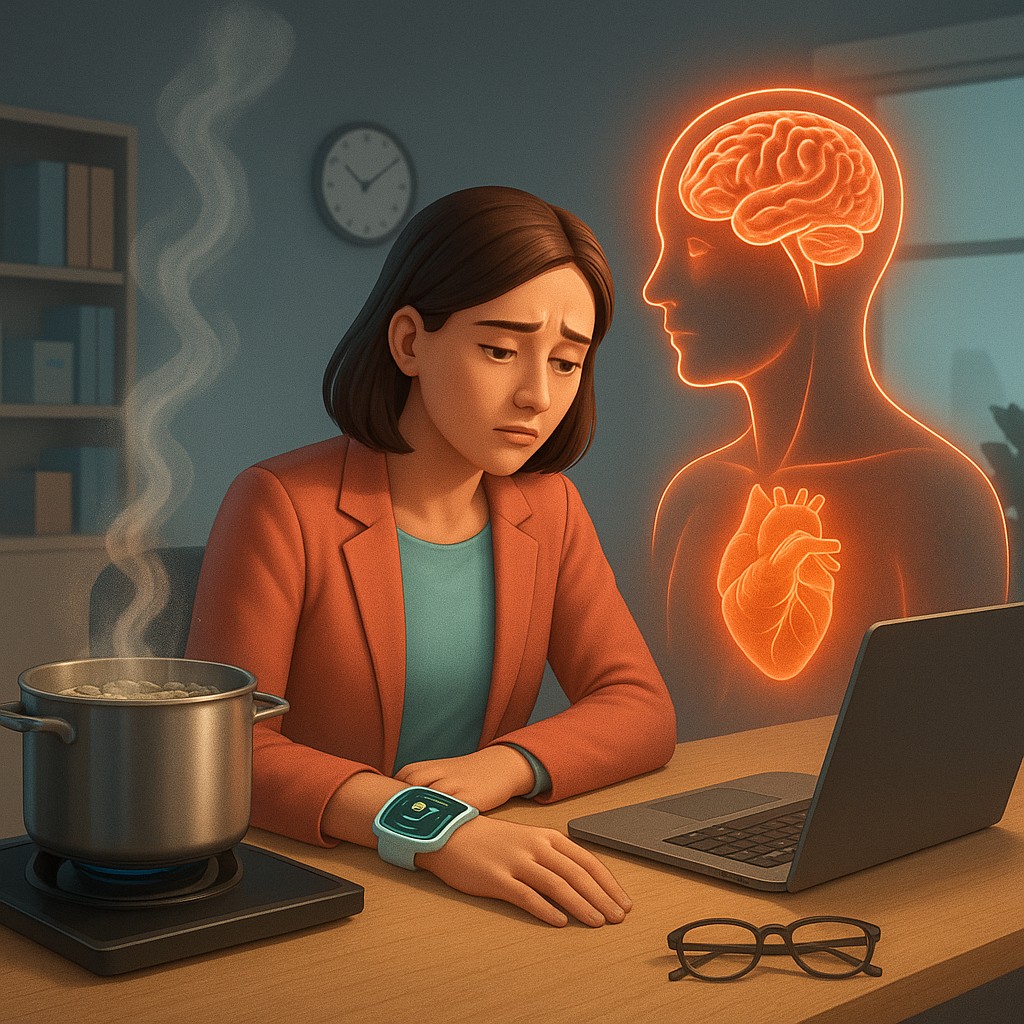
Imagine standing in a kitchen where a pot of water is slowly coming to a boil. According to an old bit of folk wisdom, a frog dropped into that pot wouldn't notice the creeping rise in temperature until it was too late. While that is biologically doubtful for real frogs, it serves as a perfect metaphor for the modern office. We sit at our desks answering a relentless stream of notifications, hitting high-stakes deadlines, and navigating office politics while our internal "temperature" rises. Over time, we stop noticing the heat. we call it "being a professional" or "powering through," but biologically, we are entering a state of dissociation where the brain learns to ignore the frantic alarms of the nervous system.
This disconnect isn't just a mental quirk; it is a survival mechanism that has outstayed its welcome. Under constant pressure, your body stays on high alert, but your conscious mind becomes numb to the physical signs of stress, like a racing heart or shallow breathing. You might feel "fine" right up until the moment you snap at a colleague, lose your focus, or burn out completely. To fight this, public health agencies are experimenting with a digital tether to reality. By using wearable sensors, they are helping workers bridge the gap between what they think they feel and what their bodies are actually going through.
The Invisible Engine of the Autonomic Nervous System
To understand how a wristband can know more about your mood than your own brain, we have to look under the hood at the Autonomic Nervous System (ANS). The ANS is the body’s automatic control center, managing everything from digestion to your pupils dilating without you ever asking. It is split into two main branches that act like a gas pedal and a brake. The Sympathetic Nervous System (SNS) is the gas pedal, responsible for the fight-or-flight response. It floods your system with cortisol and adrenaline, prepping you to either fight off a predator or hit "Send" on a scary email.
The counterpart is the Parasympathetic Nervous System (PNS), or the brake. This is the "rest and digest" system that calms you down, lowers your heart rate, and lets your body recover. In a healthy person, these two systems dance back and forth throughout the day. However, in high-pressure jobs, the gas pedal often gets stuck to the floor. Because you can't actually run away from a spreadsheet, that physical energy has nowhere to go. It sits in the body as chronic tension that the brain eventually tunes out as background noise, much like the hum of an air conditioner.
Biofeedback technology works by tapping into this engine. By measuring specific electrical and rhythmic signals, these devices can detect exactly how hard your "engine" is revving. They don't need you to say you are stressed; they can see it in how your sweat glands behave and how your heart fluctuates between beats. This data acts as an objective mirror, reflecting a physical reality that your conscious mind might be too distracted to notice. It effectively ends the era of saying "I’m not stressed, I’m just busy" by proving that, on a cellular level, your body disagrees.
Deciphering the Language of Skin and Heart
The two main metrics used in these biofeedback programs are Heart Rate Variability (HRV) and Electrodermal Activity (EDA), also known as skin conductance. Most people know what heart rate is, but HRV tells a much more detailed story. Contrary to what you might think, a healthy heart does not beat like a perfectly timed metronome. There are tiny, millisecond variations in the time between beats. When you are relaxed and your "brake" (the PNS) is working, your HRV is high, meaning there is a lot of variation. When you are stressed and the "gas" (the SNS) takes over, your heart rate becomes very rigid and robotic, leading to low HRV.
Skin conductance, or EDA, measures the electrical properties of your skin. When your fight-or-flight response kicks in, your sweat glands become more active. Even if you aren't "sweating" in the obvious way you would at the gym, the moisture on your skin increases, which allows electricity to flow more easily. Wearable sensors detect these tiny changes. Because the sweat glands are directly controlled by the stress response, EDA acts like a real-time thermometer for your emotions.
| Metric |
Focus of Measurement |
What a High Reading Means |
What a Low Reading Means |
| Heart Rate (BPM) |
Total beats per minute |
Heavy exertion or sharp stress |
Rest, recovery, or sleep |
| Heart Rate Variability |
Millisecond gaps between beats |
High resilience and relaxation |
High stress or poor recovery |
| Skin Conductance |
Electrical activity via moisture |
Active "Fight-or-Flight" state |
Calm, baseline state |
| Respiration Rate |
Breaths per minute |
Potential anxiety or effort |
Deep relaxation or focus |
By combining these two streams of data, public health experts can map a worker's nervous system. If a nurse in an Emergency Room has a sudden spike in skin moisture and a simultaneous drop in heart variability, the device can send a "haptic alert," which is a gentle vibration on the wrist. This isn't a medical diagnosis; it's a nudge. It invites the wearer to pause and check in with themselves. It breaks the cycle of tuning out by forcing the mind to acknowledge that the body is nearing its boiling point.
Moving From Reaction to Proactive Calibration
The traditional approach to mental health at work has been reactive. We wait for the "check engine" light to come on, which usually looks like a breakdown, chronic illness, or a resignation letter. Once the damage is done, we try to fix it with therapy, medication, or long leaves of absence. While these are vital, they happen after the nervous system has already suffered heavy wear and tear. Biofeedback shifts the strategy toward proactive management, allowing for small resets that prevent the "engine" from overheating in the first place.
When a wearable device warns a user that their stress is peaking, it offers a window of opportunity. This is the moment for "vagal toning" or controlled breathing. By taking just ninety seconds to perform "box breathing" - inhaling, holding, exhaling, and holding for four seconds each - a worker can manually pull the brake on their nervous system. This is essentially "hacking" the brain. Because the heart and lungs are so closely tied to the brain's emotional centers, changing your breathing sends a physical signal that the danger has passed.
This shift turns the worker from a passive victim into an active manager of their own biology. Instead of waiting for a weekend or a vacation to recover, people can reset their stress levels multiple times a day. It is the difference between letting a fire rage until the fire department arrives and using an extinguisher the moment a spark hits the rug. Over months, these tiny resets prevent the buildup of "allostatic load," which is the scientific term for the physical cost of being exposed to chronic stress.
The Human Element in a Data-Driven World
While these sensors are incredibly sensitive, they have one major limit: they don't know the context. A device can tell you that your nervous system is revving high, but it can't tell you why. Your heart rate and skin conductance might spike because you are about to give a big presentation, but they could also spike because you just had a third cup of coffee or because you're excited about a fun weekend trip. High arousal isn't always "bad" stress; it is simply a state of readiness.
This is where the user's own input becomes the most important part of the puzzle. Technology provides the "what," but the human provides the "why." Programs using these trackers usually encourage users to label their data. When an alert goes off, the user might note "Stuck in traffic" or "Argument with boss." Over time, this helps a person find their personal triggers. It might reveal that certain meetings cause a massive physical spike that the person hadn't consciously noticed.
This partnership between human intuition and machine precision helps clear up myths about stress. We often think stress is purely a "mind over matter" issue, but biofeedback proves it is "matter over mind." If your body is in fight-or-flight mode, no amount of positive thinking will instantly lower your stress hormones. You have to use physical tools to solve a physical problem. By adding context to the data, workers learn the difference between "eustress" (good stress that helps us perform) and "distress" (the draining stress that leads to burnout).
Navigating the Ethics of the Quantified Workplace
Using these technologies in the workplace brings up tough ethical questions. If an employer can see your stress levels, will they use that info to help you, or to decide you aren't "tough" enough for a promotion? Privacy is the biggest concern. For these programs to work, the data must stay with the employee rather than the HR department. The goal is self-control, not company surveillance.
Another risk is "data anxiety." Some people might get so obsessed with their scores that monitoring their stress actually becomes a new source of stress. This creates a loop: a poor score makes the person worry, which makes the score even worse. Education is the key here. Workers need to know that physical fluctuations are normal. The goal isn't to be perfectly calm all day, but to make sure the body knows how to return to normal after a spike.
When done right, with strict privacy and an emphasis on personal power, biofeedback represents a massive shift in public health. It moves the conversation away from vague ideas like "self-care" and toward concrete, measurable health. This is especially vital for "front-line" roles, like doctors, firefighters, and social workers, who are at the highest risk for tuning out their own needs. For these people, the ability to see their stress before it blindsides them is more than just a productivity hack; it's a tool for survival.
Stepping Into a More Attuned Future
We are moving past the era where "burnout" is seen as a badge of honor or an unavoidable side effect of success. As biofeedback technology becomes smaller and easier to use, we have the chance to reclaim our connection to our physical selves. We no longer have to be the frog in the boiling pot, unaware of the heat until we are exhausted. Instead, we can control our own internal climate, using real-time data to navigate work with grace and resilience.
Embracing this technology means accepting a simple truth: your body often knows you are struggling before your mind does. By listening to those invisible signals, you gain the power to step in, breathe, and reset. This is the future of mental health - a world where we don't just wait for a breakdown, but instead manage the hum of our nervous systems with care. As you go about your day, remember that your biology is talking to you. Whether through a vibrating wristband or the simple feel of your own breath, the goal is the same: to stay present and stay human in a high-speed world.