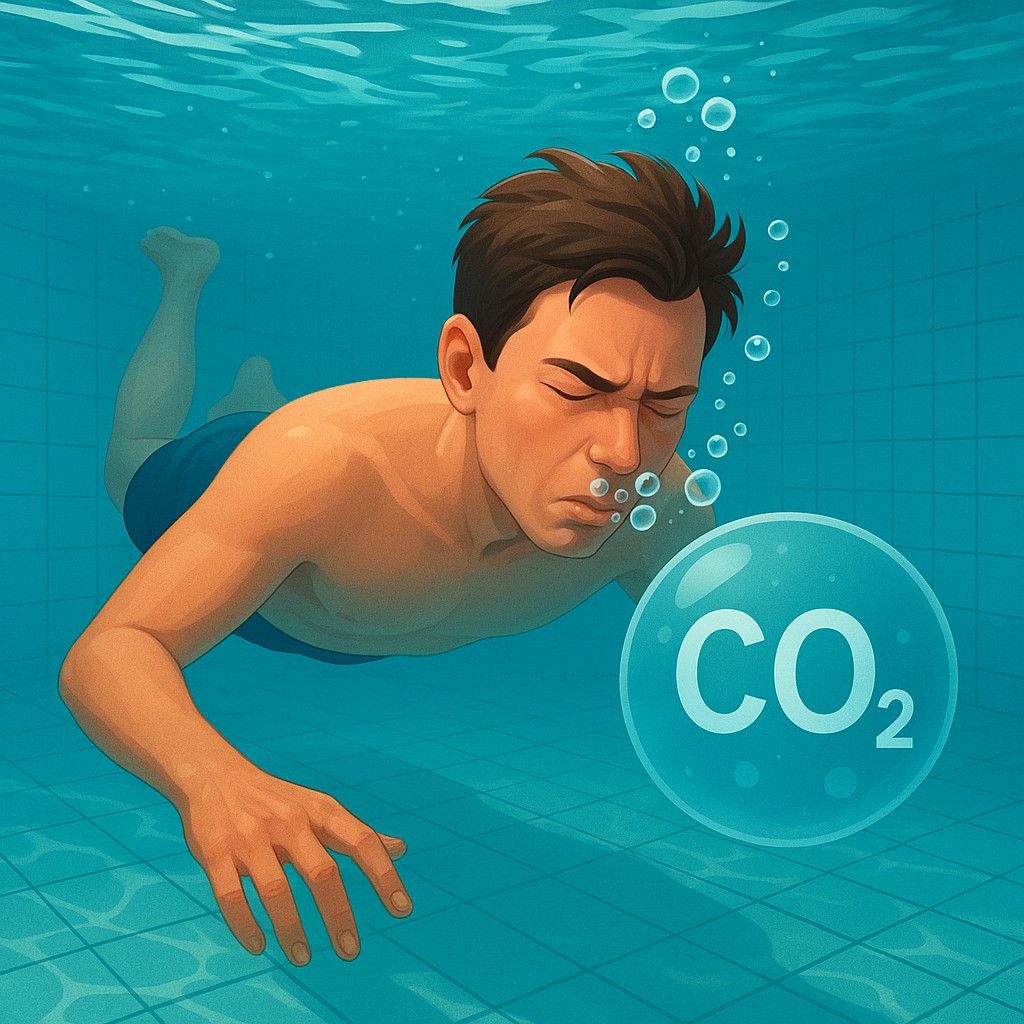
Imagine you are floating in the calm, blue water of a swimming pool, holding your breath as you sink toward the bottom. Around the forty-second mark, a persistent, uncomfortable squeezing starts to tighten in your chest and throat. Your brain screams at you to surface, insisting that your tank is empty and that every passing second brings you closer to suffocation. It is the most primal, persuasive urge you have ever felt, and yet, your interpretation of that feeling is almost entirely wrong.
Most of us grow up believing that we breathe in response to a lack of oxygen. This seems logical, as we need oxygen to survive. However, the human respiratory system is driven by a much more creative, nuanced chemical process. You are not feeling the absence of fuel, but rather the buildup of toxic exhaust. Understanding the balance between carbon dioxide management and oxygen usage is not just a scientific curiosity, it is a crucial piece of knowledge that could save your life if you are ever in the water.
The Chemistry of the Internal Alarm System
To understand why you gasp for air, we must look past your lungs and into the complex chemical bath of your bloodstream. When your cells use oxygen, they produce carbon dioxide as a waste product. This gas does not just sit in your blood as a passive passenger. Instead, it reacts with water molecules in your plasma to form a compound called carbonic acid. As the concentration of CO2 increases, the pH level of your blood drops, making the environment more acidic.
Your brain is incredibly sensitive to these microscopic changes in acidity. Located in the brainstem, specialized sensors called central chemoreceptors act as vigilant environmental monitors. When the pH shifts toward the acidic side of the scale, these sensors send a high-priority signal to your diaphragm and the muscles between your ribs. The message is simple and non-negotiable: clear the system, immediately. The frantic urge to breathe is simply your body trying to restore its delicate acid-base balance, not a panic-stricken reaction to a stalled engine.
Decoding the Oxygen Paradox
This system feels like an oxygen-deficiency alarm because, under normal circumstances, carbon dioxide and oxygen levels are linked. When you are active, your muscles burn oxygen and produce CO2 at predictable, relative rates. As you hold your breath, CO2 rises and oxygen falls in tandem. Therefore, the body's alarm system - which triggers based on CO2 - almost always fires while you still have plenty of oxygen left. Evolution designed us to be safe, creating a massive buffer of oxygen that remains in your lungs even when the initial urge to breathe hits.
However, this connection breaks down when you manipulate your breathing, such as by hyperventilating before diving. When you breathe rapidly and deeply before submerging, you effectively scrub your blood of its carbon dioxide. Because your internal alarm is calibrated to CO2, you are essentially silencing your own smoke detector. When you enter the water, your CO2 levels start from a deficit, meaning it will take much longer for them to climb back to the danger threshold that triggers the urge to breathe.
During this extended silence, your body is quietly burning through its oxygen store. By the time the CO2 buildup is finally high enough to trigger the urge to inhale, your oxygen levels might have already plummeted to a point where brain function is compromised. This is the physiological trap that causes shallow-water blackouts. The swimmer feels perfectly comfortable and in control, ignoring the lack of oxygen because they have broken the alarm system designed to keep them safe.
The Hierarchy of Chemical Cues
It is helpful to view the human body as having two safety systems for breathing. Most people focus on the secondary system, which involves peripheral chemoreceptors in the carotid arteries - blood vessels in your neck - that monitor oxygen. These are secondary because they are only meant for emergencies where oxygen drops drastically. They act as a backup if the primary system - the CO2-sensitive central chemoreceptors - fails to protect you.
The following table summarizes why these two systems operate differently and how they influence your behavior while holding your breath.
| Feature |
CO2 Sensors (Primary) |
Oxygen Sensors (Secondary) |
| Primary Goal |
Regulates blood pH levels |
Triggers in crisis or hypoxia |
| Sensory Location |
Brainstem (Central) |
Carotid arteries (Peripheral) |
| Typical Trigger |
Normal, daily activity |
Only during extreme lack of oxygen |
| Behavioral Result |
Urge to take a breath |
Impending blackout or collapse |
| Reliability |
Highly consistent |
Only engages at the edge of failure |
As shown in the table, the CO2 system is the regulatory system meant to keep your internal chemistry in the ideal zone. The oxygen system is the emergency system meant to prevent a total shutdown. By hyperventilating, you bypass the regulatory system, forcing the body to rely on the emergency system. The problem is that the emergency system is not designed to give you a polite reminder; it is designed to trigger a desperate, forced-gasp reaction that is often too late to prevent unconsciousness.
Strategies for Staying Smart and Safe
The most important takeaway for any swimmer or diver is that the ease of holding your breath is not a measure of your current oxygen levels. If you feel superhuman underwater, capable of holding your breath for much longer than usual, you are likely suffering from the very chemical imbalance that makes you vulnerable to shallow-water blackout. True safety requires listening to the body’s signals rather than trying to mute them to stay submerged a few seconds longer.
If you ever struggle to breathe, remember that your body is a sophisticated machine balancing a complex chemical equation. The urge to breathe is a gift, not a burden. It is a finely tuned alert system that understands the difference between running low on energy and running low on space for the byproducts of life. Trust that discomfort; it is your best biological tool for keeping your heart beating and your brain functioning.
Modern high-performance training often emphasizes recovery and efficiency, but in respiration, simplicity is key. When you allow your breathing to follow its natural, rhythmic cadence, you allow your brain to manage a continuous symphony of chemical checks and balances. Never try to game the system by thinning your CO2 levels to prolong a breath-hold, as the price for that extra time underwater is a gamble with your consciousness that is not worth taking.
Ultimately, your lungs are silent partners in a lifelong process of maintenance and movement. By respecting the way they communicate with your brain, you can move through the world and the water with a deeper sense of clarity. The next time you crave a giant breath of air after a long exertion, take a moment to admire the elegance of the process. You are witnessing a masterclass in biological engineering, where your brain, blood, and lungs work together to ensure you are always ready for the next moment of vitality. Keep your breathing steady, respect the alarm, and stay present in the rhythm of your own survival.