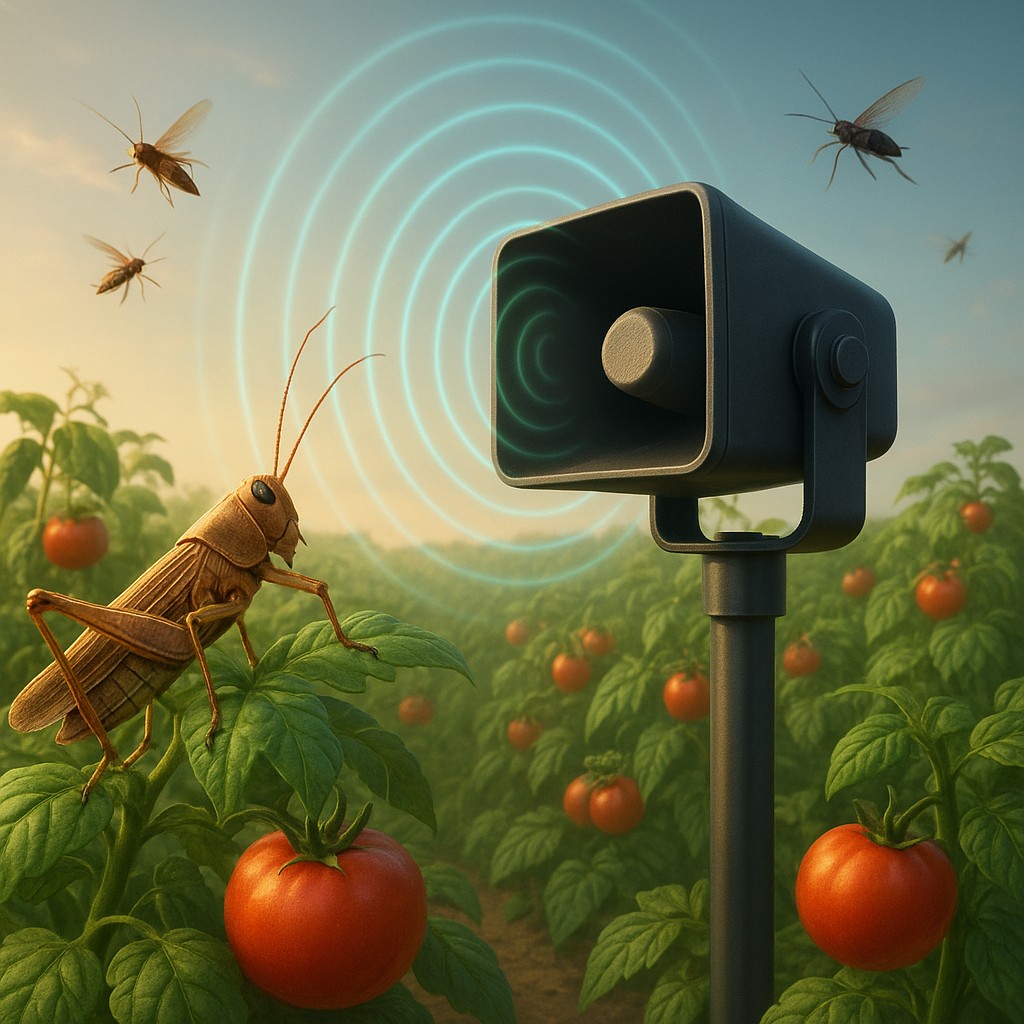
Imagine a warm summer evening on a vast farm, where the air is heavy with the scent of ripening tomatoes and the low, rhythmic hum of thousands of insects. To a casual observer, this sound is just the background music of nature. To the insects themselves, however, it is a busy social network filled with urgent personal ads, aggressive warnings to stay off their turf, and high-stakes romantic invitations. For decades, our primary way of stopping these insects from devouring our food has been chemical warfare. We douse fields in pesticides that work well but often take a heavy toll on helpful bees, soil health, and our own water systems.
But what if we could stop an infestation not by poisoning the insects, but simply by making it impossible for them to get a date? This is the core idea of a fascinating shift in agricultural science called biotremology. By understanding the specific rhythms insects use to talk to one another, researchers are now using vibrations and sound at different pitches to create a literal "wall of noise." This acoustic fog doesn't kill the insects directly. Instead, it makes the environment so loud and confusing that males and females can never find each other. Without successful mating, the population drops and the crops stay safe, all without spraying a single drop of nerve toxins.
The Secret Language of Shaking Leaves
When we think of insect sounds, we usually picture the loud chirps of crickets or the buzzing drone of cicadas. However, the vast majority of insect species communicate through vibrations that travel through solid objects. These are tiny tremors sent through the leaves and stems of plants. To a human, a grapevine might look perfectly still, but to a leafhopper or a stink bug, that vine is like a high-tech fiber-optic cable buzzing with information. These insects have incredibly sensitive sensors in their legs that can detect movements as small as the width of an atom. They use these vibrations to perform duets, where a male sends out a specific "pulse" and waits for a female to respond with a precise "click" of agreement.
This reliance on physics is the insect's greatest strength and its biggest weakness. Because these signals are so specific, like a secret handshake or a particular radio station, they are easy for researchers to identify and copy. By using contact transducers, which are essentially speakers that vibrate a physical surface instead of the air, scientists can broadcast "noise" directly into the plant. This isn't just random static; it is a calculated pattern designed to overlap with the exact pitch of the pest's mating call. If the male cannot hear the female's response over the artificial tremors, he wanders aimlessly until he is eaten by a spider or simply runs out of time.
Creating the Acoustic Fog Through Variable Frequencies
The brilliance of modern acoustic disruption lies in its variety. In the past, simple noisemakers failed because insects, much like humans living near a loud train track, can eventually get used to a constant sound. If a researcher broadcasts a steady, unchanging tone, the insect's nervous system might eventually filter it out, allowing them to hear a mate through the gaps. To counter this, engineers use variable frequencies. By constantly shifting the pitch, rhythm, and intensity of the broadcast, they ensure the insects never have a chance to adapt. The environment remains a chaotic, unpredictable mess of signals that keeps the pests in a state of permanent communication failure.
This technique works particularly well against pests like the pear psylla or the glassy-winged sharpshooter, which are famous for spreading plant diseases. These insects are high-speed communicators; they need to find mates quickly before predators spot them. When researchers flood a pear orchard with vibrational "white noise" that mimics these pests, mating success rates plummet. It is the digital equivalent of trying to have a private conversation in the front row of a heavy metal concert. No matter how loud you yell, the person three feet away can only see your mouth moving without understanding a word you say.
Precision Targeting Without Collateral Damage
One of the biggest advantages of using sound is its surgical precision. Traditional chemical pesticides are often "broad-spectrum," meaning they kill the pests but also wipe out "good" bugs like ladybugs and predatory wasps that naturally keep populations in check. Sound, however, is incredibly specific to each species. A vibration that sounds like a nightmare to a leafhopper is completely silent and irrelevant to a honeybee. This is because different insects are tuned to different "channels" on the vibration spectrum. By targeting only the specific pitch used by a certain pest, farmers can protect their crops while leaving the surrounding ecosystem alone.
Furthermore, this method addresses the growing crisis of pesticide resistance. Insects are masters of evolution. When they are exposed to a chemical poison over many generations, they often develop biological workarounds that make the toxin useless. It is much harder, however, to evolve a way to talk through a hurricane of noise. The physics of sound moving through a leaf are set by the laws of mechanics. Unless an insect completely re-invents its entire mating ritual and its ears, it cannot "resist" the fact that its partner's voice is drowned out. This makes acoustic disruption a potentially permanent solution rather than a temporary chemical fix.
Comparing Traditional Pest Control to Acoustic Disruption
To understand why this shift is so revolutionary, it helps to look at how the two methods compare in the field. While chemicals are currently cheaper to produce in bulk, the long-term health and environmental benefits of acoustic technology are pushing it to the forefront of sustainable farming.
| Feature |
Chemical Pesticides |
Acoustic/Vibrational Disruption |
| How it Works |
Biological toxicity (poisoning) |
Behavioral interference (confusion) |
| Targeting |
Broad-spectrum (often kills helpful bugs) |
Highly specific (pitch-dependent) |
| Leftover Waste |
Can stay in soil and water for years |
Zero residue (only plant vibrations) |
| Resistance |
Insects evolve immunity quickly |
Hard to evolve around physical laws |
| Application |
Spraying from tractors or planes |
Vibrators attached to wires or plants |
| Cost Profile |
High ongoing cost for materials |
High setup cost; low daily operation |
The Mechanical Logic of Mating Disruption
To appreciate how complex this technology is, we have to look at the "decision-making" an insect uses when looking for a mate. Most pests follow a three-step process: detection, localization, and engagement. Detection is simply hearing that a potential mate is out there. Localization is the hard part; the insect must follow the vibration back to its source, often navigating through a maze of branches and leaves. They do this by comparing the signal strength and timing between their different legs. If the vibration hits the front-left leg a fraction of a second before the back-right leg, the insect knows to turn left.
Researchers disrupt this process by creating "phantom" signals. By placing multiple vibration sources around a field, they can create a landscape where the signal seems to come from everywhere at once. This results in a phenomenon called "masking." The insect's brain becomes overloaded with conflicting data. It is the biological equivalent of a GPS unit that tells you to turn left, right, and make a U-turn all at the same time. Eventually, the insect gives up or spends so much energy searching for the "ghost" mate that it doesn't have the strength to reproduce even if it does find a real partner.
The Limits of Silent Invaders
While this technology sounds like a perfect solution, it does have limits. A common myth is that this will work on every bug in the garden. Unfortunately, if an insect doesn't "talk" through vibrations, we can't scream over it. Pests like slugs, snails, and certain caterpillars are "acoustically silent." They rely on scents, known as pheromones, or simple visual cues to find their way. For these species, broadcasting sound is about as effective as playing music for a stone. This means acoustic technology will likely be one part of a larger strategy rather than a total replacement for all other tools.
The physics of the plants themselves also pose a challenge. Different plants have different levels of "acoustic impedance," or how much they resist sound. A fleshy, water-heavy vine like a grape transmits vibrations beautifully, while a dry, woody tree trunk might soak up the sound before it travels very far. This means researchers have to custom-design the delivery system for every specific crop. It isn't as simple as plugging in a speaker; it requires a deep understanding of botany, engineering, and insect brains. However, as the cost of sensors and microprocessors continues to drop, the ability to "tune" a farm to the right frequency is becoming more accessible to everyday growers.
Engineering the Future of the Quiet Farm
As we look toward the future of food production, the image of the farmer is changing. Instead of a technician with a spray rig, the farmer is becoming the conductor of an invisible orchestra. Moving toward acoustic pest control shows a sophisticated understanding of the natural world. We are working with the biological limits of our competitors rather than simply trying to overpower them with chemistry. It is a more elegant, intellectual approach to survival. By mastering the frequencies of the insect world, we aren't just protecting our dinner; we are proving that human ingenuity can solve problems using nothing more than the thin, invisible threads of sound that connect all living things.
This journey into biotremology reminds us that there is a hidden layer of reality happening right beneath our fingertips. Every leaf in a forest is a drum, and every insect is a musician playing for its life. When we learn to join that symphony, even if only to play a few confusing notes to keep pests away, we move one step closer to a world where our hunger no longer requires us to poison the earth. The next time you walk through a field and hear the wind, remember that there is a high-tech conversation happening in the vibrations you can't feel. The future of our planet might just depend on our ability to listen in and turn up the volume.