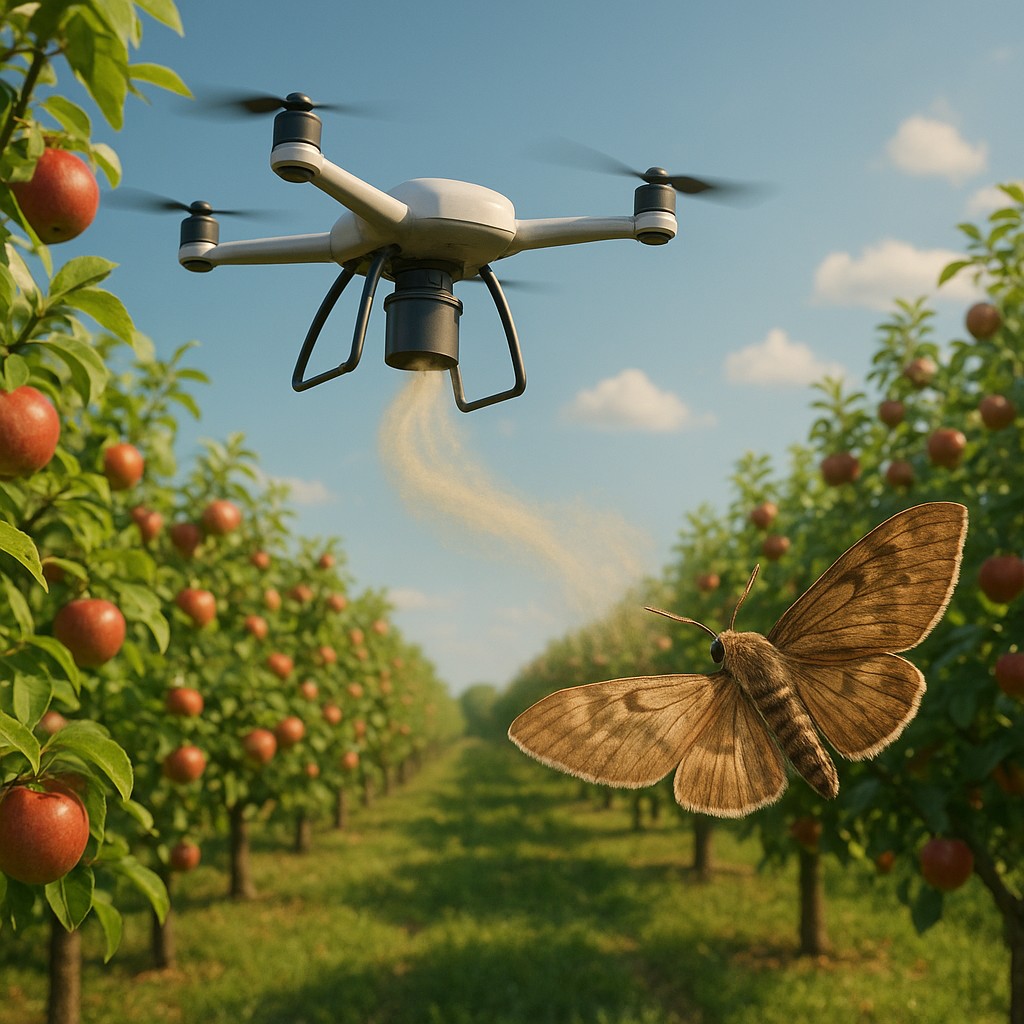
Imagine standing in the middle of a sprawling apple orchard during the height of summer. Traditionally, this scene would be defined by the rhythmic hiss of a tractor-mounted sprayer, coating every leaf in a chemical film designed to kill any insect that dares to take a bite. It is a war of attrition where the goal is to wipe out the pest before it destroys the crop, often at the cost of every other living thing nearby. But lately, the sounds of the orchard have been changing. Instead of the heavy rumble of machinery, you might hear the high-pitched whir of a drone swarm. These small, agile machines are not dropping poison; they are deploying something far more subtle and effective: the scent of desire.
The concept is simple and almost Shakespearean in its tragedy. Agricultural researchers are using pheromones, the chemical signals insects use to find mates, to create a state of total romantic chaos. By saturating the air with a lab-grown version of a female moth's scent, drones ensure that male moths spend their entire lives searching for a partner that does not exist. This biological trick collapses the population not by poisoning individuals, but by preventing the next generation from ever being born. This move from broad-spectrum chemicals to precision biology marks a fundamental shift in how we protect our food supply.
The High Stakes of the Chemical Arms Race
For nearly a century, our primary defense against crop failure has been the "nerve agent" approach. Synthetic pesticides, such as organophosphates and neonicotinoids, work by attacking an insect’s nervous system, essentially shutting down its ability to breathe or move. While these chemicals helped secure the global food supply in the mid-20th century, they are blunt instruments in a delicate ecosystem. The primary problem with "killing by contact" is that these chemicals are rarely picky. A pesticide designed to stop a cabbage looper moth will often just as easily harm a honeybee or a lacewing, the beneficial bugs that farmers actually need for pollination and natural pest control.
Beyond the collateral damage to helpful insects, humans have accidentally triggered an evolutionary sprint. When you spray a field with a lethal toxin, you are performing a massive experiment in natural selection. The 99 percent of pests that die are gone, but the one percent that carries a rare mutation allowing them to survive will rebuild the population. Within a few generations, the entire species becomes resistant to the chemical, forcing manufacturers to develop even stronger, more toxic formulas. This "treadmill of resistance" is expensive for farmers and increasingly risky for the health of soil and water runoff.
How Chemical Confusion Actually Works
To understand why pheromone misting is so effective, we have to look at the world through the eyes, or rather the nose, of a bug. Most moths and beetles navigate by smell rather than sight. A female moth ready to mate releases a microscopic puff of a specific pheromone. For a male moth, this scent is like a lighthouse in a dark ocean. He uses his sensitive antennae to detect just a few molecules of the scent, flying upwind in a zig-zag pattern to find its source. This behavior is called chemotaxis, a hardwired biological drive that the insect cannot ignore.
When a drone moves through an orchard, it isn't just spraying a liquid; it is creating a "cloud of misinformation." By releasing a high concentration of synthetic pheromone, the drone turns the entire orchard into one giant, glowing signal. The male moth's antennae become completely overwhelmed, a phenomenon researchers call sensory fatigue. Imagine trying to find a single candle in a dark room, only for someone to suddenly turn on ten thousand stadium floodlights. The male moth is not hurt, but he is hopelessly lost. He flies aimlessly until he runs out of energy, never finding the female he was programmed to seek.
The Art of Mechanical Precision
Deploying these scents is more complicated than simply dumping perfume over a field. Because pheromones are volatile, meaning they evaporate and drift easily, they can be whisked away by a light breeze or broken down by the sun’s rays. This is where drones become game-changers. Unlike stationary dispensers on the ground, drones use GPS mapping and weather sensors to calculate exactly where and when to release the mist. They can fly just above the treetops, placing "scent clouds" in the specific layers of air where the target pests are most active.
This precision is vital because insects have very short "mating windows" that last only a few weeks. If pheromones are released too early, the scent disappears before it is needed; too late, and the eggs have already been laid. Drones allow researchers to be surgical. They can wait for the first sign of a pest emerging and then deploy a fleet to saturate the area within hours. This "just-in-time" delivery keeps the scent thick enough to be effective without wasting expensive synthetic materials.
| Feature |
Traditional Pesticides |
Pheromone Misting |
| Primary Mechanism |
Lethal toxicity (killing) |
Mating disruption (confusion) |
| Environmental Impact |
High; affects bees and soil |
Very Low; targets one species |
| Resistance Factor |
High; insects evolve immunity |
Low; insects can't ignore mating |
| Application Method |
Heavy machinery, high volume |
Drones, micro-misting, low volume |
| Cost over Time |
Increases as resistance grows |
Stabilizes as population stays low |
Solving the Evolution Problem
One of the most fascinating aspects of pheromone technology is its natural resistance to evolution. When a pest evolves to survive a poison, it usually involves a change in a single enzyme or a nerve receptor. However, for a moth to "evolve" its way out of pheromone confusion, it would have to fundamentally change its entire mating communication system. If a male moth stopped being attracted to the female's pheromone to avoid being confused, he would also fail to find real females. He would effectively be opting out of the gene pool.
This creates a biological checkmate. Because this communication is so deeply rooted in the species' survival, it remains stable for thousands of years. We are essentially using the insect’s own biological "software" against it. While researchers occasionally tweak the chemical blends to ensure the lab-made scent perfectly mimics the natural one, the strategy remains robust against the adaptive tricks that make chemical farming so difficult. Furthermore, because these pheromones are "species-specific," a mist designed for the Codling Moth will have zero effect on a ladybug or a honeybee, as they are tuned into entirely different chemical frequencies.
Tracking the Weather and the Wind
The major hurdle for this technology is the unpredictability of nature. If a sudden thunderstorm rolls through or if the wind picks up to twenty miles per hour, the scent cloud can be scattered into the next county. To combat this, researchers are linking drones with ground-based sensor networks. These sensors monitor wind speed, humidity, and temperature in real time. If conditions are too breezy, the drone stays grounded. When the air turns still at dusk, the peak time for many moth species, the drone takes flight to refresh the "mating noise" in the air.
Manufacturing is another challenge. Pheromones are complex molecules that are difficult and expensive to produce in large quantities. Unlike general pesticides produced by the ton, each pheromone must be custom-built to match the specific "code" of a single insect species. However, as drone technology becomes cheaper and synthetic biology makes production more efficient, the cost gap is closing. Farmers are increasingly seeing this not as an experimental luxury, but as a strategic investment in the long-term health and organic certification of their land.
A More Harmonious Future for Farming
The move toward pheromone drones represents a broader shift in agriculture: moving away from "killing everything" and toward "managing the system." By understanding the lives of the creatures we share the land with, we can protect our resources without leaving a trail of environmental destruction. This technology points toward a future where our fields are vibrant, buzzing with life, and full of the insects that actually help us, while the pests are left wandering in a harmless, scent-filled daze.
A drone hovering over a vineyard is more than just a cool gadget; it is a sign of a smarter, more empathetic form of engineering. Sometimes, the most powerful way to solve a problem isn't with a hammer, but with a whisper. By mastering the language of scents, we are learning to guide nature rather than trying to beat it into submission, ensuring our food is grown in a world healthy enough to sustain us all.