Imagine you are standing on a quiet beach, feeling the grains of sand slip between your toes. To most of us, that sand is just the backdrop for a summer vacation or the frustrating grit that finds its way into every crevice of a picnic basket. However, to a new generation of engineers, that humble pile of silica represents something far more profound: a massive, low-tech, and incredibly efficient vault for the world's energy. As we move toward a future powered by the sun and wind, we are running into a frustrating paradox. We often have too much energy when the sun is blazing or the wind is howling, but we lack a cheap, sustainable way to keep that power in a "savings account" for the dark, still days of winter.
Traditional lithium-ion batteries are excellent for things like your phone or your electric car because they are light and pack a punch. But when it comes to storing enough energy to keep a whole city warm for a week in January, lithium-ion starts to look like a very expensive and environmentally taxing solution. This is where the sand battery enters the stage, trading high-tech rare metals for the most common material on Earth. By shifting our perspective from storing electricity in chemical form to storing it as pure heat, we are discovering that the solution to our most complex modern problem might be as old as the desert itself.
The Logic of the Giant Thermal Thermos
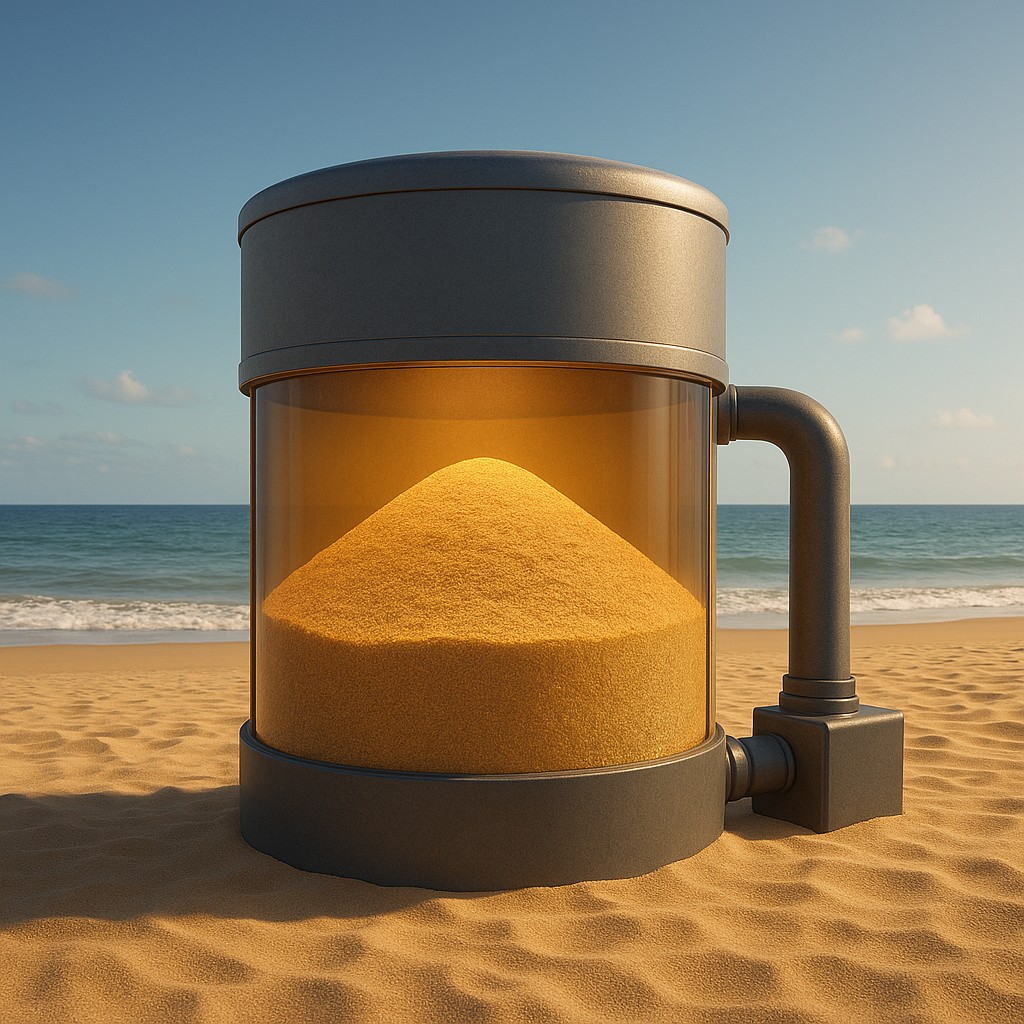
To understand why sand is such a brilliant choice for energy storage, we first have to look at the physics of heat. Most substances are either good conductors, meaning they let heat pass through them quickly, or good insulators, which hold heat back. Sand exists in a sweet spot. It can absorb a staggering amount of thermal energy and, because of its density and the tiny air pockets between grains, it is remarkably stubborn about letting that heat go. A sand battery is essentially a giant, insulated steel silo filled to the brim with low-grade sand or crushed stone. It does not need to be the pristine white sand of a Caribbean resort; even the coarse, industrial sand used in construction works perfectly.
Inside this silo, engineers bury a network of heat exchange pipes. When the local power grid has a surplus of electricity, perhaps during a particularly sunny afternoon when everyone is at work and not using their appliances, that extra power is used to run high-capacity heaters. These heaters warm up the air, which is then pumped through the pipes in the sand. As the hot air travels through the silo, it transfers its energy to the sand grains, raising the temperature of the entire mass to over 600 degrees Celsius (about 1,100 degrees Fahrenheit). At this point, the sand is literally glowing with energy, yet it remains solid and stable.
The magic happens because the silo is heavily insulated from the outside world. Since sand is a poor conductor of heat when it is sitting still, the core of the battery stays scorching hot while the outer layers act as additional insulation. This allows the system to store that energy for weeks or even months with minimal loss. It is the ultimate "thermal thermos," keeping the summer sun's energy tucked away until the first snow falls and the town's heating needs skyrocket.
Moving Beyond the Chemical Constraints of Lithium
When we compare sand batteries to the lithium-ion technology we use every day, the differences in philosophy and physics are stark. Lithium batteries rely on complex chemical reactions to move ions back and forth between an anode and a cathode (the two ends of a battery). This process is efficient but delicate. Over time, those chemical pathways degrade, which is why a three-year-old laptop doesn't hold a charge as well as it used to. Furthermore, lithium-ion batteries are prone to "thermal runaway" if they get too hot, which is a polite way of saying they can catch fire and be very difficult to extinguish.
Sand, by contrast, is chemically inert. You can heat it up and cool it down thousands of times without changing its fundamental structure. There are no "cycles" to worry about in the traditional sense; a sand battery built today could potentially function for decades with almost no maintenance. Because sand is non-flammable and stays solid at the temperatures used in these systems, the risk of a catastrophic fire is virtually zero. This makes them ideal for placement in the middle of residential neighborhoods or industrial parks where safety is a primary concern.
| Feature |
Lithium-Ion Batteries |
Sand Batteries (Thermal Storage) |
| Primary Material |
Lithium, Cobalt, Nickel |
Low-grade sand or crushed soapstone |
| Energy Medium |
Chemical potential |
Thermal (heat) |
| Lifespan |
5-10 years (1,000-5,000 cycles) |
20-50+ years (nearly unlimited cycles) |
| Best Use Case |
Short-term grid balancing, EVs |
Long-duration heating, seasonal storage |
| Environmental Impact |
High (due to mining and recycling) |
Negligible (sand is abundant and recyclable) |
| Safety Profile |
Risk of fire or overheating |
Non-flammable and stable |
As the table illustrates, we aren't necessarily looking for a replacement for lithium, but rather a partner. While lithium handles the "fast" tasks like stabilizing the grid's frequency or powering a car, sand handles the "heavy lifting" of long-term storage. Using sand allows us to reserve rare and expensive metals for applications where weight and volume are critical, while letting cheap, abundant dirt handle the stationary storage of the world's thermal needs.
The Seasonal Bridge and District Heating
The true superpower of the sand battery lies in its ability to solve the "Intermittency Problem," or the gap in energy production, on a seasonal scale. In many parts of the world, especially in northern latitudes like Finland, where the first major sand batteries have been deployed, energy demand is not just a daily cycle; it is a yearly one. These regions have an enormous amount of wind power available in the autumn and winter, but they also have massive heating requirements during those months. The sand battery acts as a bridge, soaking up the cheap, green electricity produced during windy or sunny periods and turning it into a reliable source of heat.
Once the sand is hot, the process of getting the energy back out is elegantly simple. When the temperature drops and people turn on their heaters, the system reverses its airflow. Cool air is pumped into the hot sand, where it picks up the stored thermal energy. This superheated air is then passed through a water heat exchanger. The resulting hot water is pumped into a "district heating" network, a system of underground pipes that carries warmth directly into homes, offices, and even swimming pools across an entire town.
This direct use of heat is much more efficient than trying to turn the heat back into electricity. While it is possible to use the sand's heat to create steam and spin a turbine to generate power, you lose a significant amount of energy in that conversion. By using the heat as heat, these systems can achieve round-trip efficiencies upwards of 90 percent. For cities that already have district heating infrastructure, adding a sand battery is like giving the town a giant, green heartbeat that keeps everyone warm using the "leftover" energy of the previous season.
Correcting the Myth of Technological Complexity
A common misconception in the world of renewable energy is that every solution must be more high-tech and "smarter" than the last. We often imagine that the future of the grid involves quantum computers and exotic new elements found at the bottom of the ocean. The sand battery turns this idea on its head by proving that sometimes the "smartest" solution is the simplest one. By stripping away the need for rare earth minerals, complex electronics, and hazardous chemicals, we create a technology that is not only cheaper to build but also easier to understand and maintain.
Another myth is that sand batteries are only useful in cold climates. While the current focus is on heating homes in the winter, the principle of thermal storage is universal. In warmer climates, the high-grade heat from a sand battery can be used for industrial processes, such as food processing, textile manufacturing, or chemical production, all of which require constant, high-temperature heat. Traditionally, these industries rely on burning natural gas or coal. By substituting a sand battery, a factory can run its 24/7 operations using solar energy captured during the day, drastically reducing its carbon footprint without needing to overhaul its entire machinery.
The scalability of this technology is also frequently underestimated. You do not need a laboratory or a clean room to build a sand battery. You need a big steel container, some insulation, metal pipes, and a lot of dirt. This means that developing nations can implement these systems using local materials and local labor, rather than being dependent on a global supply chain for high-tech components. It is a democratizing force in energy, allowing communities to build their own resilience using the very ground they stand on.
The Engineering Behind the Heat Flow
While the concept is simple, the engineering involves a clever dance of thermodynamics and fluid dynamics. To keep the energy stored efficiently, engineers have to manage "thermal stratification." This is the same principle that makes the water at the top of a lake warmer than the water at the bottom. In a sand battery, the heat is managed so that different zones of the silo hold different temperatures. This allows the system to provide "high-grade" heat for industrial steam or "low-grade" heat for residential radiators, depending on which part of the battery the air is drawn from.
The choice of medium is also a point of constant refinement. While silica sand is the standard, some systems are now experimenting with crushed soapstone, a byproduct of the fireplace industry. Soapstone has an even higher heat capacity than sand, meaning it can store more energy in the same amount of space. This flexibility in the "storage medium" means that the technology can adapt to whatever material is most abundant in a given region. The goal is always the same: finding a material that can withstand high temperatures without melting, clumping, or losing its ability to let air flow through it.
Finally, we must consider the environmental lifecycle. When a lithium battery reaches the end of its life, it becomes a hazardous waste problem that requires expensive and energy-intensive recycling to recover the materials. When a sand battery reaches the end of its multi-decade lifespan, the "battery" is just sand and steel. The steel can be melted down and reused, and the sand can literally be returned to the earth or used in construction. It is one of the few technologies that fits perfectly into a truly "circular" economy, leaving almost no footprint behind.
As we stand at the threshold of a totally renewable world, the sand battery serves as a vital reminder that innovation does not always require inventing something brand new. Sometimes, it involves looking at the most basic materials around us and finding a way to use them more wisely. By capturing the fleeting power of the wind and the sun and locking it inside the ancient, patient grains of the earth, we are discovering a path to a sustainable future that is as stable as the ground beneath our feet. This shift represents more than just a new way to stay warm; it is a fundamental recalculation of how we value the resources of our planet, proving that with a bit of ingenuity, even the most common dust can become a treasure chest for a cleaner, brighter tomorrow.