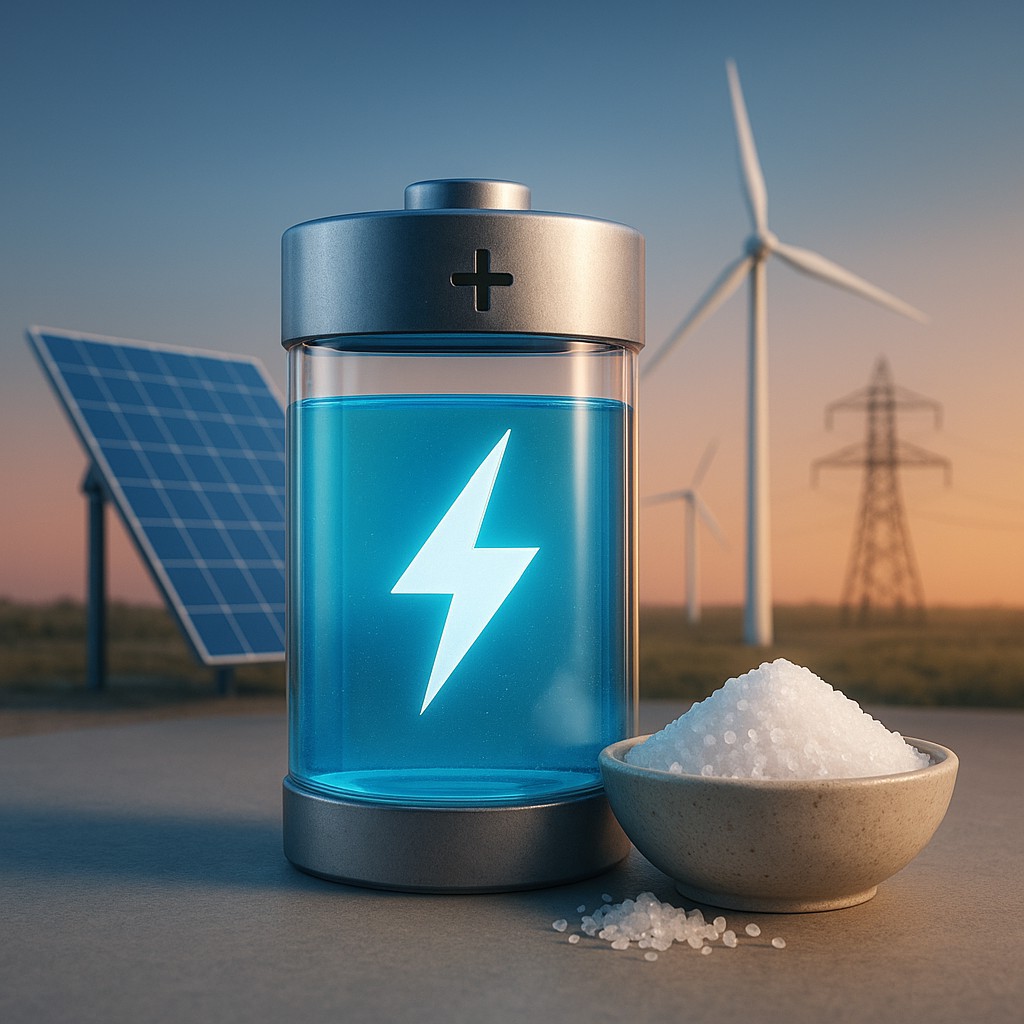
Imagine for a moment that the transition to green energy is a massive, global dinner party. We have the guest list ready, including solar panels and wind turbines, and the venue is set with a vast electrical grid. However, we face a major logistical problem: the snacks - the energy - only arrive at random times. Sometimes the wind blows so hard we have enough appetizers to feed a city for a week; other times, the sun slips behind a cloud and the buffet lines go empty. To keep the party going through the night and during the calmest days, we need "Tupperware" on a massive scale. We need batteries that can hold gigawatts of power without costing more than the house itself.
For the last decade, we have relied almost exclusively on lithium-ion batteries for this job. They are the high-performance sports cars of the battery world: sleek, powerful, and light enough to fit in your pocket or a car's frame. But there is a catch. Lithium is increasingly expensive, difficult to mine, and concentrated in just a few spots on the globe, creating a bottleneck for our green ambitions. Enter the sodium-ion battery, a technology that essentially swaps out a rare, temperamental metal for something you probably have on your kitchen table right now: salt. By using sodium, we are moving away from a scarcity mindset toward a future where the ingredients for energy storage are as common as the ocean.
The Chemistry of Common Ground
To understand why sodium is such a big deal, we first have to look at its position on the periodic table. Sodium sits directly below lithium in the first column, which means they are chemical cousins. In the world of chemistry, family members often behave in similar ways. Both have a single electron in their outer shell that they are desperate to shed, making them highly reactive and excellent at moving an electric charge. In a lithium battery, lithium ions shuttle back and forth between two electrodes (the battery’s contact points) through a liquid electrolyte. In a sodium-ion battery, the mechanism is virtually identical, but the "shuttle" is just a slightly larger, heavier sodium ion.
Because the basic physics are so similar, engineers did not have to reinvent the wheel. They were able to take decades of research into lithium technology and adapt it for sodium. Historically, the main challenge has been the size of the ion. Think of the internal structure of a battery electrode like a parking garage. Lithium ions are like compact cars that zip in and out of tight spaces easily. Sodium ions are more like SUVs; they are about 25 percent larger in radius. This means they need "wider lanes" and sturdier structures within the battery so they do not crack the material as they move. Recent breakthroughs in material science have finally given us the right kind of "parking garages," often made of hard carbon, which can handle these larger ions for thousands of charge cycles.
From Salty Brine to Megawatts of Power
One of the most exciting aspects of sodium-ion technology is where we get the ingredients. Lithium extraction is a complex, water-intensive process that often involves massive evaporation ponds in the high-altitude deserts of South America or hard-rock mining in Australia. Sodium, by contrast, is the sixth most abundant element in the Earth's crust. It is found in massive underground salt deposits and, of course, in the trillions of tons of seawater that cover our planet. We are not just talking about a slight discount here; the raw material cost of sodium is about one-eightieth the cost of lithium.
This abundance changes the geopolitical math of the energy transition. Currently, the "lithium rush" has countries scrambling to secure supply chains, much like the oil rushes of the 20th century. Sodium levels the playing field. Since salt is everywhere, any country with an ocean or a salt mine can theoretically produce its own energy storage components. This leads to true energy independence, where the ability to store wind and solar power is no longer tied to owning a specific mineral deposit. It turns energy storage from a luxury commodity into a true utility, accessible to developing nations and industrial giants alike.
Comparing the Heavyweights and the Lightweights
While sodium-ion batteries are winning the popularity contest for cost and availability, they are not a perfect one-to-one replacement for lithium in every scenario. The primary trade-off is energy density. Because sodium ions are heavier and the chemistry is slightly less space-efficient, a sodium-ion battery is generally bulkier than a lithium-ion battery of the same capacity. This is why you likely will not see a sodium-ion smartphone anytime soon; it would make your pocket feel like it was holding a lead brick. However, for a power grid, weight simply does not matter. A shipping container full of batteries sitting in a field next to a wind farm does not care if it weighs 20 tons or 30 tons.
Safety is another area where sodium begins to shine. Lithium-ion batteries are notoriously finicky about temperature and can, in rare cases, experience "thermal runaway" (a polite term for catching fire). Sodium-ion batteries are much more stable at higher temperatures and are significantly less prone to fire. They can even be drained to zero volts for shipping, which makes them much safer to transport than lithium batteries, which must be kept at a partial charge to remain stable. To see how these two stack up, let us look at the key differences in their profiles.
| Feature |
Lithium-Ion Batteries |
Sodium-Ion Batteries |
| Abundance |
Rare (0.002% of Earth's crust) |
Abundant (2.3% of Earth's crust) |
| Cost |
High and volatile |
Low and stable |
| Energy Density |
High (ideal for small devices/EVs) |
Moderate (ideal for grid storage) |
| Safety |
High risk of catching fire |
Higher heat stability |
| Operating Temp |
Sensitive to cold and extreme heat |
Strong performance in wide ranges |
| Transport |
Restrictive (must stay charged) |
Easier (can be shipped at zero volts) |
The Rise of the Salt-Powered Grid
We are currently witnessing the first real-world "pilots" of this technology moving from the lab to the landscape. In the United States, companies like Peak Energy are deploying sodium-ion systems at sites like SolarTAC in Colorado, demonstrating that these batteries can be integrated into the grid right now. These systems are often "passively cooled," meaning they do not require complex, power-hungry air conditioning units to stay functional, further increasing their efficiency. China has also leaped ahead, recently launching sodium-ion stations that can hold megawatt-hours of energy, proving that the technology is ready for the big leagues.
These pilot projects are essential because they provide the data that utility companies need to feel confident. To a utility manager, a battery is not just a box of chemicals; it is an investment that needs to last for 20 years. By showing that sodium cells can survive thousands of cycles of charging and discharging without losing their punch, these pilots are clearing the path for massive manufacturing plants. As production scales up, the cost is expected to drop even further, potentially making renewable energy storage cheaper than burning coal or gas. We are moving toward a world where the "duck curve" - the problem where solar power peaks at noon but demand peaks at night - is solved by vast warehouses of salt-based batteries.
Correcting the Myth of the "Second-Rate" Battery
A common misconception in the tech world is that if something is "cheaper" and "less dense," it must be inferior. This could not be further from the truth when it comes to infrastructure. In the world of engineering, the best tool is the one most fit for the purpose. We do not use carbon fiber to build the foundations of skyscrapers even though it is stronger and lighter than concrete, because concrete is cheap, abundant, and does the specific job of staying still perfectly well. Sodium-ion is the "concrete" of the battery world.
Another myth is that sodium batteries will completely kill off the lithium industry. In reality, they will likely coexist in a hybrid ecosystem. Lithium will remain the king of high-performance applications like long-range electric vehicles and high-end electronics. Sodium will take over the heavy lifting of the grid and perhaps entry-level, short-range electric scooters or city cars. By offloading the grid storage demand to sodium, we actually make lithium cheaper for electric car manufacturers, as there is less competition for the limited supply. It is a win-win for the entire green energy sector.
Designing the Materials of Tomorrow
The magic of sodium-ion technology also lies in what is not inside the battery. Most lithium-ion batteries require cobalt and nickel in their cathodes (the positive side of the battery). Cobalt mining is notoriously fraught with ethical concerns and environmental damage. Many sodium-ion designs use "Prussian Blue" analogues or layered oxides that rely on iron and manganese instead. These are minerals you can find almost anywhere, and they do not carry the same heavy ethical or environmental baggage.
Even the current collectors inside the battery are cheaper with sodium. In a lithium cell, the negative collector must be made of copper because aluminum would react with the lithium. In a sodium cell, aluminum does not react, so engineers can use aluminum foil for both sides. Aluminum is about three to four times cheaper than copper and much lighter. Every time we look at the internal parts of a sodium-ion cell, we find another way it cuts cost and complexity. It is an elegant example of "frugal innovation," where simplifying the chemistry leads to a more robust and scalable solution for the planet.
A Future Powered by the Sea
As we look toward the horizon, the shift toward sodium-ion technology represents more than just a clever chemical swap. It represents a fundamental change in how we think about resources. For over a century, the world has been at the mercy of "resource traps," where the energy that powers our lives is tied to wherever ancient fossils or rare minerals happen to be buried. This has led to wars, economic instability, and vast inequalities between nations.
The arrival of grid-scale sodium storage suggests a more democratic energy future. When the main ingredients for your power grid are sun, wind, and salt, the barriers to entry begin to vanish. We are building a world where a remote village can store its own solar power using batteries made from the very earth they stand on. This is the promise of the sodium revolution: a storage solution that is as sustainable as the energy it holds. By looking at the common salt on our tables with new eyes, we have found the missing link that could finally allow us to leave the age of fossil fuels behind for good.