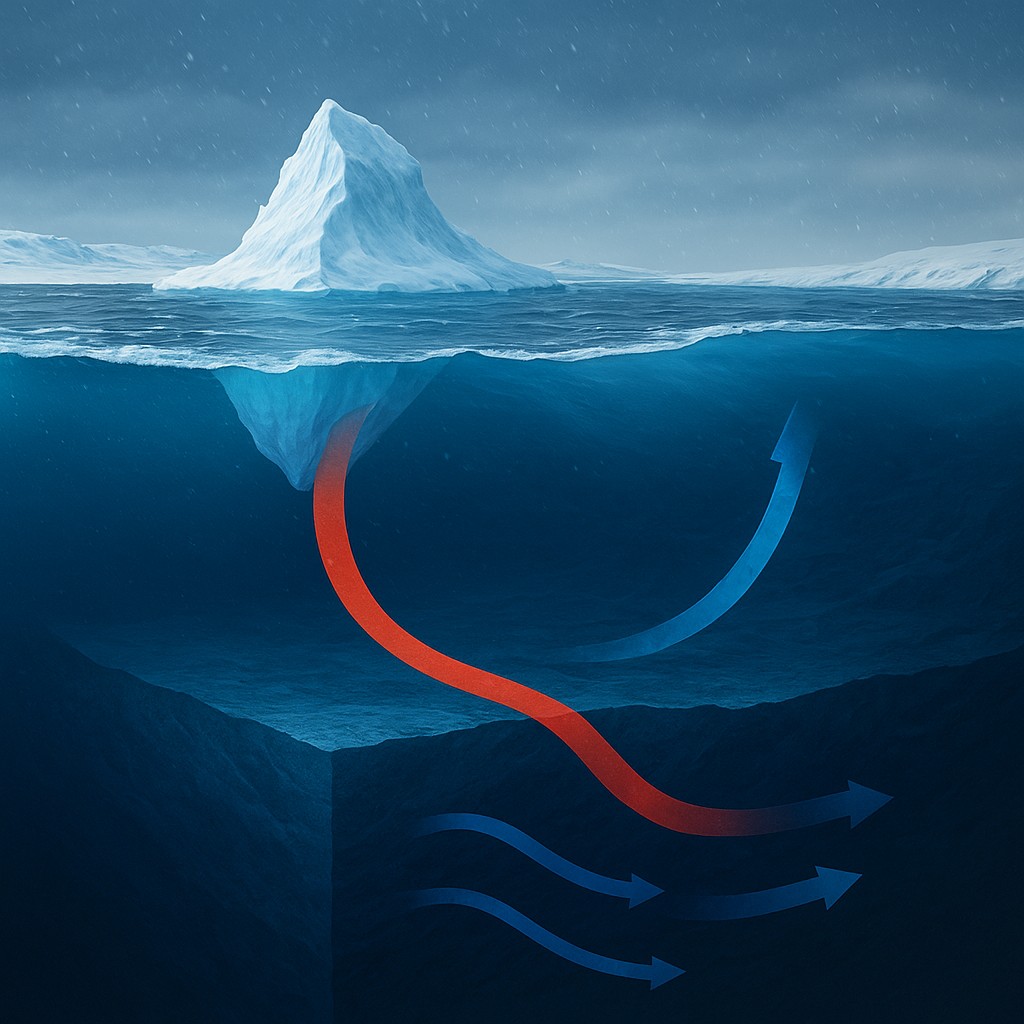
Imagine standing on the frozen edge of the Weddell Sea in Antarctica. The wind screams across the ice, temperatures have plummeted far below zero, and the ocean is doing something that seems totally backward. As the water freezes into solid ice, it actually makes the water below it more active and more alive. This process is vital for the health of the entire planet. We often think of the deep ocean as a dark, still basement where water just sits for eternity. In reality, the abyss is a roaring highway of movement, powered by a silent, invisible force that begins at the surface of polar seas.
This movement is the heartbeat of our planet. It is fueled by a process called brine rejection. While we usually focus on the vast white ice sheets covering the poles, the real work happens during the chemical "divorce" between water and salt. When seawater freezes, it creates a substance so thick and heavy that it sinks through the ocean like a lead weight. This falling water is the engine for the Global Ocean Conveyor Belt. This system recycles nutrients from the seafloor and carries oxygen down to the crushing depths where sunlight never reaches. Without this gravity-driven plunge, the deep oceans would essentially suffocate.
The Chemistry of an Icy Divorce
To understand why the deep ocean stays cold, we have to look at how ice forms at a molecular level. Most people assume that when seawater freezes, it just becomes a solid block of frozen salt water. In truth, water molecules are very picky about their partners when they form a crystal lattice, or a solid structure. As temperatures drop, water molecules bond into a rigid, six-sided shape. This structure has no room for the bulky salt ions - sodium and chloride - found in the sea. As the ice crystals grow, they physically squeeze the salt out, spitting it back into the surrounding water.
This process turns the remaining liquid into a super-concentrated, incredibly salty slush called brine. Because salt makes water denser, and cold temperatures do the same, this brine becomes the "heavyweight champion" of the sea. While the fresh ice floats on top, the discarded brine is far too heavy to stay at the surface. It begins to sink, cutting through the lighter layers of water beneath it. This isn't just a slow leak; in areas where a lot of ice is forming, it is a massive downward rush that carries the freezing cold of the poles all the way to the seafloor.
The Gravity-Powered Elevator to the Abyss
Once this salt-heavy water begins its trek downward, oceanographers call it Bottom Water. In the southern hemisphere, it is known as Antarctic Bottom Water (AABW). It is the coldest, saltiest, and densest water on Earth. As it sinks, it doesn't just vanish. It acts like a giant piston, pushing the water already at the bottom out of the way and forcing it toward the equator. This creates a vertical loop called thermohaline circulation. The word "thermo" refers to temperature, while "haline" refers to salt. Together, they act as the two-part engine of the deep sea.
This gravity-driven elevator is the only way oxygen reaches the deep. Since the atmosphere only touches the surface, all the oxygen needed by deep-sea creatures must be carried down from the top. When brine rejection forces water to sink, that water takes a fresh "gulp" of oxygen from the surface and delivers it to the depths. If this process stopped, the deep ocean would become a stagnant, oxygen-starved dead zone where complex life couldn't survive. The sinking brine effectively "ventilates" the abyss, acting as a set of lungs for the planet’s largest habitat.
| Characteristic |
Surface Seawater |
Rejected Brine (Sinking) |
| Temperature |
Varies (About -1°C near poles) |
Extremely Cold (Near -1.9°C) |
| Salinity |
Standard (35 parts per thousand) |
High (Concentrated Salt) |
| Density |
Baseline |
Maximum Density |
| Role |
Atmospheric Interaction |
Driving Global Circulation |
| Movement |
Wind and Tides |
Gravity-driven (Sinking) |
Debunking the Freezer Myth
A common mistake is thinking the deep ocean is cold simply because the sun doesn't reach it. While it is true that sunlight only hits the top few hundred meters, that doesn't explain why the deep sea isn't just lukewarm. If the ocean were a still pond, heat from the Earth's core and warmth slowly leaking down from the surface would eventually make the water much warmer than it is. The reason the bottom stays at a steady 0 to 3 degrees Celsius (32 to 37 degrees Fahrenheit), even at the equator, is that it is constantly being refilled with freshly chilled water from the poles.
Imagine a large bathtub filled with warm water. If you put an ice cube at one end, the water near the ice gets cold, but the other end stays warm. However, if you have a pump that constantly pours ice-cold, heavy syrup into the tub, that syrup will slide along the bottom, eventually covering the entire floor and pushing the warm water up. This is exactly what brine rejection does. It is a delivery system that spreads polar cold across the entire seafloor, no matter how hot the weather is in the Caribbean or the Sahara.
The Global Conveyor Belt and Climate Stability
This downward flow is the starting point for the Global Ocean Conveyor Belt. This is a journey so long that it can take a single molecule of water over a thousand years to finish. After the heavy brine sinks near Antarctica or the North Atlantic, it travels along the seafloor through the Indian and Pacific Oceans. Eventually, it warms up, becomes lighter, and rises back to the surface in a process called upwelling. This brings deep-sea nutrients back to the top to feed the plankton that support the entire marine food chain.
This system also acts as a vital buffer for our climate. By moving massive amounts of heat and carbon dioxide around the planet, the ocean prevents any one region from getting too hot or too cold. The sinking water at the poles also "hides" carbon dioxide in the deep ocean, keeping it out of the atmosphere for centuries. However, this system relies on a delicate balance. If the poles get too warm and the ice stops forming - or if too much fresh water from melting glaciers pours into the sea - the water won't be salty or heavy enough to sink. This could "stall" the conveyor belt, leading to unpredictable changes in global weather.
Engineering the Future of Ocean Health
The more we learn about brine rejection, the more we realize the poles are not just remote, frozen wastelands. They are the high-pressure pumps that keep the world’s water moving. Today, scientists use satellite data and underwater robots to track the "pulse" of this sinking water. They have found that the rate of Bottom Water formation is changing as the planet warms. This has huge consequences for how the ocean stores heat and supports life. Understanding how density and salt work isn't just a niche hobby; it is the key to predicting the future of our climate.
When you think about the deep ocean now, do not picture a still, dark void. See it as a moving, flowing landscape shaped by the chemistry of freezing water. Every time a new ice crystal forms in the Arctic or Antarctic, it contributes to a global movement. These tiny acts of salt rejection add up to billions of tons of falling water, creating a force of nature that makes the world’s largest waterfalls look small. It is a reminder that the most important changes on our planet often happen in the quietest, coldest moments, far beneath the waves and out of sight.
The next time you look at a map, try to visualize the invisible rivers flowing five miles beneath the surface. These cold, salty currents are proof that our world is connected. They remind us that the ice at the top of the world is linked to the life at the bottom of the sea. By understanding the heavy, sinking brine of the poles, we gain a deeper respect for the massive, silent machinery that keeps our planet a place where we can live.