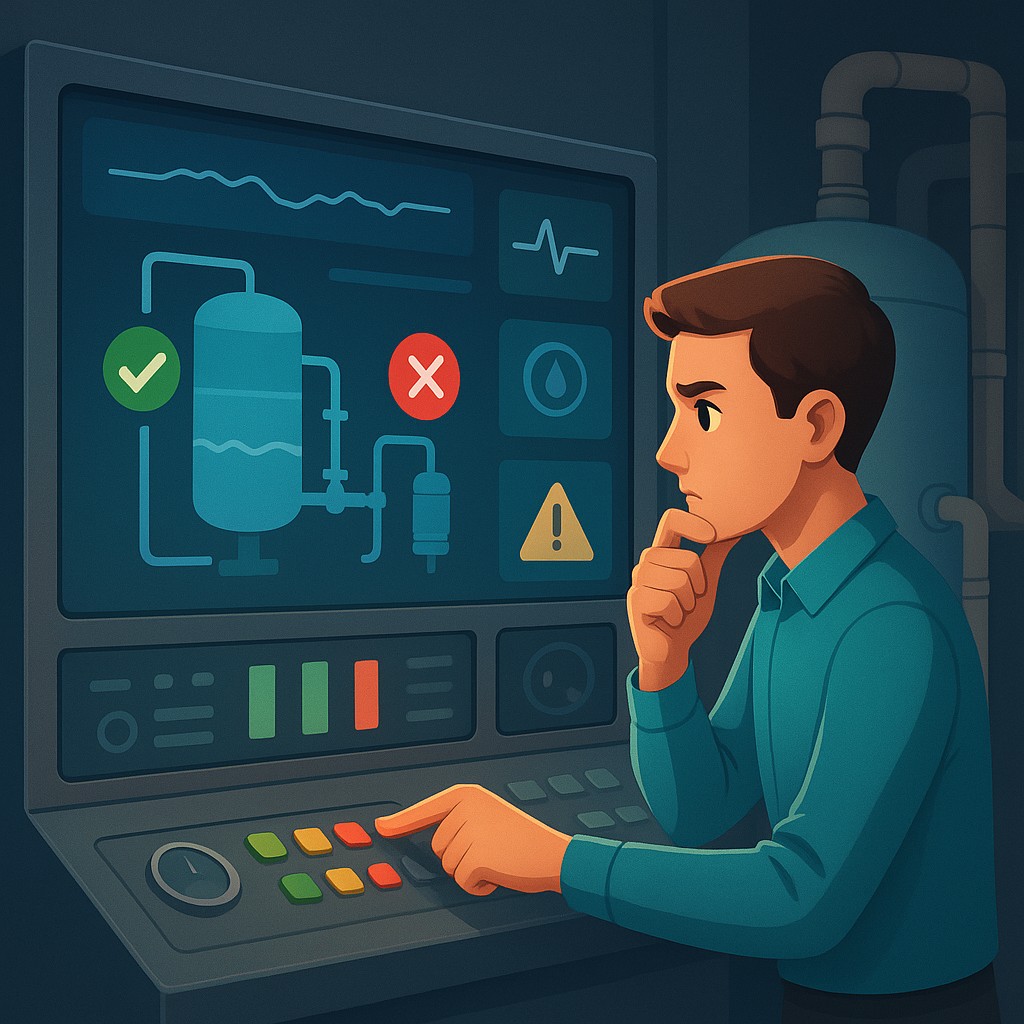
Imagine standing before a high-tech control panel for a massive water filtration plant. To ensure the city never runs dry, you install a primary pump. To be safe, you add a secondary backup. Then, out of caution, you add a third emergency battery system, digital sensors for every valve, and an automated software override that kills the power if it detects a single leaking drop. You feel invincible. You have built a fortress where nothing can go wrong because you have planned for every possible mishap.
Three months later, the entire plant grinds to a halt. It wasn't a mechanical failure. Instead, the sensors on the third backup system sent a conflicting signal to the software override, triggering a "safety" shutdown during a routine check. The system was so packed with protective layers that the layers began to fight each other. This is the heart of the safety paradox: the more we try to protect a complex system by adding "just one more" feature, the more we invite the very chaos we want to avoid. Instead of making a system stronger, we often make it more fragile, confusing, and unpredictable.
The Counterintuitive Logic of Interactive Complexity
To understand why more is not always better, we have to look at how different parts of a system talk to each other. In a simple system, like a bicycle, the parts are "linear." If the chain breaks, the bike stops, and the cause is obvious. But in complex systems like nuclear power plants, flight grids, or global financial markets, the parts have "interactive complexity." This means Part A does not just affect Part B; it might affect Part K in a way that Part M did not expect, which then triggers a reaction in Part A that no one programmed for.
When engineers add a new safety layer, they are adding a new set of interactions. Every new sensor or alarm is another component that can fail, report a false alarm, or react strangely with existing parts. For instance, if you add an automatic braking system to a train, you must also add a system to monitor those brakes. Now you have two systems that can fail. If the monitor glitches and tells the brakes to slam on while the train is at high speed, the "safety" feature causes a derailment. This is what experts call "normal accidents," the idea that in highly complex, tightly linked systems, failure is a built-in part of the design rather than a stroke of bad luck.
The Peltzman Effect and the Human Element
The safety paradox is not just about hardware; it is rooted in human psychology. This is known as the Peltzman Effect, named after economist Sam Peltzman. He suggested that when people feel a system is safer, they compensate by taking more risks. It is why a driver with top-rated brakes and ten airbags might feel comfortable driving twenty miles per hour faster on an icy road than they would in an old car with no safety features. The safety net actually encourages the very behavior it was meant to prevent.
In workplaces, this leads to a dangerous kind of laziness. If a technician knows there are four backup alarms for a chemical tank, they may stop checking the physical gauges manually. The safety layers act as a psychological sedative. Furthermore, when a system is buried under protocols, operators lose their "feel" for the machine. They are no longer monitoring the chemical reaction; they are monitoring screens that monitor sensors that monitor the reaction. When the screen flickers, the human is so far removed from the "ground truth" (the actual physical reality) that they may not know how to react if the automation fails.
When Safeguards Collide
One of the most hidden dangers of the safety paradox is the "inter-system error." This happens when two safety systems, both working perfectly on their own, create a disaster by interacting with each other. Imagine a modern office building with a fire suppression system and a high-security lock system. During a fire, the suppression system seals doors to starve the fire of oxygen. At the same time, the security system locks all doors to prevent intruders during the emergency. If these systems are not perfectly synced, people could be trapped in a room without air while the exits are electronically bolted.
These errors are hard to predict because they do not happen inside a single part, but in the "white space" between them. Designers usually focus on how one part breaks, but the safety paradox thrives on "functional resonance." This is when small, normal fluctuations in different systems happen at the same time and amplify each other until the whole structure collapses. It is like two people trying to help you carry a heavy table: if one lifts too high while the other pushes too far left, their "help" flips the table over.
Redundancy vs. Resilience
It is important to know the difference between having a spare tire and having a thousand sensors that tell you if the spare tire is full. Redundancy is having a backup; resilience is the ability to handle a shock and keep going. The safety paradox shows us that adding redundancy often kills resilience because it makes the system harder to understand and fix. When a system is simple, a person can quickly find the problem. When it is layered and opaque, the diagnosis can take so long that the chance to fix it disappears.
The table below compares a "layered" approach to a "resilient" one, showing why more parts do not always provide more peace of mind.
| Feature |
Redundancy-Heavy (The Paradox) |
Resilience-Focused (The Solution) |
| Philosophy |
Add parts to prevent any single failure. |
Simplify design to make failures obvious. |
| Complexity |
High; many hidden interactions. |
Low; clear cause and effect. |
| Human Role |
Operator watches the automation. |
Operator understands the mechanics. |
| Failure Mode |
Sudden, total, and hard to explain. |
Local, slow, and easy to fix. |
| Example |
5 backup sensors for one fuel valve. |
A valve designed to fail in a "safe" position. |
The Art of Intentional Simplicity
If adding safety layers is dangerous, how should we build critical systems? The answer is "graceful degradation." This means that when a part fails, the system is designed to fail in a predictable, manageable way, rather than triggering a domino effect of secondary alarms. Engineers are learning that a "naked" system that is easy to understand is often safer than a "clothed" system that hides its flaws behind digital alerts.
Simplicity is a choice that takes more effort than adding layers. It involves asking, "What is the absolute minimum number of parts we need?" rather than "How many backups can we afford?" It also requires "observability." A system is observable if an outsider can look at it and immediately understand its health without a manual. By focusing on transparency and reducing hidden interactions, we can avoid the traps of the safety paradox.
Navigating a Layered World
The safety paradox changes how we look at everything from phone apps to government agencies. We live in an era where "more" is marketed as "better," and "complex" is mistaken for "sophisticated." But true sophistication is the ability to manage risk without suffocating a system in its own protective gear. Whether you are designing a workflow, managing a team, or setting up home security, remember that every new rule and every new backup comes with a hidden cost.
In the future, resist the urge to solve problems by simply adding more. Sometimes, the safest thing to do is to remove clutter, clarify a process, and trust in a clear design. By choosing simplicity and staying alert even when things seem "fully protected," you master true safety. You become someone who does not just rely on the net, but understands how to walk the tightrope.