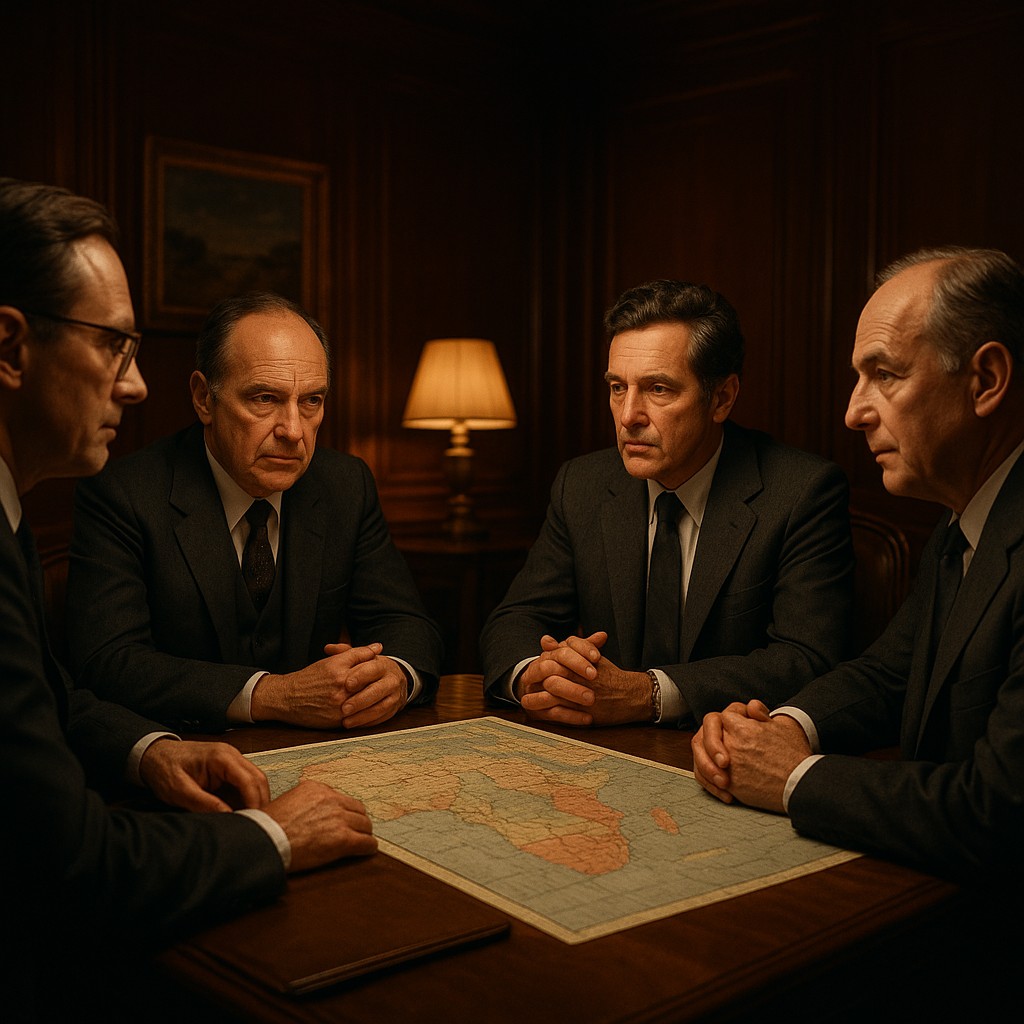
Imagine for a moment that you are a top intelligence official in the mid-1970s. The world feels like it is spinning out of control. In the United States, the post-Watergate era has pushed the CIA to a breaking point. The Church Committee is busy airing decades of "family jewels"- - the agency’s most embarrassing and scandalous secrets - -while Congress has passed the Clark Amendment, legally banning any involvement in foreign civil wars. Meanwhile, across the ocean, the 1974 Carnation Revolution has ended Portugal’s centuries-old empire overnight. This left massive parts of Africa, from Angola to Mozambique, suddenly up for grabs. To Western Cold War leaders, the map was turning red, and the usual defenders of the status quo were legally forbidden from getting their hands dirty.
In this power vacuum, a group of men who refused to accept this "new world order" met in the shadows to take charge. They didn't gather in the Oval Office or at the United Nations. Instead, they met in the wood-paneled rooms of luxury villas and private clubs. They formed a pact so secret that even most of their own governments didn't realize how far it reached. This was the Safari Club: a temporary alliance of rogue intelligence agencies that decided if the American superpower was going to stay on the sidelines, they would play the game themselves. They were the original "private-sector" Cold War firm, and their influence would change the politics of an entire continent.
A League of Extraordinary Spies
The Safari Club was not a formal organization like NATO. It was more like an exclusive, invite-only group for people who thought the CIA had become too timid. Founded in 1976, the club's members represented a unique mix of interests: France, Egypt, Saudi Arabia, Morocco, and Imperial Iran. Each member brought a specific tool to the table, creating a self-sufficient machine for secret operations. France provided elite military expertise and a deep network of African contacts. The Saudis and the Iranians (under the Shah) provided the nearly endless oil wealth needed to pay for secret wars. Egypt and Morocco offered the soldiers and the geographic head start needed to reach conflict zones quickly.
This alliance was the brainchild of Alexandre de Marenches, the legendary head of the SDECE, France’s foreign intelligence service. He realized that while the Americans were stuck dealing with democratic oversight and government red tape, a "private" group could act without any consequences. The Club set up its headquarters in Cairo and focused on one main goal: stopping Soviet influence from spreading in Africa. They saw themselves as the last line of defense against communism, stepping in wherever a "weakened" United States failed to act. It was a strange, high-stakes setup where a French aristocrat, a Middle Eastern king, and North African generals planned global strategy over dinner.
The Carnation Revolution and the African Power Vacuum
To understand why the Safari Club felt so desperate, we have to look at what happened on April 25, 1974, in Lisbon. That day, a group of frustrated Portuguese military officers overthrew the long-standing authoritarian government. The coup was famously peaceful, with citizens placing carnations into the barrels of soldiers' rifles. While it was a win for democracy in Europe, it was a massive shock for Africa. Portugal had been fighting long, brutal colonial wars in Angola, Mozambique, and Guinea-Bissau for over ten years. The new left-wing government in Lisbon wanted out immediately, leading to a rushed and messy withdrawal from their colonies.
This sudden exit sparked a "gold rush" for power. In Angola, the Portuguese departure triggered a three-way civil war between groups backed by the Soviet Union, the United States, and China. When the U.S. Congress passed the Clark Amendment in 1976, cutting off all aid to American-backed rebels, the Safari Club saw it as a disastrous betrayal. They believed that if they did not step in, the entire southern half of Africa would become a Soviet puppet. The Club became the "off-the-books" pipeline to keep money and weapons flowing to anti-communist forces, completely bypassing the watchful eyes of the U.S. Senate.
Funding Factions and Fighting Proxy Wars
The hallmark of Safari Club operations was their speed and lack of bureaucracy. Unlike the CIA, which had to explain its spending to committees, the Safari Club could simply have a Saudi prince write a check. One of their biggest moves happened in 1977 during the Shaba I conflict in Zaire (now the Democratic Republic of the Congo). When rebels, reportedly backed by Angola and the Soviet bloc, invaded the mineral-rich Shaba province, the Safari Club acted immediately. They didn't wait for a UN vote. They flew in Moroccan troops using French planes, all paid for with Saudi money.
The mission was a total success for the Club. They pushed back the rebels and protected the government of Mobutu Sese Seko, a key Western ally who was also notoriously corrupt. This victory gave the group the confidence to do even more. The table below shows the roles each member played, illustrating how the alliance worked as a complete intelligence system.
| Member Country |
Role in the Alliance |
Main Motivation |
| France |
Technical skill, logistics, and intelligence |
Keeping its colonial influence in Africa |
| Saudi Arabia |
Main financial backer (oil money) |
Fighting against atheism and Soviet influence |
| Imperial Iran |
Funding and regional intelligence (SAVAK) |
Boosting the Shah’s image as a global power |
| Egypt |
Weapons and strategic location |
Managing regional rivals and protecting the Nile |
| Morocco |
Ground troops and military training |
Winning Western favor and strengthening local rule |
The Somalia-Ethiopia Chess Match
The Safari Club’s most ambitious and ethically messy move took place in the Horn of Africa during the Ogaden War between Somalia and Ethiopia. In a strange Cold War twist, the Soviet Union switched sides, abandoning its old ally, Somalia, to support the new Marxist government in Ethiopia. This left the Somali dictator, Siad Barre, looking for new partners. While the United States was nervous about teaming up with Barre, the Safari Club saw a perfect chance to flip a Soviet-backed state over to the West.
The Club began sending huge amounts of aid and weapons to Somalia. Egypt provided old Soviet-made gear that Somali troops already knew how to use, while Saudi Arabia covered the costs. This was "off-the-shelf" diplomacy at its peak. By the time the U.S. government realized what was happening, the Safari Club had already changed the course of the war. This move proved the Club wasn't just reacting to the news; they were actively shaping the map to ensure the "secret war" continued, no matter what the U.S. Congress wanted.
Bypassing the American Oversight Machine
One of the most fascinating things about the Safari Club was its relationship with the United States. Even though the Club was created because the U.S. government was legally restricted, they weren't exactly working against Washington. Instead, they acted like a "shadow CIA" that the real CIA could use whenever they needed a way to deny involvement. George H.W. Bush, who led the CIA when the Club started, and later Theodore Shackley, a famous undercover specialist, kept unofficial ties with the group.
This allowed the U.S. executive branch to have it both ways. They could tell Congress they were following the law while knowing their "friends" in Riyadh, Tehran, and Paris were handling the dirty work. It was a loophole the size of a continent. If an operation turned into a scandal, the White House could truthfully say they didn't authorize it, because the Safari Club wasn't an American organization. This era changed the world of spying, moving intelligence work away from official government deals and into the hands of international networks of wealthy donors and true believers.
The Legacy in the Shadows
The Safari Club essentially fell apart after the 1979 Iranian Revolution. When the Shah was overthrown, the Club lost one of its main funders and its most stable base in the Middle East. Additionally, with the election of Ronald Reagan in 1980, the CIA was given back much of its freedom and funding, making the "private" alliance less necessary for the Americans. However, the model the Safari Club built didn't go away. The methods they started, especially using Saudi money to fund secret wars through third parties, became the blueprint for the Iran-Contra scandal in the 1980s.
The history of the Safari Club is a powerful reminder that history is rarely as simple as the treaties we see in public. For nearly five years, a few men changed the fate of several African nations from the privacy of their villas. They proved that in the world of high-stakes spying, where there is a will (and a large enough bank account), there is always a way around the law. Their story is a complex mix of the end of empires, Cold War fear, and the birth of a new kind of secret global power that still influences how "dirty wars" are fought today.
When looking back at this strange chapter, it's clear the Safari Club was born from a desire to keep control of a world that felt like it was slipping away. While their methods were often questionable and they avoided democratic rules, their impact on African borders and politics is still felt today. They were the ultimate "fixers" of the 1970s, showing that the biggest moves on the global stage often happen behind closed doors, by hands we never see and in rooms we are never invited to enter. Understanding these historical maneuvers helps us see the world today more clearly, as the echoes of these secret alliances still ring through the halls of power.