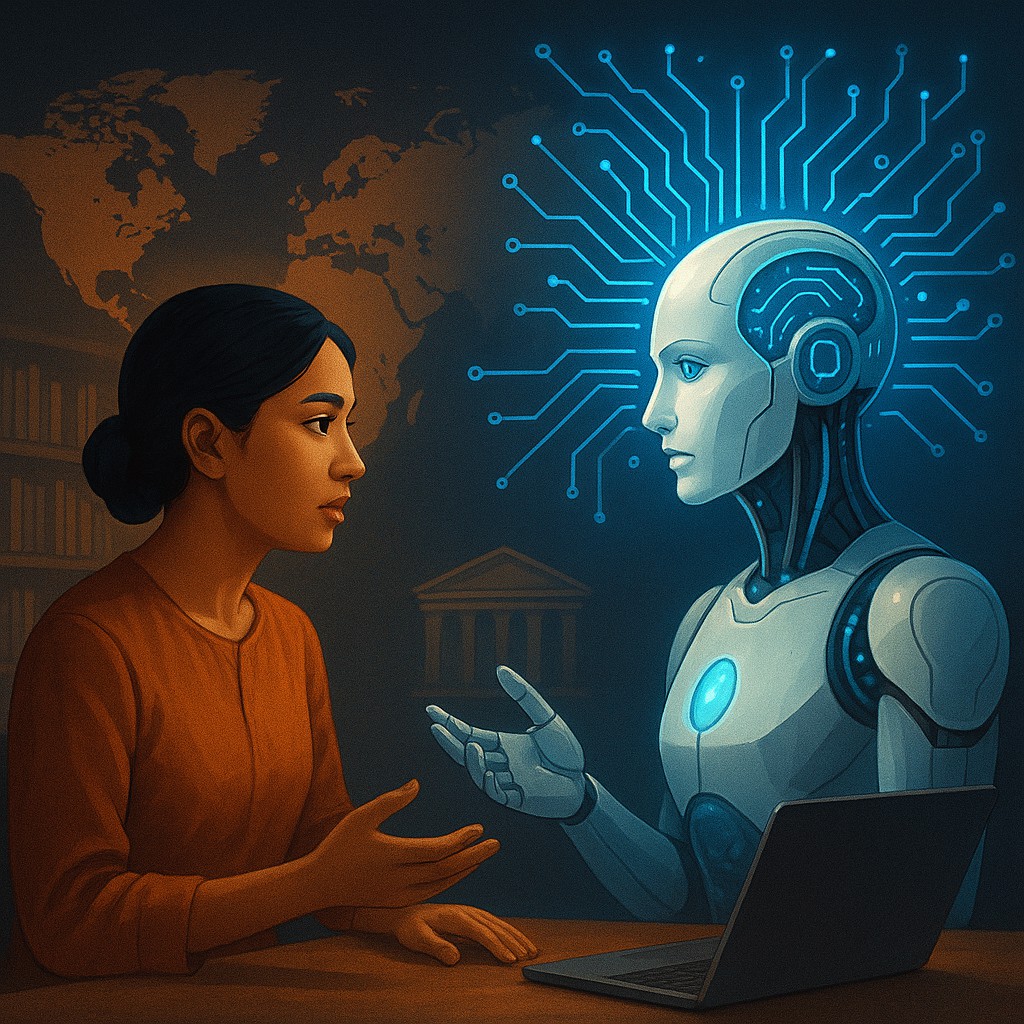
Imagine sitting down to chat with a highly advanced artificial intelligence that has read every book, article, and transcript ever written in the English language. It can compose a sonnet about a toaster or explain quantum physics in a pirate's accent. However, when you ask it for the most respectful way to decline a wedding invitation in a specific rural province of Thailand, or to explain a legal concept unique to the Nigerian court system, it suddenly stumbles. It offers a generic, slightly "Westernized" answer that ignores the subtle social cues and linguistic nuances that matter most to you. This is the "cultural gap" in modern AI. Global models, trained mostly on a diet of North American internet data, struggle to speak the true language of the rest of the world.
This gap is exactly why governments across the globe are shifting from being mere consumers of technology to becoming its architects. We are entering the era of Sovereign AI Infrastructure - a movement where nations treat artificial intelligence like roads, bridges, or the electrical grid. By building their own physical data centers, securing thousands of specialized computer chips, and organizing datasets that reflect their own history and values, countries are attempting to reclaim their digital identities. It is a high-stakes race to ensure that the "brains" of the future look and think a little more like the people they are designed to serve, rather than just a handful of corporations in Silicon Valley.
The Digital Mirror and the Missing Nuance
To understand why a nation would spend billions on its own AI, we first have to look at how these systems learn. Most large language models are like giant sponges, soaking up the collective knowledge of the open internet. Since a massive portion of the web is written in English and reflects Western viewpoints, the AI naturally develops a bias. It is not necessarily a malicious bias, but a statistical one. If a model sees the word "breakfast" associated with "eggs and bacon" ten million times, it might fail to recognize that for millions of others, breakfast is a bowl of rice porridge (congee) or a plate of rice and beans (gallo pinto). When AI is used to help judges write legal summaries or help doctors communicate with patients, these small statistical preferences can lead to serious real-world misunderstandings.
Sovereign AI acts as a digital mirror that reflects a country's specific reality. By focusing on local data, a nation can train a model on its own government records, its local literature, and the specific dialects spoken in its streets. This ensures that the AI understands "sociolects" - the way people of different social classes or regions speak - which general models often flatten into a generic, robotic tone. For example, a sovereign model in the Middle East might better handle the complexities of Arabic dialects that vary wildly from Morocco to Iraq, whereas a global model might default to a formal version of the language that nobody actually uses in daily conversation.
Furthermore, this is about more than just words; it is about values and laws. Every nation has its own "social contract" - the unwritten rules about what is polite, what is forbidden, or how people respect authority. A sovereign AI can be "aligned" with these local values from the ground up. Instead of having a California-based company decide what counts as "harmful content" for a user in Vietnam or Brazil, those nations can set their own guardrails. This allows the technology to fit naturally into a country’s unique legal and ethical framework rather than feeling like a foreign import that doesn’t quite match local customs.
The Physical Foundation of Digital Independence
Building sovereign AI is not something a country can do with just a few laptops and a good internet connection. It requires a massive physical footprint, often called the "AI Stack." At the very bottom of this stack is the hardware, specifically Graphics Processing Units (GPUs). These specialized chips are the engines of the AI world, capable of performing the quadrillions of calculations per second required to train a model. We are seeing a global scramble for these chips, with countries like Saudi Arabia and various European states placing massive orders for tens of thousands of processors to fill their domestic data centers.
Once the hardware is in place, the focus shifts to the "data refinery." This is where the work of localization happens. Instead of just scraping the broad internet, a sovereign project might digitize national archives, collect scientific papers from local universities, and record oral histories from indigenous populations. This creates a "gold standard" dataset that is high-quality and culturally accurate. Because this data is owned and managed within the country’s borders, it also solves "data residency" issues. Many governments are uncomfortable with their citizens' private data or sensitive government documents being processed on servers located in another country, where they have no legal control over who sees it.
The final piece of the puzzle is talent and software. Sovereign AI projects often include heavy investment in local universities and research hubs to ensure that a nation has its own experts who can fix, update, and improve the models. This aims to end "brain drain" and create a local ecosystem where developers can build apps on top of the national AI. Imagine a national financial cloud where banks use a government-backed AI to detect fraud using local transaction patterns, all while keeping the data safely within national borders. This creates a closed loop of innovation that benefits the local economy rather than sending all the value overseas.
Balancing National Identity with Global Realities
While the promise of a localized, culturally sensitive AI is attractive, the path to achieving it is paved with significant hurdles. The most pressing challenge is the sheer amount of resources required. AI models are incredibly "thirsty" for two things: money and electricity. A world-class data center can consume as much power as a small city, and as more nations try to build their own, the strain on global power grids is becoming a major point of tension. There is a delicate balance to strike between technological independence and environmental goals. A country might want to preserve its culture through AI, but at what cost to its carbon footprint?
There is also the risk of "digital isolation." If every country builds its own walled garden of AI, we might lose the ability to communicate across borders effectively. If one AI is trained exclusively on French data and another is trained purely on Japanese data, the models might develop such different "worldviews" that they struggle to translate the nuance between us accurately. However, supporters of sovereign AI argue the opposite: by having a model that truly understands its own home culture, it can actually act as a better bridge, explaining the "why" behind a cultural difference rather than just translating word-for-word.
| Feature |
Global AI Models |
Sovereign AI Infrastructure |
| Data Source |
General internet (mostly English) |
Local datasets and national archives |
| Cultural Focus |
Western-based or "Universal" average |
Local nuance, dialects, and social habits |
| Physical Location |
Distributed global servers (often US) |
Domestic data centers inside the country |
| Control |
Private corporations |
National governments or public partnerships |
| Energy Use |
Centralized in massive hubs |
Distributed across national power grids |
| Primary Goal |
Broad use and profit |
Cultural identity and strategic autonomy |
The Growing List of National AI Ambitions
Different regions are taking unique approaches to this challenge, reflecting their own political and economic priorities. In Europe, the focus is often on "digital autonomy" and privacy. European nations are wary of being caught between the technological dominance of the US and China. By funding shared AI projects like the Swiss Institute of AI or various European-wide initiatives, they hope to create a "Third Way" that prioritizes data protection and ethical standards while remaining competitive. They are treating AI as a public good, much like a public broadcasting service or a national railway, funded by the state to serve the collective interest.
In the Middle East, the push is often tied to economic growth. Countries that have historically relied on oil are investing heavily in AI to transition to a knowledge-based economy. These nations are not just buying chips; they are building entire ecosystems from the ground up, including the world’s first sovereign financial clouds. Their goal is to become global hubs for AI development that understands the specific needs of the Global South. By creating tools that understand Arabic and regional financial laws, they are positioning themselves as leaders in a niche that global tech giants have often overlooked.
Meanwhile, countries with large populations but less representation in global data, such as India or Indonesia, are looking at sovereign AI as a way to provide government services more efficiently. In a nation with dozens of official languages, a sovereign AI can act as a universal translator for government forms, healthcare advice, and educational tools. By training models on local languages that have been historically ignored by "Big Tech" firms, these nations can ensure that the benefits of the AI revolution reach everyone, not just those who speak English or live in major cities. This move to make technology accessible to all is perhaps the most powerful argument for why sovereign infrastructure is a necessity rather than a luxury.
Correcting the Myths of National AI
A common misconception is that sovereign AI is simply a form of "government snooping" or a tool for censorship. While it is true that any powerful technology can be misused, the primary driver for most sovereign projects is actually economic and cultural survival. Without their own AI, nations fear they will become "digital colonies," forced to pay rent to foreign companies for the basic tools of modern life. They worry that their children will grow up talking to AI assistants that don't know their national heroes, their folklore, or their local slang. Sovereign AI is as much about pride and identity as it is about data and server racks.
Another myth is that these national models will always be "worse" than the giant global ones. People assume that because a small nation doesn't have the budget of a trillion-dollar tech giant, its AI will be outdated. However, size isn't everything in the world of AI. A smaller, "bespoke" model trained on high-quality, specific data often outperforms a massive, "general" model on specialized tasks. Think of it like comparing a massive, all-you-can-eat buffet to a high-end local kitchen. The buffet has everything, but the local kitchen knows exactly how to prepare the regional specialty just right. For a lawyer in Singapore or a farmer in Kenya, the "local kitchen" of AI is often more useful than the global buffet.
Finally, some critics argue that the hardware race is a waste of money because technology moves so fast. They suggest that countries should just wait and "rent" the power from existing leaders. But history shows that control over infrastructure is the key to long-term stability. Just as nations wouldn't want to rely entirely on a foreign power for their water or electricity, they are realizing that "computing power" is the electricity of the 21st century. Owning the chips and the data centers means that even if global trade tensions rise or a company changes its terms of service, the nation’s digital life can continue without interruption.
Embracing a Multi-Polar Digital Future
As we look toward the future, imagine a world where the digital landscape is as diverse and vibrant as a global marketplace. Instead of a single, massive intelligence that speaks with one voice, we are moving toward a multi-polar world of AI. In this future, your digital assistant might seamlessly switch "mindsets" as you travel or work, respecting the local laws and the culture of the person you are talking to. It is a world where technology doesn't erase our differences but learns to celebrate and preserve them.
The journey toward Sovereign AI is about more than just building faster computers; it is about deciding who gets to tell a nation's story in the digital age. It is an invitation for every culture to have a seat at the table of the future, ensuring that as we move toward an automated world, we don't leave our heritage behind. By investing in our own digital foundations, we ensure that the rise of the machines remains a deeply human story, told in every tongue and reflected in every unique way of life across the globe. This shift means the AI of tomorrow will be as diverse, complex, and beautiful as the humanity that created it.