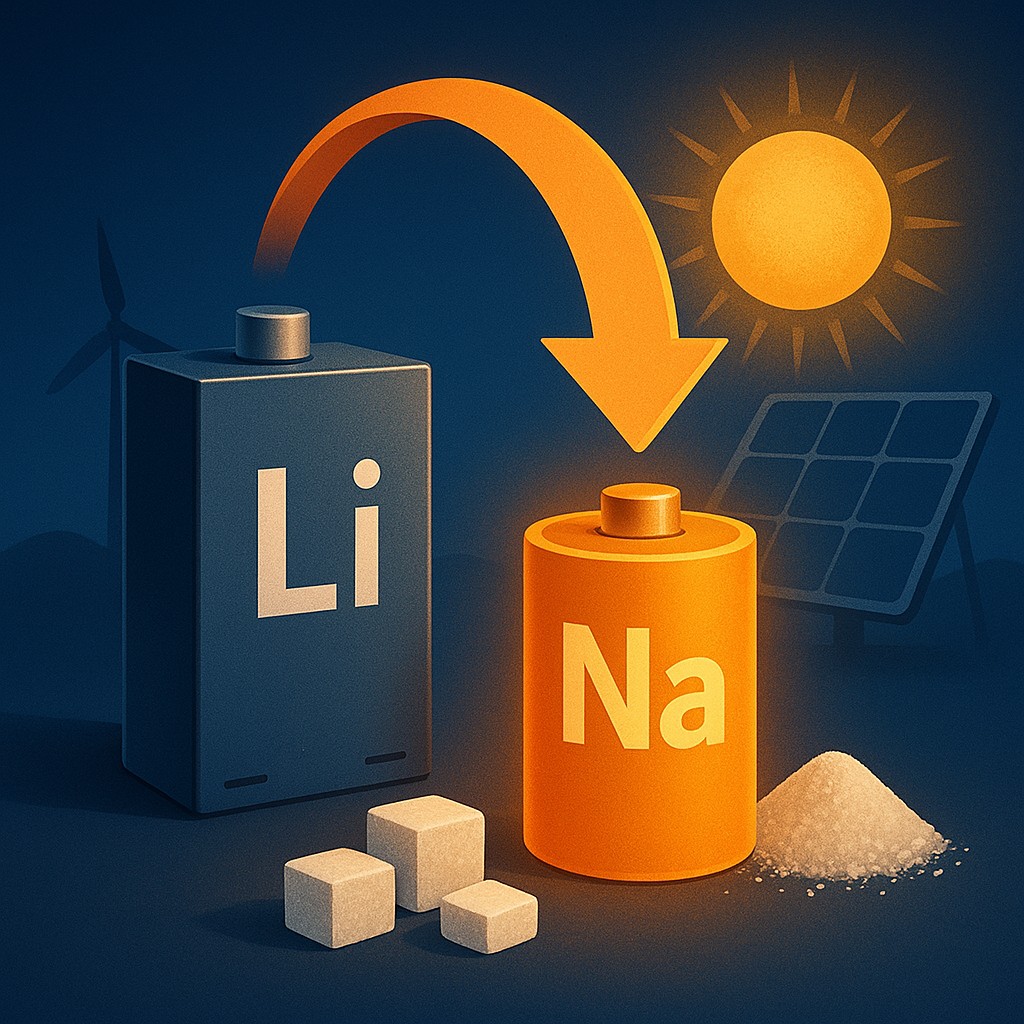
Imagine for a moment that the global transition to clean energy is a high-stakes dinner party. For the last decade, the guest of honor has been Lithium. It is sleek, energetic, and undeniably the life of the party, but it has a few glaring social flaws. It is expensive to invite, it is notoriously picky about where it comes from, and it tends to get temperamental if the room gets too hot or too cold. As the guest list for electric vehicles and renewable energy storage grows into the billions, we are starting to realize that relying on a single superstar might not be the most sustainable way to keep the party going.
Enter Sodium. You likely know it best as the partner to Chloride in your table salt, but in the world of electrochemistry, it is the reliable, abundant, and hardy cousin that is finally stepping into the spotlight. Sodium is everywhere, from the depths of the oceans to the salt flats of the world, making it thousands of times more available than lithium. While we have spent years refining the lithium-ion battery, a quiet revolution in labs and mega-factories is proving that shifting our focus to sodium could be the key to making green technology affordable for everyone, not just those with a luxury car budget.
The Chemistry of a Salty Shuffle
To understand why sodium is such a big deal, we first need to look at how a battery actually works. At its most basic level, a rechargeable battery is a chemical "rocking chair." When you charge your phone or your car, you use electrical energy to push ions, which are electrically charged atoms, from the positive cathode to the negative anode. When you use that device, the ions naturally want to flow back to the cathode, releasing that stored energy as a current. In a lithium-ion battery, lithium atoms do the heavy lifting. In a sodium-ion battery, we simply swap out the lithium for sodium.
The mechanics remain remarkably similar, which is great news for manufacturers. It means that many of the multimillion-dollar machines currently used to build lithium batteries can be repurposed to build sodium ones with only minor adjustments. However, sodium ions are physically larger and heavier than lithium ions. Imagine lithium as a nimble gymnast and sodium as a sturdy powerlifter. The powerlifter can do the same job, but he needs a slightly larger "chair" to sit in at either end of the battery. Scientists have had to develop new materials, like specialized hard carbons for the anode and Prussian Blue analogues, a type of synthetic pigment, for the cathode to give these larger sodium ions a comfortable place to land.
Trading Density for Durability
In the world of engineering, there is no such thing as a free lunch. If sodium is so abundant and cheap, why haven't we been using it all along? The trade-off comes down to energy density. Because sodium ions are heavier and larger, you cannot pack as many of them into the same amount of space as you can with lithium. This means that, pound for pound, a sodium-ion battery currently holds about 20 to 40 percent less energy than its high-end lithium counterpart. If you want to drive a high-performance sports car from New York to Washington, D.C. on a single charge, lithium is still your best bet.
However, sodium-ion batteries have a "superpower" that lithium lacks: they are incredibly resilient to extreme temperatures. Lithium-ion batteries are notoriously fragile in the cold, often losing a huge chunk of their range when the thermometer drops below freezing. Sodium-ion cells, by contrast, can maintain nearly 90 percent of their capacity even at minus 20 degrees Celsius. They are also significantly safer because they are less prone to "thermal runaway," which is the technical term for when a battery gets too hot and catches fire. For someone living in a cold climate or a homeowner looking for a safe battery to store solar energy in their garage, the slightly heavier weight of sodium is a trade-off well worth making.
| Feature |
Lithium-Ion (NMC) |
Sodium-Ion (Na-Ion) |
| Abundance |
Rare and Expensive |
Very High and Low Cost |
| Energy Density |
High (250-300 Wh/kg) |
Moderate (140-170 Wh/kg) |
| Cold Weather |
Poor Performance |
Excellent Performance |
| Safety |
High Fire Risk |
Very Stable and Low Fire Risk |
| Ideal Use |
Long-range EVs and Phones |
Budget EVs and Grid Storage |
Breaking the Supply Chain Stranglehold
Safety and science aside, the real driver behind the sodium-ion rush is a mix of geopolitics and simple economics. Lithium mining is concentrated in a handful of places, often involving complex refining processes and ethically murky supply chains. Because lithium is relatively rare, its price swings wildly based on global demand. When every car manufacturer on Earth decided to go electric at the same time, the price of lithium skyrocketed, making the "affordable" $25,000 electric vehicle seem like a pipe dream.
Sodium, however, can be extracted almost anywhere. You can get it from salt mines or even from seawater. By shifting to sodium-ion technology, countries can build their own battery industries without being tied to a fragile global supply chain. Recent breakthroughs by industry giants like CATL and Natron Energy have moved sodium-ion from the laboratory to mass production. We are now seeing the first generation of small, budget-friendly electric cars hitting the streets powered entirely by salt. These aren’t meant to win races or cross continents, but for a daily commute or a grocery run, they provide a path to zero emissions at a fraction of the current cost.
The Future of the Electric Grid
While cars get most of the headlines, the most important role for sodium-ion batteries might actually be standing still. Our future power grid relies on intermittent sources like wind and solar. To keep the lights on when the sun goes down or the breeze stops, we need massive stationary batteries to store that energy. Weight is not an issue for a battery that sits in a shipping container in the middle of a desert. In this scenario, sodium’s lower energy density does not matter, but its lower cost and higher safety profile are game-changers.
By using sodium for grid storage and short-range city cars, we can save the world's limited lithium supply for the applications that truly need it, such as long-haul trucking, aviation, and high-performance electronics. This hybrid approach creates a more balanced ecosystem where we aren't putting all our eggs in one mineral basket. As researchers refine the materials used in sodium batteries, we can expect their energy density to climb, further narrowing the gap and making "salt power" a common part of modern life.
The transition to a sustainable future is not about finding one single "miracle" technology that solves every problem. Instead, it is about finding the right tool for the right job. Sodium-ion batteries represent a victory for practical engineering over flashy performance. They remind us that sometimes the most sophisticated solutions are hidden in the most common places, even in a grain of salt. As you look toward a future of quieter streets and cleaner air, remember that the revolution might not be powered by a rare, expensive metal, but by the very same element that seasons your dinner. It is a shift that promises to make the green revolution more than a luxury for the few, but a reality for everyone.