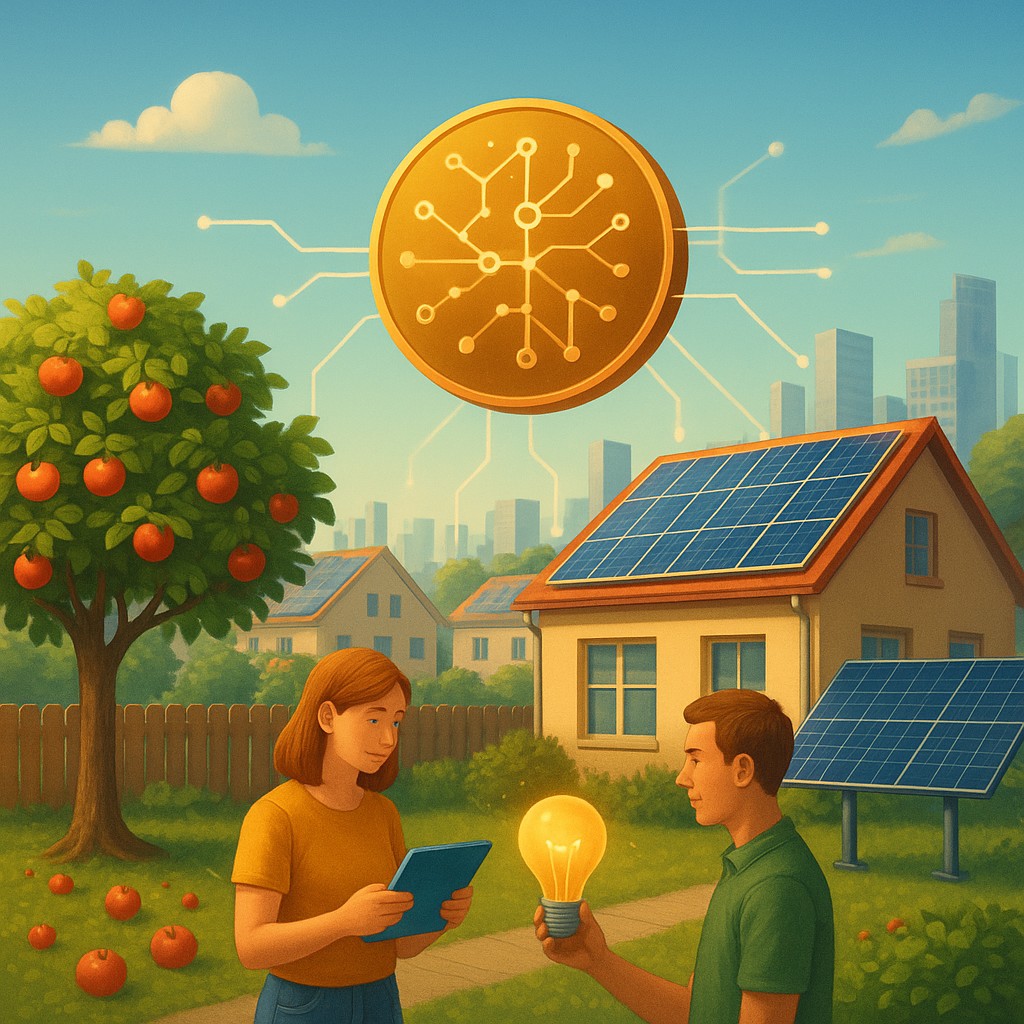
Imagine for a moment that your neighborhood is a giant, invisible fruit bowl. Your neighbor, Sarah, has an apple tree in her backyard that produces so much fruit that the extra apples are rotting on the grass. You, meanwhile, have run out of apples and want to bake a pie. In the traditional world, Sarah would have to ship her apples to a massive industrial processing plant fifty miles away to be washed and packaged, then shipped back to the grocery store on your corner. By the time you buy them, the apples are bruised from the journey, and you have paid three times the price to cover the shipping costs. This is exactly how our current power grid operates, moving electricity over vast distances and losing a massive chunk of that energy to heat and resistance along the way.
We are currently witnessing a shift toward a more logical, localized way of managing power. New international pilot programs are rethinking the "fruit bowl" by creating urban microgrids. These are small-scale energy networks that allow people with solar panels - known as "prosumers" because they both produce and consume - to sell their excess electricity directly to their neighbors. Instead of that energy traveling back to a distant central power plant, it stays within the block. By using decentralized ledgers - the same record-keeping technology that powers digital currencies - these neighborhoods are creating automated marketplaces where energy is traded in real time. This isn't just a digital gimmick; it is a fundamental redesign of how we power our lives, turning a passive utility into a vibrant, community-led ecosystem.
The Architecture of a Neighborhood Power Hub
To understand how these projects work, we have to look at the physical and digital setup of a microgrid. A standard grid is like a one-way street where power flows from a massive plant to your toaster. A microgrid, however, is a "loop" that can operate on its own if the main grid fails. It consists of local power sources, like rooftop solar panels or small wind turbines, and storage systems like large-scale batteries. The "secret sauce" of the modern trials being tested in cities like Brooklyn, Delhi, and Bangkok is the way they connect smart meters to a decentralized ledger. This ledger acts as a transparent, unchangeable record of who produced and used what, ensuring every bit of energy is accounted for without needing a giant utility company to act as a middleman.
The beauty of this localized approach is its ability to handle "transactive energy." In a traditional setup, you are just a consumer paying a flat rate. In a microgrid pilot, your house becomes an intelligent part of the network. When your neighbor’s solar panels produce a surplus at 2:00 PM while they are at work, the digital ledger recognizes the extra power. If your air conditioner kicks on at the same time, the system executes a "smart contract" - an automated agreement that sells her excess power to you at a rate lower than the utility's price, but higher than what she would get by selling it back to the main grid. It is a win-win scenario where the money stays within the community rather than disappearing into the overhead costs of a massive corporation.
Why Proximity Matters for Efficiency and Resilience
One of the most persistent myths about electricity is that it is a weightless substance that travels instantly and perfectly. In reality, moving electricity is a messy process. As power travels through miles of high-voltage wires, it hits resistance, which turns some of that energy into heat. This is known as "line loss." On average, between 5% and 10% of all electricity generated is simply lost during its journey to your home. By keeping the energy local, urban microgrids virtually eliminate these losses. When Sarah's solar panels power your TV three houses away, the distance is so short that the efficiency is near perfect. We are effectively harvesting and using energy on the same patch of land, which is the ultimate goal of sustainable design.
Beyond efficiency, there is the critical factor of resilience. Our current central grids are often "brittle," meaning a single fallen tree on a high-voltage line in a remote forest can cause a blackout for an entire city. Microgrids are designed with "islanding" capabilities. If the main grid goes down due to a storm or a cyberattack, the microgrid can disconnect itself and continue to function using its own local power and battery storage. During a large-scale blackout, a block with a microgrid would be the only one with the lights still on. These pilot programs are proving that decentralization is not just about saving money; it is about creating a "honeycomb" of power where the failure of one cell does not bring down the entire structure.
| Feature |
Traditional Centralized Grid |
Decentralized P2P Microgrid |
| Power Source |
Distant large plants (Gas, Coal, Nuclear) |
Local rooftop solar, wind, and batteries |
| Flow Direction |
One-way: Utility to Consumer |
Multi-directional: Neighbor to Neighbor |
| Energy Loss |
High (due to long-distance travel) |
Extremely Low (used where it is made) |
| Control System |
Centralized utility management |
Automated smart contracts on a ledger |
| Resilience |
At risk from single-point failures |
Can "island" itself during blackouts |
| Market Role |
Passive Consumer |
Active Prosumer (Producer + Consumer) |
The Role of the Digital Ledger in Fair Trading
It is important to clear up a common misunderstanding: trading energy with your neighbors is not the same as buying "green energy credits" from your utility. When you buy a credit, you are essentially paying for the idea of renewable energy being created somewhere else. In a microgrid, you are trading the actual, physical energy. The ledger, often built on blockchain technology, ensures that no one "double counts" their power. It provides a level of trust that was previously impossible. Without a central authority, how do you know your neighbor actually sent you five kilowatt-hours? The digital ledger records the meter data from both houses at the same time, creating a permanent, verifiable receipt.
This technology also allows for fairness and customization. Recent research into "Multi-Agent Reinforcement Learning" - a type of artificial intelligence - is being used to design marketplaces that are equitable, not just efficient. For example, a microgrid could be programmed to prioritize selling low-cost energy to a local hospital or low-income housing before offering it to the highest bidder. Because the system is run by code, the community can democratically decide the "rules" of their local energy market. This transforms the grid from a cold necessity into a social tool that reflects the values of the people living there.
Overcoming the Hurdles of Hardware and Regulation
If this technology is so much better, why isn't every city block already its own microgrid? The primary challenges aren't the digital ledgers or the solar panels; they are old-fashioned regulations and physical switches. Most current laws were written in the mid-20th century and assume that only a government-regulated utility has the right to sell power. These pilot programs are essential because they provide a "regulatory sandbox" - a safe space where governments can test new rules without breaking the law. They are proving to lawmakers that allowing neighbors to trade power doesn't crash the system, but actually makes it more stable.
There is also the matter of the physical hardware. For a microgrid to work, it needs "switchgear" that can safely disconnect from the main grid without sending a dangerous surge of power back into the lines where utility workers might be making repairs. These "smart switches" and high-capacity local batteries are still relatively expensive, though prices are falling fast. Projects like the Brooklyn Microgrid have shown that even without a full hardware overhaul, a "virtual" trading layer can be set up where the financial transactions happen on a ledger while the physical power follows the path of least resistance through existing wires. This hybrid approach lets communities start trading now while they gradually upgrade their equipment.
The Shift from Consumer to Participant
Perhaps the most profound change brought about by these projects is psychological. For over a century, we have been "passive consumers" of energy. We flip a switch, the light comes on, and we pay a bill at the end of the month without thinking about where that power came from. By participating in a peer-to-peer marketplace, you become an active part of the energy ecosystem. You might check an app and realize that because it is a particularly sunny day, you can make five dollars by waiting to do your laundry and selling your solar surplus to the bakery down the street.
This level of involvement leads to better habits. When you can see the direct financial and community benefit of saving energy, you are more likely to invest in efficiency. It creates a "closed loop" of accountability. You aren't just saving the planet in some abstract sense; you are helping your neighbor power their home and keeping money in your local economy. This shift in perspective is what will ultimately drive the transition to a carbon-neutral world. We are moving away from a model of "extraction and waste" and toward a model of "sharing and optimization."
Redefining the Future of Urban Power
The transition to decentralized energy is more than a technical upgrade; it is a social evolution. As we continue to refine the way digital ledgers interact with physical wires, the very definition of a "utility" will change. In the future, large power companies might not be the primary providers of electricity, but rather the managers of the "superhighway" that connects thousands of individual microgrids. They will facilitate the movement of power between neighborhoods when one area is cloudy and another has bright sun, acting as the connective tissue for a massive, living network of prosumers.
As you look out your window at the houses on your street, try to imagine them not just as buildings, but as interconnected batteries and generators. The technology to make this happen is already moving out of the laboratory and onto the streets of cities worldwide. By embracing the complexity of digital trading and the simplicity of local sharing, we are building a world that is more resilient, more efficient, and more human. The next time you see a solar panel on a neighbor's roof, remember that it isn't just a piece of glass; it's the start of a revolution that is putting the power, quite literally, back into the hands of the people.