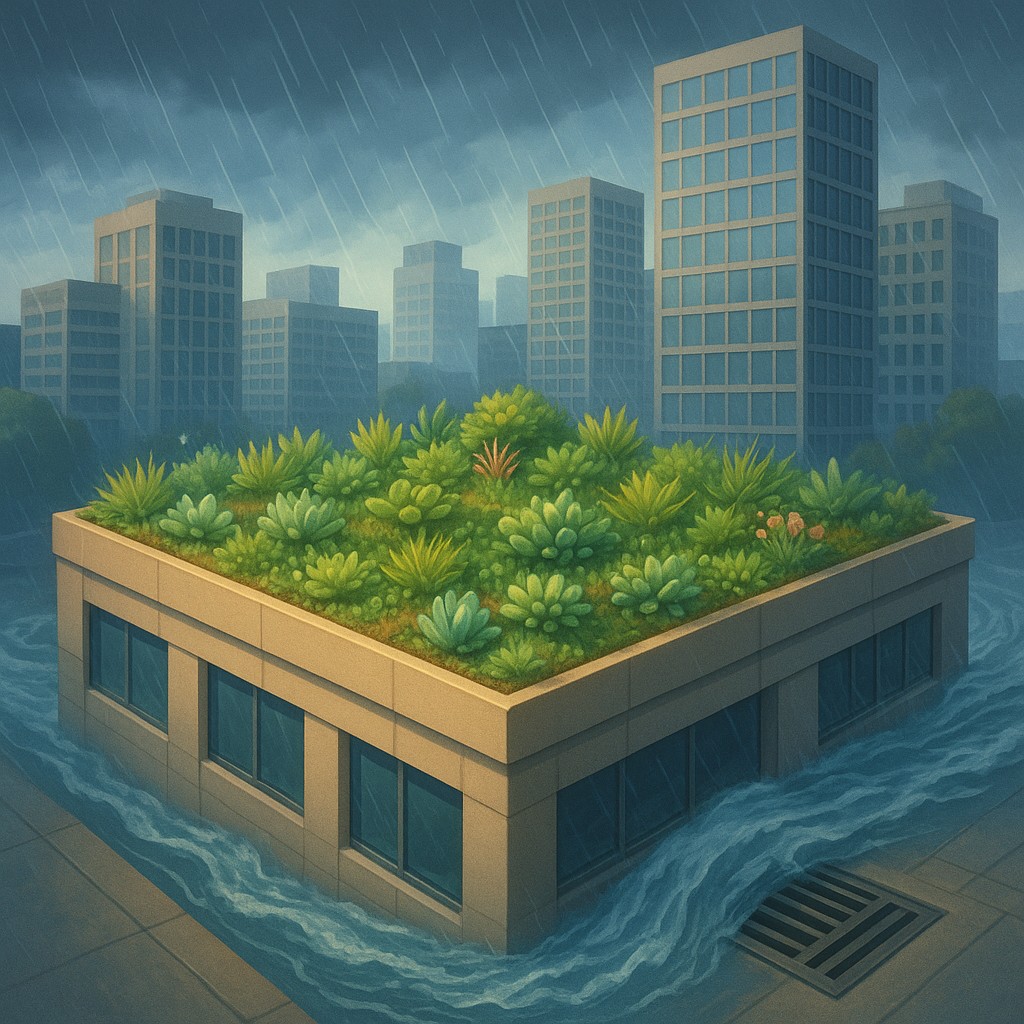
Imagine the anatomy of a typical modern city. We usually see a landscape of vertical glass towers and horizontal asphalt streets, but to a civil engineer, a city is actually a massive, rigid funnel. When a thunderstorm rolls in, every square inch of concrete acts like a slide, accelerating rainwater toward the nearest storm drain. In a forest, that water would soak into the soil or slow down as it trickles through leaf litter; in a city, it creates a sudden, violent surge. This surge causes a "bottleneck" where underground pipes simply cannot keep up with the volume, leading to the flash flooding we see so often in urban areas.
The consequences of this bottleneck go beyond soggy shoes and stalled traffic. In many older cities, the pipes carrying rainwater are the same ones that carry raw sewage from our toilets and sinks. When a heavy downpour overwhelms the system, it triggers a "Combined Sewer Overflow." To prevent plumbing from backing up into homes, the system intentionally diverts the excess mix of rain and sewage directly into local rivers and oceans. It is a messy, low-tech solution to a high-speed problem. However, a new architectural shift is turning our rooftops into the first line of defense against this ecological disaster.
Rethinking the Urban Sponge
For years, the gold standard for eco-friendly building was the "green roof," a lush layer of succulents and grasses atop a skyscraper. While these are wonderful for insulating buildings and providing habitats for bees, they have a hidden limitation during heavy rain. Once those few inches of soil are soaked through, any additional rain simply runs off the edge, just as it would on flat concrete. A green roof acts like a small kitchen sponge; it is great at holding the first bit of moisture, but once it is full, it cannot stop a flood.
This is where the "blue-green" roof comes in. Instead of focusing only on the plants, engineers have begun installing a hidden, hollow layer beneath the soil. This "detention" layer acts as a temporary reservoir, a void created by high-strength plastic crates or honeycomb structures. When the sky opens up, the water does not just hit the soil and leave. It filters through the greenery and fills this subsurface tank. By treating the roof as a storage vessel rather than just a garden, we transform a passive architectural feature into an active piece of water-management machinery.
The Intelligence of the Slow Release
The "blue" part of the blue-green roof is the revolutionary bit. If you simply caught the water and kept it there, the roof would become incredibly heavy, potentially risking the building's structural integrity. Furthermore, you would have no room left for the next storm. The magic lies in a device called a "smart valve" or a restricted-flow orifice. Instead of a wide drain that lets water gush out instantly, these systems use sensors and weather data to control how much water leaves the roof and when.
Think of it as the difference between dumping a five-gallon bucket of water onto a floor versus turning on a slow-dripping faucet. During the peak of a storm, while the city's sewers are struggling, the blue-green roof stays largely closed. It holds those thousands of gallons of water captive, away from the streets. Only once the storm has passed and the city's main pipes have "exhaled" and emptied out does the smart valve begin to open. It releases the stored rainwater over the next 24 to 48 hours, ensuring the water enters the city's infrastructure at a rate the pipes can actually handle.
Comparing Traditional and Modern Rooftop Solutions
To understand why this is such a significant upgrade, it helps to look at how different rooftop styles handle a typical heavy rain event. While each has its merits, the blue-green approach is specifically designed to tackle the systemic issue of sewer capacity.
| Feature |
Standard Concrete Roof |
Traditional Green Roof |
Blue-Green (Detention) Roof |
| Water Retention |
Zero. Runoff is immediate. |
Moderate. Saturated quickly. |
High. Controlled by hidden tanks. |
| Peak Flow Timing |
Hits sewers at the storm's peak. |
Slightly delayed by soil. |
Delayed by hours or days via valves. |
| Evaporation |
Low. Water flows away fast. |
High. Plants release water to air. |
High. Multi-layered cooling effect. |
| Primary Goal |
Shed water to protect building. |
Insulation and biodiversity. |
Urban flood and sewage prevention. |
| Complexity |
Very Low. |
Moderate (requires soil care). |
High (requires sensors and valves). |
The Physics of Weight and Structural Safety
One of the most common questions people ask about blue-green roofs is, "Won't the building collapse under the weight?" It is a fair concern. Water is heavy, weighing roughly 62 pounds per cubic foot. If a roof holds four inches of standing water over a massive surface area, that adds up to many tons of extra pressure. This is why these systems are not just "slapped onto" existing buildings. They are integrated into the structural engineering phase, where "dead load" (the weight of the building itself) and "live load" (temporary weights like people or snow) are adjusted to account for maximum water storage.
However, engineers have a clever trick: they do not actually need to store the water for long. Because the system is dynamic, it can be programmed to purge itself if a truly catastrophic storm is detected. If sensors indicate a "once-in-a-century" rainfall that exceeds the roof's capacity, the smart valves can fully open to prevent weight-related damage. Interestingly, these roofs also utilize "hydraulic head," which is the pressure created by standing water, to help push the liquid through filtration layers. This ensures the water leaving the roof is cleaner than when it arrived, having been filtered twice by the soil and the detention crates.
The Ghost of the Combined Sewer
To appreciate the blue-green roof, you have to understand the "ghost" haunting our older cities: the Combined Sewer System. In places like New York, London, Philadelphia, and Chicago, 19th-century engineers thought it was brilliant to put everything in one pipe. It saved money and space. For a hundred years, it worked fine. But as cities grew and more "impermeable surfaces" like concrete and asphalt were laid down, the volume of rain hitting those pipes increased exponentially. Today, even a relatively light rain of half an inch can trigger an overflow event.
When a builder installs a blue-green roof, they are essentially providing a "buffer" for that aging infrastructure. By holding back the rain, they prevent the tipping point where the sewer treatment plant gets overwhelmed. This is why local governments are starting to offer massive tax breaks or even making these roofs mandatory for new developments. It is far cheaper for a city to demand that developers build smart roofs than it is for the city to dig up every street and replace miles of antique piping with larger, separate systems.
The Cooling Effect and Urban Heat Islands
Beyond flood prevention, blue-green roofs tackle another silent urban killer: heat. You have likely noticed that walking through a city in July feels significantly hotter than walking through a park. This is the "Urban Heat Island" effect, caused by dark surfaces like asphalt and rubber roofing membranes absorbing sunlight and radiating it back out as heat. A standard black roof can reach 150 degrees Fahrenheit on a sunny day.
A blue-green roof works like a massive, natural air conditioning system. First, the plants reflect more sunlight than black rubber does. Second, the water stored in the detention layer provides thermal mass, meaning it takes a long time to heat up. Most importantly, through a process called evapotranspiration, the plants use the stored water to stay cool, effectively "sweating" and cooling the air around the building. Some studies show that if a significant percentage of a city's roofs were converted to blue-green systems, the temperature of the entire city could drop by several degrees during heatwaves, reducing energy demand and saving lives.
Maintenance and the Future of Smart Water
The transition to blue-green infrastructure represents a shift from "dumb" buildings to living systems. These roofs require more than just a gardener; they require a technician. The smart valves must be checked for clogs, the sensors must stay calibrated, and the drainage layers must be kept free of sediment. This creates a new niche in the labor market: the urban water technician, someone who understands both the biology of plants and the digital logic of water valves.
As climate change makes weather patterns more volatile, with longer droughts followed by more intense downpours, the blue-green roof will likely become the standard rather than the exception. We are moving toward a future where "smart cities" are not just about high-speed internet and self-driving cars, but about buildings that work in harmony with the water cycle. By slowing down, holding on, and releasing with intention, our skyscrapers are finally learning to mimic the wisdom of the natural world, turning a rainy day from a threat into a resource.
The next time you are caught in a downpour in a major city, look up. While some of that water is certainly causing a mess on the ground, a quiet revolution is happening hundreds of feet above your head. In a series of hidden reservoirs, billions of droplets are being caught, paused, and redirected. It is an invisible dance of physics and technology that keeps our rivers cleaner and our streets drier. We are finally learning that to master the urban environment, we do not need to fight the water; we just need to give it a place to stay for a while.