Have you ever noticed how a rowdy birthday party suddenly feels quiet when everyone starts singing "Happy Birthday," despite the crowd? Or maybe you have sat in a massive staff meeting where twenty people are huddled around a mahogany table, but only two are doing the heavy lifting while the rest stare blankly at their coffee. This is a strange paradox of human nature. From childhood, we are taught that "many hands make light work" and "there is no 'I' in team." In practice, however, throwing more people at a problem often results in everyone doing a little bit less. This does not happen because people are naturally lazy. Instead, it is caused by a fascinating psychological glitch in how we view our own value when we are part of a crowd.
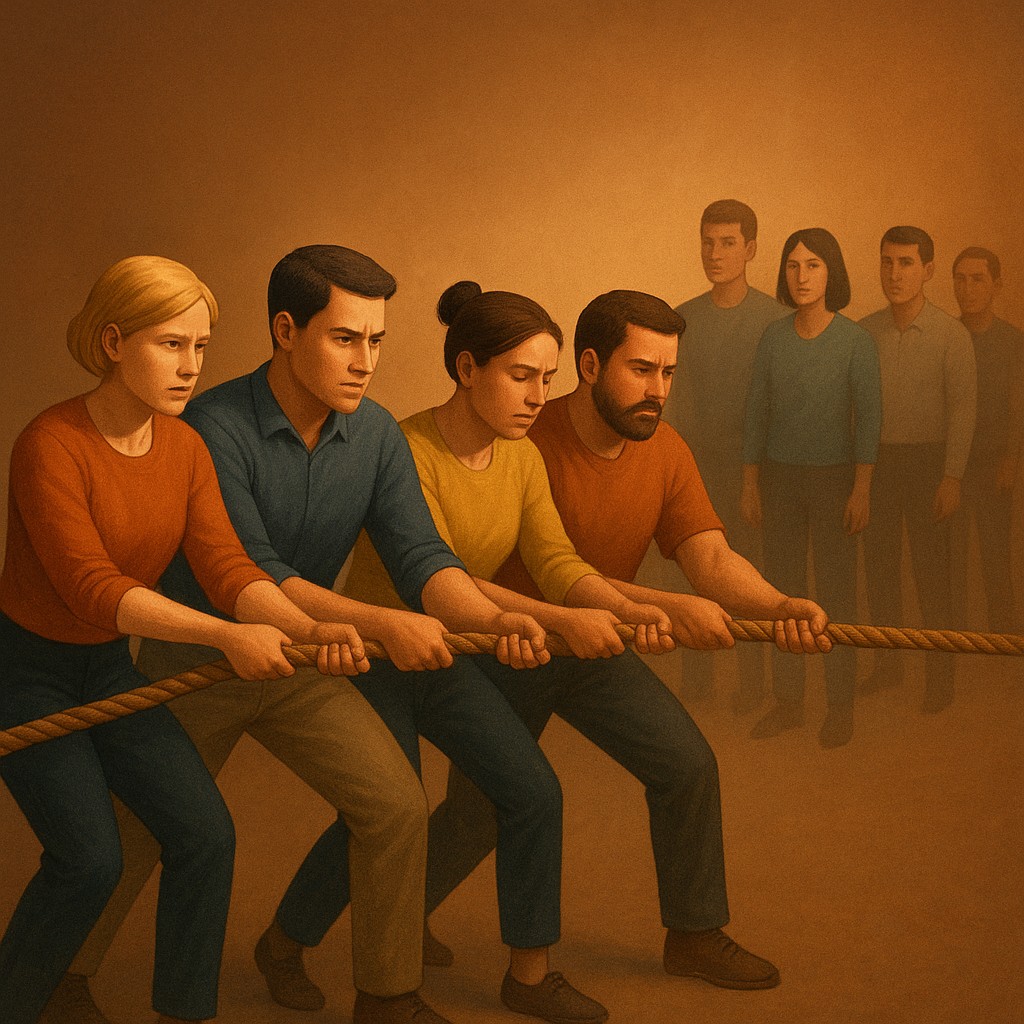
This phenomenon was first spotted in the late 19th century by a French agricultural engineer named Maximilien Ringelmann. He was not looking at corporate boardrooms or software developers, but rather the sheer physical power of men pulling on ropes. He discovered something that defied the common sense of the time: as he added more men to the rope, the total pulling force went up, but the effort from each individual dropped significantly. When a person pulled alone, they gave 100 percent of their strength. But when eight people pulled together, they were not even using half of their individual capacity. This discovery is known as the Ringelmann Effect. It explains everything from why school group projects are a nightmare to why massive corporations often move at a snail's pace.
The Secret Math of Pulling Your Weight
Maximilien Ringelmann’s original experiments were simple and elegant. He asked volunteers to pull on a rope as hard as they could, first alone and then in groups of various sizes. If one person could pull with 100 units of force, logic suggests that two people should pull with 200 units, and eight people should hit 800. However, the data told a different, lazier story. When two people pulled, they only reached about 93 percent of their combined potential. By the time a group reached eight people, individual effort dropped to a staggering 49 percent. It appeared that as the crowd grew, the "invisible" nature of the work allowed people to unconsciously take their foot off the gas.
Decades later, psychologists followed Ringelmann’s lead to see if this was just a matter of people getting their arms tangled or if something deeper was happening in the brain. They ran "pseudo-group" experiments where participants were blindfolded and told they were pulling with a team, when they were actually pulling alone. The results were revealing. Even when they were the only ones on the rope, if they thought four other people were helping, they worked much less hard. This proved the Ringelmann Effect is not just a physical coordination problem; it is psychological. This is what we now call "Social Loafing," the tendency for people to put in less effort when they are part of a group than when they work by themselves.
Why We Subconsciously Decide to Slack Off
To understand why this happens, we have to look at the "Diffusion of Responsibility." In a solo task, you are the star, the director, and the stagehand. If the task fails, it is your fault. If it succeeds, you get the glory. But as soon as you add more people, the psychological "cost" of failure is divided. If a project fails in a group of ten, you only feel 10 percent responsible. This mental math leads to a sense of anonymity. If your specific contribution cannot be measured, identified, or rewarded, your brain starts to wonder why it should burn its energy being a hero.
Another factor is the feeling of being "dispensable." In a large group, you might feel that your specific effort is not essential to the final result. You tell yourself that "someone else has probably got this," or that your extra 10 percent of effort won't really change the outcome. This rationalization happens almost entirely below the level of conscious thought. You are not trying to be a slacker; you are simply reacting to a situation where the link between your effort and the result has been diluted. This is especially common in "additive tasks," where the final product is just the sum of everyone doing the same thing, like data entry, raking leaves, or pulling a rope.
The Two Hidden Culprits of Group Inefficiency
The Ringelmann Effect is actually caused by two different problems that often get lumped together. The first is "motivation loss," which is the social loafing we just discussed. This is the psychological side where we just don't feel like trying as hard because we are hidden in the crowd. The second culprit is "coordination loss." even if every single person in a ten-person group wanted to give 100 percent effort, they would still likely produce less than ten individuals working separately because they would get in each other’s way.
Coordination loss is the "too many cooks in the kitchen" problem. On a rope, people might not pull at exactly the same micro-second, or they might pull at slightly different angles, causing their forces to cancel out. In a modern office, this looks like endless "reply-all" emails, redundant meetings to schedule more meetings, and three different people accidentally working on the same spreadsheet. The larger the group, the more time and energy must be spent simply communicating and staying in sync, which leaves less energy for the actual work.
| Factor |
Description |
Impact on Performance |
| Motivation Loss |
People feel less accountable and work less hard because their effort is hidden. |
Lowers individual output as the group gets bigger. |
| Coordination Loss |
Group members struggle to sync up or get in each other's way. |
Creates friction and wastes time on "work about work." |
| Identifiability |
How easily an individual's specific work can be seen by others. |
High visibility reduces social loafing significantly. |
| Evaluation Apprehension |
The awareness or fear that one's performance is being judged. |
Increases effort but can also increase stress during complex tasks. |
Collective Work vs. True Collaboration
It is vital to understand that the Ringelmann Effect does not mean all teams are bad. There is a huge difference between a group of people doing the "same" work and a diverse team collaborating on a complex project. Ringelmann’s rope pullers were all doing an identical, simple task. In that scenario, more people almost always lead to diminishing returns. However, if you are building an airplane, one person cannot do it alone, no matter how hard they pull on their metaphorical rope. You need a structural engineer, a computer expert, a designer, and a project manager.
This is true collaboration, where the group is made of different skill sets that fit together. In these cases, the Ringelmann Effect is naturally blocked because each person’s contribution is unique and highly visible. If the computer expert stops working, the plane has no operating system, and everyone knows exactly who was responsible for that part. The "mask of the crowd" is removed because no one else can do what they do. To avoid the Ringelmann Effect, you must turn tasks where everyone does the same thing into "specialized" tasks where every piece of the puzzle is clearly owned by one person.
Strategies for Building Lean and Effective Teams
So, how do we fight the shadow of social loafing? The most obvious answer is to keep groups small. Jeff Bezos, the founder of Amazon, famously used the "Two-Pizza Rule," which says a team should never be so large that it takes more than two large pizzas to feed them. By keeping the head count low, you ensure that every person’s contribution is visible and that the "coordination tax" stays low. When you are one of five people, you cannot hide. When you are one of fifty, you can disappear for an entire afternoon without anyone noticing.
Another powerful tool is the "Individualization of Output." If you must have a large group, find ways to break the main task into smaller pieces assigned to specific people. If people know their name will be attached to a specific slide in a presentation or a specific line of code, the Ringelmann Effect essentially evaporates. We are social creatures who care about our reputations. As long as we feel our peers and leaders can see us, we are much more likely to stay engaged. Accountability is the natural enemy of the slacker.
Turning the Tide on Team Fatigue
Overcoming the Ringelmann Effect also requires a shift in how we value work. Often, we celebrate the size of a department or the number of people assigned to a project as if the headcount itself measures importance. In reality, a large headcount is often a burden. Great leaders focus on "Talent Density" rather than a high volume of bodies. They ensure every person on the team feels "indispensable." When a team member knows their presence truly matters and their absence would be felt, their motivation to contribute peaks.
Finally, creating a culture of high engagement and transparency can stop the subconscious urge to coast. When a team has a clear, shared goal that everyone believes in, "Motivation Loss" is replaced by a sense of purpose. People are less likely to loaf when they feel they are part of a mission rather than just a cog in a machine. By building an environment where individual work is recognized and group sizes stay lean, you can harness the true power of cooperation without falling into the trap of diminishing returns. Efficiency is not just about working harder; it is about structuring our groups so our natural tendency to rest does not get in the way of our potential.
Now that you understand the invisible forces pulling on the rope of productivity, you can look at your own work and social circles with a fresh eye. Whether you are leading a company or organizing a neighborhood cleanup, remember that more is not always better. By shrinking the circle, clarifying roles, and ensuring every hand on the rope is visible, you turn a group of onlookers into a powerhouse of action. Design your teams with precision, and watch as your collective results finally equal, or even exceed, the sum of their parts.