Why the story of Christmas is more interesting than you think
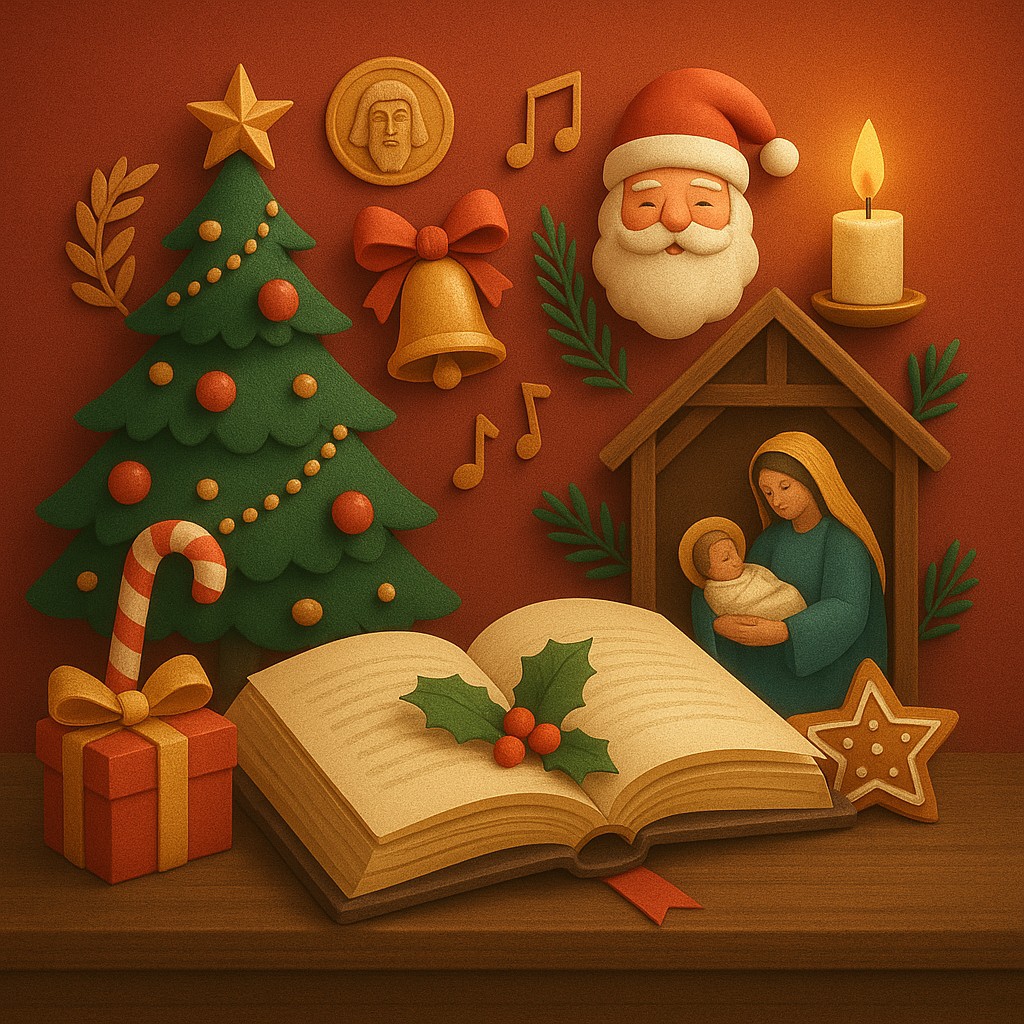
Most of us picture Christmas as a cozy mix of twinkling lights, a blaring pop carol, and a plate of cookies left for a jolly man in red. That image feels timeless, but the holiday we call Christmas is actually a layered tapestry sewn from very different threads: ancient sun festivals, Roman parties, Germanic tree reverence, early Christian theology, medieval saints, and modern marketing. Learning where Christmas came from helps us see how human communities invent meaning, borrow symbols, and keep reinventing rituals so they stay useful and fun.
If you are curious about history, folklore, or why we hang evergreen boughs in the middle of winter, the origins of Christmas are a small, enthralling history lesson about cultural creativity. The story mixes documented facts, plausible reconstructions, and a few charming myths that refuse to die. By the end of this piece you will be able to explain why December 25 was chosen, who brought the Christmas tree into homes, why St Nicholas became Santa Claus, and which parts of our celebrations are ancient rather than invented last century.
Along the way we will correct common misunderstandings, balance scholarly evidence with storytelling energy, and show how rituals satisfy deep psychological and social needs. Think of this as a guided stroll through time: you will leave smarter, entertained, and with a few memorable talking points for holiday dinners.
Why winter prompts festivals: light, survival, and social glue
Human beings living in temperate climates have always felt the cold months as a turning point that demands attention. The winter solstice, the day with the least sunlight, is not just a celestial event, it has massive practical consequences for food stocks, travel, and social stability. When days grow short, people respond by conserving resources and also by intensifying social bonds - feasting and celebration become ways to strengthen cooperation through scarcity. That is why many cultures have midwinter festivals: they mark the year’s pivot while giving people reasons to gather, share, and plan for the months ahead.
Rituals that celebrate light - candles, bonfires, torches - make intuitive sense in a season of darkness. They are not merely decorative; they symbolically affirm life and continuity in a risky time. Evergreen plants, which stay green through winter, serve as living reminders that life persists. Festivities also reduce stress, create shared memories, and provide an occasion to redistribute food and wealth - all practical stabilizers for communities when survival is less certain.
Anthropologists emphasize that ritual timing also helps coordinate labor and expectation. A midwinter festival creates a social clock: everyone knows that after this point, certain labors can restart, inventories will be counted, and seasonal rhythms will shift. Over centuries, these practical and symbolic reasons made midwinter an attractive slot for major communal rituals, which then became culturally sticky.
Romans, revelry, and political theater: Saturnalia as a template
One of the most famous Roman celebrations that shaped later winter customs was Saturnalia. Held in December in honor of Saturn, the god of agriculture, this festival featured feasting, public gambling, role reversals between masters and servants, and the exchange of small gifts. Saturnalia’s spirit was one of license and topsy-turvy merriment, and its popularity among Romans helped normalize December as a season for public celebration and private fun.
Because the Roman world was so extensive, Saturnalia’s practices and vocabulary circulated widely. The idea of wearing special clothes, lighting lamps, and giving presents were social motifs easily transferred into other contexts. Importantly, many early Christians lived in a Roman cultural environment shaped by festival rhythms, so when Christianity sought to create its own ritual calendar it often did so in conversation with existing practices rather than from scratch.
Saturnalia provides a clear example of how preexisting festival forms can be adapted by a new religious movement. Instead of entirely rejecting the season’s social functions, early Christian leaders frequently reinterpreted or re-timed them to emphasize theological meanings while preserving the social benefits of celebration.
Northern lights: Yule, evergreen worship, and communal feasts
In the Germanic and Norse world, the winter festival called Yule or Yuletide carried many customs that later blended into Christmas. Yule was a time of feasting, storytelling about the ancestors and gods, and rituals honoring the turning of the seasons. Evidence from medieval Scandinavia and later folklore shows practices such as the yule log, large communal feasts, and toasts to the gods and the household spirits.
Evergreens played a strong symbolic role in these northern traditions because they visibly resisted winter’s decay. Wreaths, boughs, and later whole trees were used to signify resilience and to mark sacred spaces. In some folk beliefs, decorations and offerings during Yule were thought to propitiate domestic spirits or household gods, linking prosperity and protection to ritual acts.
When Germanic and Norse peoples were Christianized, many of their Yule practices persisted in modified forms. The result was a syncretic landscape where pre-Christian motifs met Christian narratives, producing hybrid customs that felt both ancestral and doctrinally acceptable.
Choosing December 25: calculation, competition, and compromise
One of the most debated questions about Christmas is why December 25 was chosen as the date to celebrate Jesus’ birth. The short answer is there is no single simple reason; instead historians point to at least two major influences that likely converged. One is a theological calculation used by some early Christians that pegged Jesus’ conception to March 25, a date already associated with significant religious symbolism. Adding nine months gives December 25 as the birth date. This "calculation" theory appears in several early Christian writings and shows how symbolic chronology shaped liturgical timing.
A second influence is the presence of Roman midwinter observances, most notably the celebration of Sol Invictus - the Unconquered Sun - which Emperor Aurelian promoted in the third century. December was already a festival time in Rome, and choosing December 25 allowed Christian leaders to repurpose familiar public moments for Christian worship. There is also evidence of political dynamics: after Constantine’s conversion, the Christianization of public rituals accelerated, and adopting a popular festival slot made it easier to win adherence.
We should also note that in the eastern parts of the Christian world, other dates such as January 6 were important for celebrating Jesus’ birth and baptism. The consolidation of December 25 as the dominant date in the West took centuries and involved both theological argument and pragmatic cultural adaptation.
The Nativity narratives: story, theology, and historical puzzles
The biblical accounts of Jesus’ birth appear in Matthew and Luke, and they emphasize theological points more than precise historical detail. Luke’s narrative features shepherds, suggesting a rural scene, while Matthew focuses on magi, Herod’s massacre, and a different setting. These differences tell us that the early Christians were less concerned with creating a factual biography and more interested in expressing what the birth meant for different audiences.
Historical evidence for the exact date or detailed circumstances of the birth is thin. Scholars debate whether shepherds at night indicate a spring birth rather than a winter one, and whether census descriptions can be reconciled with known Roman practices. The result is a reasonable scholarly consensus that the Gospel nativity accounts are theological narratives shaped by memory and liturgical needs, not modern-style historical reports.
That does not diminish their cultural power. The nativity stories provide rich symbolic material that communities have used for centuries to frame the season: themes of light in darkness, humble birth, divine visitation, and the reversal of worldly status. Those themes made it easy for preexisting festival forms to be folded into Christian celebrations.
From St Nicholas to Santa: saints, merchants, and myth-making
Gift-giving around midwinter gained new meanings through saints, especially St Nicholas of Myra, a fourth-century bishop famed for secret generosity. Stories of his charity fed into medieval and early modern customs of giving on saints’ feast days. In the Low Countries, the figure of Sinterklaas developed strong local traditions: a bishop-like figure arriving by boat, distributing gifts to children, with attendant folklore.
When Dutch settlers brought Sinterklaas to North America, the figure began to merge with British and American ideas of a winter gift-bringer, evolving into what we now call Santa Claus. Important literary and visual boosters include Clement Clarke Moore’s 1823 poem "A Visit from St. Nicholas" and the nineteenth-century cartoons by Thomas Nast. Popular portrayals solidified a jolly, rotund man in a red suit, flying reindeer, and a North Pole workshop.
A common myth is that Coca-Cola invented the modern Santa image. In reality, the red-suited Santa is an accumulation of influences across centuries, and Coca-Cola’s advertising in the 1930s simply popularized an already familiar image. The progression from saintly generosity to a commercialized, gift-delivering cultural icon reveals how religion, folklore, and commerce can combine to produce enduring figures.
Table: Quick comparison of key traditions that fed into Christmas
| Tradition |
Time and place |
Core practices |
Symbolic meaning |
How it influenced Christmas |
| Saturnalia |
Roman Republic/Empire, December |
Feasting, role reversal, gift-giving |
Social license, reversal of norms, community cohesion |
Modeled December as festival time and gift exchange |
| Yule |
Germanic/Norse, midwinter |
Feasting, yule log, evergreens |
Renewal, endurance of life, ancestor veneration |
Evergreens, communal feasting, seasonal symbols |
| Sol Invictus |
Roman Empire, late December |
Public rituals honoring sun god |
Triumph of light, imperial unity |
Helped fix solstice-related festivals in late December |
| Early Christian Christmas |
4th century onward, Mediterranean |
Nativity liturgy, hymns, feasts |
Incarnation theology, light in darkness |
Reinterpreted midwinter symbols for Christian meaning |
Carols, trees, and Victorian reinvention
Many of the festive trimmings we now take for granted were solidified in the 18th and 19th centuries. The Christmas tree, while having precursors in medieval Germanic customs, became a domestic centerpiece in the early modern period and popularized in Britain after Prince Albert, a German prince, set up a decorated tree at Windsor in the 1840s. Caroling combines medieval wassail traditions, early Christian hymns, and communal music making that reinforced social ties.
Victorian sensibilities played a huge role in shaping the modern family-centered, sentimental Christmas. Christmas cards, turkey dinners, and an emphasis on children reflect tastes and social reforms of the era. The period also saw the rise of charitable campaigns oriented around Christmas, embedding the idea of generosity and social responsibility into the holiday.
Commercialization accelerated in the twentieth century with mass production, modern advertising, and global media. Yet even with commodification, many communities keep reinventing the holiday to express local values and family bonds.
Clearing up common myths about Christmas
- Myth: Christmas was invented by the Romans to replace pagan festivals. Correction: Early Christian leaders appropriated and reinterpreted some cultural forms, but Christmas emerged through a complex blend of theological decisions, local customs, and social needs rather than simple replacement.
- Myth: The Bible says Jesus was born on December 25. Correction: The Gospels do not give a date for the birth; December 25 is a later liturgical adoption.
- Myth: Puritans banned Christmas entirely in colonial America. Correction: In some places and periods Puritans discouraged public celebrations, but reactions were diverse and not universally prohibitive.
- Myth: Coca-Cola created Santa Claus. Correction: Coca-Cola popularized a specific visual image, but the figure evolved over centuries.
- Myth: Christmas is one unbroken tradition from antiquity. Correction: Christmas is a palimpsest made of many different practices assembled over time.
Why rituals survive: psychology meets culture
Rituals like Christmas persist because they serve predictable social and psychological functions. They structure time, create shared narratives, and produce synchrony - the kind of coordinated emotion and behavior that builds trust and cooperation. Light-based symbols soothe anxieties about scarcity and mortality by providing dramatic, collective affirmation that life continues. Music, story, and ritual acts also enhance memory, making traditions easy to transmit across generations.
From an economic perspective, festivals stimulate redistribution and exchange, which can lubricate social ties and local economies. From a cognitive angle, ritualized repetition reduces complexity and uncertainty, giving people a reliable script during a season that might otherwise feel emotionally fraught. Understanding these functions helps explain why elements of Christmas adapt but rarely disappear entirely.
How to use this history to make Christmas meaningful for you
Knowing the origins of Christmas gives you permission to curate your own celebration. You can conserve elements that sustain connection - a shared meal, story, music, acts of generosity - while discarding practices that feel hollow or stressful. Being aware of the holiday’s layered past allows you to appreciate its symbols, whether you prize them for religious reasons, cultural memory, or simple aesthetic pleasure.
If you celebrate, try naming the symbols you use: the tree as a sign of life, the light as a promise of warmth, the gifts as a ritual of mutual care. If you do not celebrate, you can still recognize the holiday’s communal function and participate in acts that build social capital, such as volunteering or sharing a meal. Either way, history shows that rituals work best when they are meaningful, inclusive, and manageable.
Final nudge: celebrate with curiosity and intention
Christmas did not arrive fully formed; it is the result of human beings borrowing, inventing, and negotiating meaning over millennia. That makes it an ideal case study in cultural creativity: the same human capacities that produced saints and solstice fires now create shopping malls and streaming carol playlists. Your choice about how to mark the season can be informed by knowledge and shaped by purpose. Whether you prefer candlelight and quiet, a boisterous feast, or nothing much at all, understanding the holiday’s origins gives you the power to keep the parts that matter and remix the rest with joy and intention. Go tell someone one of the surprising facts you learned here, and watch the season look a little brighter.