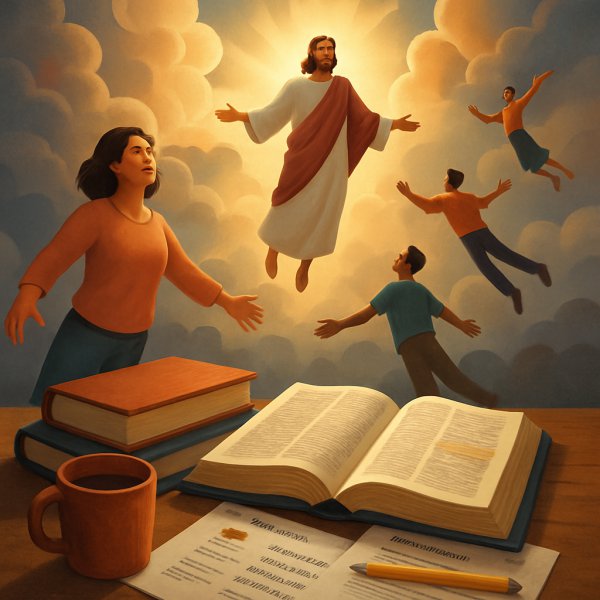
Why the idea of the rapture still grabs people’s attention
Imagine a crowded airport, where one day a narrow gate opens and a few people suddenly vanish, leaving luggage and bewildered faces. That dramatic image, part mystery and part rescue, is why many people find the idea of the rapture irresistible. It promises an abrupt change, a rescue for some, and a cosmic meeting with Christ that reads like a scene from a cliffhanger novel. Whether you encounter the rapture in pulp fiction, evangelical sermons, or casual conversation, it tends to stir curiosity, hope, anxiety, and lots of questions.
This topic matters because it touches on core human concerns: what happens after death, how justice is served, and whether divine intervention can interrupt history. For Christians, beliefs about the rapture shape spiritual life, ethics, and how one thinks about the future. For the wider culture, the rapture has influenced films, politics, and popular imagination. Sorting out what people mean when they say rapture helps you understand not only theology but also how religious ideas live in everyday life.
You do not need to accept any particular religious claim to make sense of the topic. We will walk through the biblical texts, historical origins, main interpretations, and real-world consequences. Expect clear comparisons, a helpful table, reflective questions, and practical steps to deepen your own understanding. The goal is to leave you more informed, less confused, and ready to talk about the rapture with curiosity rather than fear.
By the end you will have tools to evaluate different claims, talk with friends who believe differently, and appreciate why this idea continues to shift hearts and headlines. You may not convert overnight, but you will be able to explain what Christians usually mean by the rapture, why there are many versions, and how to think about the topic responsibly.
What people mean by the rapture: a simple explanation
When Christians talk about the rapture they are usually referring to the moment when believers are "caught up" to meet Christ in the air. The phrase commonly connects to 1 Thessalonians 4:13-18, where the apostle Paul describes the Lord descending and the faithful being raised to meet him. The word rapture itself does not appear in most English Bibles; it comes from the Latin raptura, translating the Greek word harpazo, which means to seize, snatch, or catch up.
At heart the rapture is about being reunited with Christ and fellow believers. Some people picture a sudden disappearance of people from the earth, followed by tribulation or final judgment. Others imagine a single final coming of Christ that includes resurrection and judgment at once. So, the essential idea is straightforward: a divine gathering of believers to Christ. The real complexity begins when we ask when it happens, who exactly is gathered, and how it relates to other end-time events mentioned in the Bible.
Think of the rapture as one piece of a larger puzzle called eschatology, which is the study of last things. Different Christians assemble that puzzle very differently. The aim here is to explain those assemblies with simple language and fair summaries, so you can see the map behind the different pictures people hang on their walls.
The biblical passages people use and what they might mean
Several New Testament texts are central to rapture discussions. Each passage is short and vivid, which invites many interpretations.
-
1 Thessalonians 4:13-18. This is often the foundational text for rapture theology. Paul comforts a grieving church by describing the Lord descending and believers being caught up together to meet him in the air. The language emphasizes hope and reunion rather than precise timing, but many readers take it as describing a sudden rescue.
-
1 Corinthians 15:51-52. Paul speaks of a mystery: not everyone will die, but all will be changed "in a moment, in the twinkling of an eye" at the last trumpet. This text is commonly linked to resurrection and transformation of the body.
-
John 14:1-3. Jesus promises to go to prepare a place and return to take his followers to be with him. Some see this as an early hint of a "meeting" with Christ, though context suggests comforting words about future life rather than a timetable.
-
Matthew 24 and the Olivet Discourse. Jesus discusses coming signs, a "great tribulation," and suddenness of his return. Some of Jesus' sayings emphasize readiness, warning against date-setting and making the timing ambiguous.
-
Revelation. The apocalyptic images of judgment, heavenly worship, and the final defeat of evil are woven into the tapestry of end-times thought. Revelation does not explicitly use the word rapture, but it offers dramatic scenes that different readers combine with the above passages.
Reading these passages in context matters. Paul addresses local churches with pastoral concerns. Jesus' speeches address first-century listeners and disciples in a specific historical context. Revelation uses symbolic language typical of apocalyptic literature. The more you attend to genre, audience, and language, the clearer the choices interpreters make.
The main ways Christians interpret the rapture, explained plainly
Christian believers organize the rapture into several well-defined views, each answering the question: when does the gathering happen relative to a period called the tribulation, and who goes? Below is a concise table to compare the major views side by side.
| View name |
Timing relative to tribulation |
Who is gathered |
Key emphasis or scriptural basis |
Typical proponents |
| Pre-tribulation rapture |
Before the tribulation begins |
All true Christians |
Protects believers from God's wrath; based on Paul's "caught up" and Daniel/Revelation timeline |
Dispensational evangelicals, popularized by Darby and Scofield |
| Mid-tribulation rapture |
Midway through the tribulation |
Believers who persevere to that point |
Emphasizes purification through suffering; links to "half hour" signals in Revelation |
Some evangelical scholars and pastors |
| Pre-wrath rapture |
Before God's intense wrath (but during tribulation) |
Believers alive at that time |
Distinguishes between general tribulation and God's final wrath |
Emerging evangelical position |
| Post-tribulation rapture |
At the end of the tribulation, with Christ's return |
All believers, some dead then resurrected |
Unites resurrection, rapture, and final return as one event |
Historic Protestant and Catholic readings |
| Partial rapture |
Different Christians taken at different times |
The faithful only, based on readiness |
Emphasizes sanctification and faithfulness |
Minority view among some revivalist groups |
| No distinct rapture |
No separate catching up event |
Resurrection and return are the same event |
Argues New Testament describes one final coming, not two |
Many mainline Protestants, Catholics, Orthodox |
This table simplifies complex traditions, but it clarifies why disagreements persist. Some see the rapture as a protective rescue before catastrophic judgment. Others read the New Testament as teaching one grand return of Christ that includes resurrection and judgment together. The differences often come down to how literally one reads apocalyptic imagery, and how one links different biblical books together.
Where the modern rapture idea came from historically
Beliefs about Christ’s return go back to the earliest Christians. However, the specific, highly detailed modern rapture doctrine has a traceable development. In the 19th century John Nelson Darby and the Plymouth Brethren advanced a form of dispensationalism that sharply divided history into eras and introduced a distinct pre-tribulation rapture. The Scofield Reference Bible, published in the early 20th century, popularized those notes and timelines among English-speaking Protestants.
From there the idea spread widely through revivalist preaching, popular books, and later films. Hal Lindsey’s 1970s best seller and the late 20th-century Left Behind novels and movies brought a dramatized pre-tribulation rapture into mass culture. Earlier Christian writers did speak of sudden returns and resurrection, but they rarely separated the "catching up" from the final coming with the degree of technical detail found in modern dispensational manuals.
Understanding the historical arc helps explain why some Christians insist the rapture is central while others regard it as a relatively recent theological innovation. The question of novelty does not automatically prove right or wrong, but it does show the rapture as a living tradition shaped by cultural, literary, and theological currents.
Practical reasons the rapture matters for believers and nonbelievers
Belief in the rapture affects real lives. For believers it can offer comfort, urgency, and a sense of vindication. It can strengthen hope for reunion with lost loved ones, and motivate moral vigilance and evangelism. For some, it provokes fear that loved ones left behind will suffer, creating interpersonal strain and apocalyptic anxiety.
Socially and politically, rapture expectations have shaped migration decisions, charitable giving, and attitudes toward long-term planning. On the other hand, communities that fixate on imminent evacuation may neglect social justice, environmental stewardship, or future-oriented responsibilities. Pastors often worry about fatalism: when focus shifts from daily goodness to escape, relationships and institutions can suffer.
For nonbelievers, the rapture can seem bizarre or frightening, but it is also an opportunity to engage in meaningful conversation about hope, mortality, and what people mean when they say salvation matters. At stake are questions of how one lives now under the conviction that the future will be dramatically interrupted by divine action.
Common misconceptions and clarifications
-
Myth: The word rapture is in the Bible. Clarification: The English word rapture is not a direct biblical term but comes from Latin translations of Greek phrases meaning to be caught up.
-
Myth: Only one Christian tradition holds the rapture. Clarification: Many denominations discuss the rapture, but the specifics and emphasis vary widely. Some traditions do not accept a distinct rapture at all.
-
Myth: The rapture guarantees showy disappearances and movies portray it accurately. Clarification: Popular culture tends to sensationalize. Scriptural texts focus more on resurrection, reunion, and judgment than on movie-style vanishings.
-
Myth: Every Christian who believes in the rapture predicts dates. Clarification: Most serious theologians who affirm a rapture reject date-setting and emphasize readiness rather than calendars.
-
Myth: If you do not believe in the rapture you are not a true Christian. Clarification: Christians across history have disagreed about eschatology. Holding different views on this topic does not alone determine the authenticity of a person’s faith.
Clearing up these myths helps reduce fear and opens the door to more constructive discussion.
How to study this topic yourself, step by step
If the rapture intrigues you, here are practical steps to learn more responsibly and respectfully.
-
Read the primary passages slowly and in multiple translations. Start with 1 Thessalonians 4, 1 Corinthians 15, Matthew 24, John 14, and Revelation. Note repeated words and images rather than skipping immediately to commentaries.
-
Learn basic Greek or consult interlinear resources if you want nuance. Words like harpazo (to seize or catch up) and parousia (arrival or presence) carry shades of meaning that influence interpretation.
-
Explore historical theology. Read early church fathers on the return of Christ to see how earlier Christians described last things. This gives perspective on what is ancient and what is recent.
-
Read representative modern sources from different camps. If you want a pre-tribulation view, sample Darby or a dispensational scholar. For post-tribulation, read Augustine or a historic Protestant exposition. For critical overviews, try a balanced academic survey.
-
Talk with people who hold different positions. Ask sincere questions and listen more than you argue. Most people can explain why their view matters to them personally.
-
Keep a simple journal of what you read, questions that arise, and how your views shift. Writing helps clarify thinking and spot emotional reactions separate from intellectual reasons.
Following these steps will help you avoid the traps of sensationalism and echo chambers, and it makes your conclusions more intellectually honest.
Reflection prompts to deepen understanding right now
-
When you hear descriptions of the rapture, what emotions arise first: hope, fear, indifference, curiosity, or something else? Why do you think that is?
-
How do you personally want a believer to respond to the idea of sudden divine rescue? Would it change your daily decisions, relationships, or priorities?
-
Which biblical passage about the end of days resonates most with you, and what does it say about God’s character rather than just timing?
-
Imagine a friend strongly believes in one version of the rapture and you disagree. How can you hold that relationship in charity while being honest about your differences?
Set aside 15 minutes, read 1 Thessalonians 4 slowly, and write a paragraph describing what hope and fear you notice in the text. Repeat occasionally over weeks and track how your understanding changes.
Talking to someone about the rapture without starting a fight
Start with curiosity, not correction. Ask what they believe and why it matters to them personally. Listen for emotional themes like longing for justice or fear of catastrophe. Avoid asking leading or loaded questions such as "Do you really think the world will end soon?" Instead try, "How does this belief shape how you live?"
When you share your perspective, explain the reasons calmly and acknowledge the sincerity behind alternate views. Focus on shared values like mercy, faithfulness, and humility. If the conversation gets heated, step back, affirm the relationship, and suggest returning later. Remember that eschatology often expresses deeper hopes and anxieties rather than only doctrinal propositions.
A final, practical encouragement
Whether you end up leaning toward a pre-tribulation, post-tribulation, or no separate rapture at all, let the study shape your life in humane ways. The promise of being gathered to Christ can become a source of comfort and moral courage rather than fear or escapism. Use your learning to strengthen compassion, serve your community, and invest in relationships that matter regardless of how history ends.
If you are a believer, allow the hope of reunion and transformation to influence gratitude and resilience. If you are a skeptic or exploring, use this topic as an opportunity to practice careful reading, historical awareness, and charitable dialogue. The rapture debates, when handled well, can expand your empathy and sharpen your intellect.
There is real spiritual and human value in studying difficult questions together. Keep asking, keep reading, and keep showing up to conversations with curiosity and humility. In that way, no matter which view you adopt, you will be living out the most important lesson many of these texts urge: be ready, be loving, and be wise.