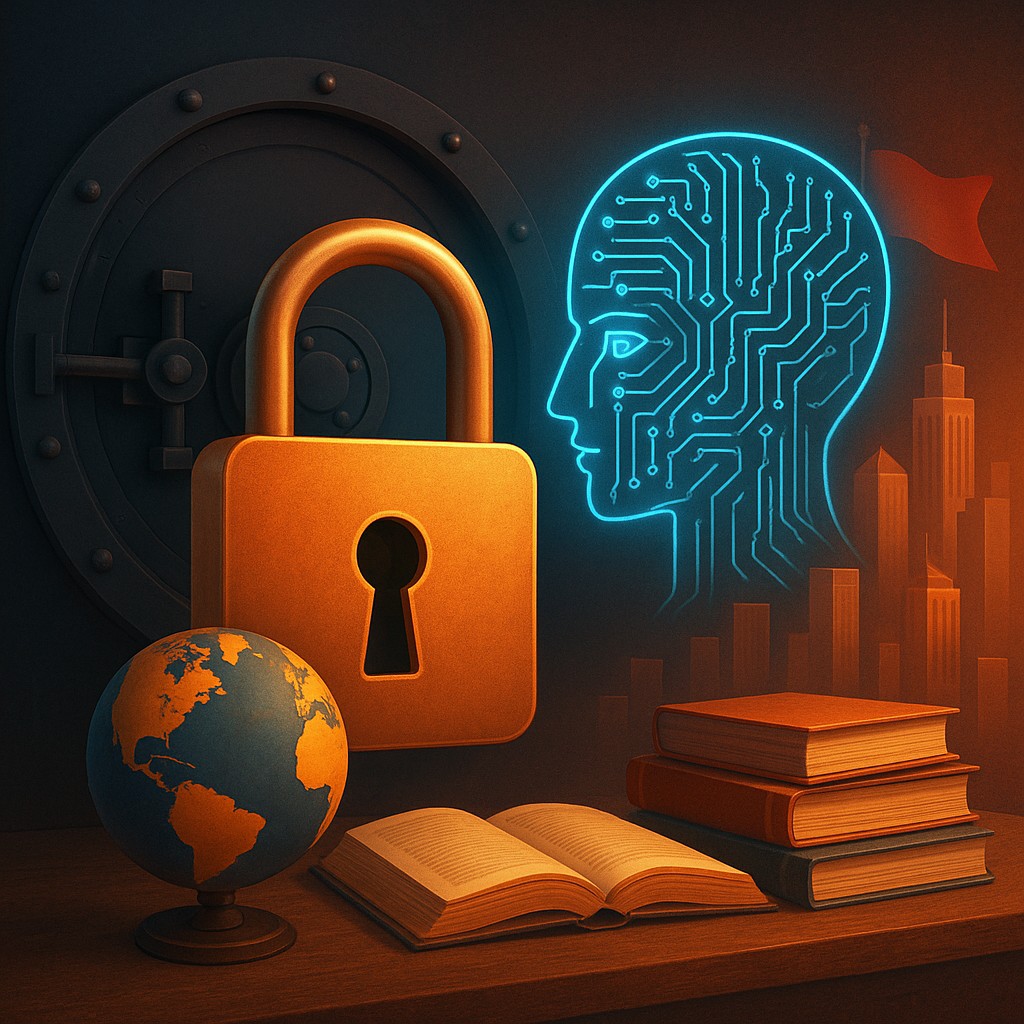
Imagine for a moment that every book in your local library, every law in your country, and every private conversation you have ever had was stored in a single, massive vault located thousands of miles away. Now, imagine that the people who own that vault get to decide which books you are allowed to read, how your laws are interpreted, and what language your children should speak to be "understood" by the world's most powerful computers. This is not the plot of a dystopian novel; it is a fairly accurate description of the current global landscape of Artificial Intelligence. Most of the "brains" behind modern AI belong to a handful of massive corporations based in just one or two nations, creating a digital monopoly that touches every corner of the globe.
As AI becomes the primary engine of the modern economy, countries are beginning to realize that relying entirely on foreign technology is like building a house on a rented lot where the landlord can change the locks at any time. This realization has sparked a global movement known as Sovereign AI. This is an ambitious effort by nations to build their own local computing centers, secure their own data, and train models that reflect their unique cultural values and linguistic nuances. By reclaiming control over the "stack" - which includes everything from the physical microchips to the final software interface - nations are trying to ensure their digital future remains in their own hands.
The Massive Concentration of Digital Wisdom
To understand why a country would spend billions of dollars to build its own AI, we first have to look at where the power sits today. Right now, a staggering amount of the world’s AI processing happens in data centers owned by a tiny group of companies. While these companies have provided incredible tools, their models are essentially reflections of the data they were fed. This data is predominantly Western, centered on the English language, and filtered through specific corporate values. When a student in Thailand or a government official in Brazil uses a generic global AI, the responses they receive are shaped by a worldview that might not align with their local customs, legal systems, or history.
This concentration creates a "black box" effect where sensitive national data, such as medical records or tax filings, is sent across borders to be processed. Even if the service provider promises privacy, the reality is that the data has left the home country's legal control. If the relationship between those two nations soured, or if a new law was passed in the provider's country, a nation could suddenly find itself locked out of its own digital tools. Sovereign AI is the strategic response to this vulnerability. It treats computing power not just as a luxury service, but as a critical piece of public infrastructure, much like roads, water pipes, or the electrical grid.
Building the Intelligence Factory from the Ground Up
Constructing a Sovereign AI ecosystem is a massive task that goes far beyond simply buying a few powerful computers and plugging them in. It requires the development of what many experts call "AI Factories." These are specialized data centers packed with thousands of high-end GPUs (Graphics Processing Units), which are computer chips designed specifically to handle the complex math required for machine learning. For a nation to achieve true independence, it must look at the entire supply chain. This includes securing a steady supply of chips, which is currently a global challenge, and ensuring there is enough green energy to power these digital giants without crashing the local power grid.
The software side is just as complex. To create a model that is truly "sovereign," a country must gather its own sets of information. This means digitizing national archives, legal rulings, and local literature in a way that captures the heart of the culture. For example, India has been a leader in this area, hosting summits to discuss how to train models on the dozens of official languages spoken across the region. A model trained on the nuances of Bengali or Marathi will naturally perform better for local citizens than a global model that treats those languages as secondary translations of English. By owning the data and the hardware, a country ensures that the "intelligence" it produces is a direct product of its own people and history.
Comparing Global AI and Sovereign AI Models
While the dream of digital independence is inspiring, it comes with trade-offs. Global AI models benefit from "scale," meaning they have seen almost everything on the internet and are backed by massive budgets. Sovereign models are more specialized but often have to work with less data and smaller budgets. The following table shows the key differences between these two approaches.
| Feature |
Global Corporate AI |
Sovereign National AI |
| Data Privacy |
Data often crosses borders and jurisdictions |
Data stays within national borders and local laws |
| Cultural Alignment |
Focused on Western and English perspectives |
Tailored to local languages, customs, and values |
| Hardware Control |
Owned and run by private tech giants |
Managed as national public infrastructure |
| Resource Scale |
Massive, nearly infinite computing power |
Smaller, highly specialized computing clusters |
| Regulatory Control |
Follows corporate policies and foreign laws |
Directly governed by local regulations |
| Primary Goal |
Profit and global market dominance |
National security and digital self-reliance |
The Challenge of Cultural Nuance and Language
One of the strongest arguments for Sovereign AI is the protection of different languages. Most global AI models are trained on the "Common Crawl," a massive collection of data from the internet where English is the main language. This creates a "linguistic gravity well" where the AI starts to think and respond in a way that mirrors English sentence structures and idioms, even when it is "speaking" another language. This can lead to a "cultural flattening" where unique local expressions and ways of thinking are slowly erased because the AI does not understand the context behind them.
Think of it as the difference between a tourist using a translation app and a local storyteller who understands the weight of every word. A Sovereign AI for a country like Iceland, which has a small population but a rich literary history, can be specifically tuned to protect and promote the Icelandic language. It can be taught the specific legal jargon of Icelandic courts and the details of its historical sagas. This ensures that as the world moves toward an AI-driven future, smaller cultures are not forced to choose between using modern technology and keeping their cultural identity. They can have both, provided they have the infrastructure to support it.
Correcting the Myth of the Perfect Model
There is a common misunderstanding that for an AI model to be useful, it must be the biggest and most powerful one on the planet. This leads people to believe that if a country cannot build something larger than the top global models, they should not bother at all. However, this is like saying that if a country cannot build the world's largest airplane, it should not have its own local airline. In many cases, a "smaller" model that is highly specialized in a specific area, like French administrative law or Japanese medical ethics, will actually perform better than a giant global model at those specific tasks.
Another myth is that Sovereign AI is purely about isolation or "digital nationalism." While there is a competitive element, many nations see Sovereign AI as a way to participate more fairly in the global community. By having their own local capabilities, they can enter into partnerships from a position of strength rather than dependence. It also allows for "Federated Learning," where different countries can share what their models have learned without actually exchanging the sensitive raw data itself. This creates a global network of intelligence that is spread out and more resistant to failure.
The Economic Engine of the Twenty-First Century
Nations are not just building AI for the sake of pride; they are doing it because AI is the new oil. In the past, industrial power was measured by how much steel a country could produce or how much oil it could refine. In the future, national power will be measured by "compute." Every industry, from farming to finance, is being transformed by machine learning. If a country has to pay a fee to a foreign company every time one of its businesses wants to use an AI tool, that is a massive drain on the national economy, often called "digital rent."
By moving toward Sovereign AI, governments are essentially creating a new utility. They can provide affordable access to computing power for local startups, universities, and researchers, helping a local innovation scene grow. This prevents a "brain drain" where a country's smartest computer scientists move abroad because they do not have the equipment they need at home. When the infrastructure is local, the talent stays local, and the economic benefits of AI productivity stay within the country. It is an investment in the people and knowledge of the entire nation.
Navigating the Friction of a Fragmented Internet
The rise of Sovereign AI suggests a shift away from the "One World, One Internet" dream of the early 1990s. We are moving toward a more divided digital landscape, sometimes called the "splinternet," where different regions have different rules, hardware, and AI personalities. While this can feel like a step backward for global cooperation, it is also a necessary change for a world that is waking up to the risks of putting too much power in one place. A divided system is often more secure because there is no single point of failure that can crash the entire global network.
However, this shift brings its own challenges. Businesses that operate in multiple countries may soon find themselves needing to adapt their software to work with twenty different Sovereign AI systems, each with its own quirks and legal requirements. Developers will need to become experts in "interoperability" - the ability for different systems to talk to each other. The goal is not to build walls that stop information from flowing, but to build gates that the home nation can control, ensuring that data is safe, ethical, and helpful to its citizens.
As you look toward the future, the rise of Sovereign AI should not be seen as a threat to global progress, but as an expansion of what technology can be. We are entering an era where AI will no longer be a single voice coming from a few distant towers. Instead, it will be a diverse chorus of digital minds, each reflecting the unique wisdom, language, and values of the people who created it. By taking ownership of their digital destiny, nations are ensuring that the most powerful tool ever created remains a tool for everyone, everywhere. This journey is an invitation to imagine a world where technology does more than just change our lives - it honors the very things that make our different cultures worth celebrating.