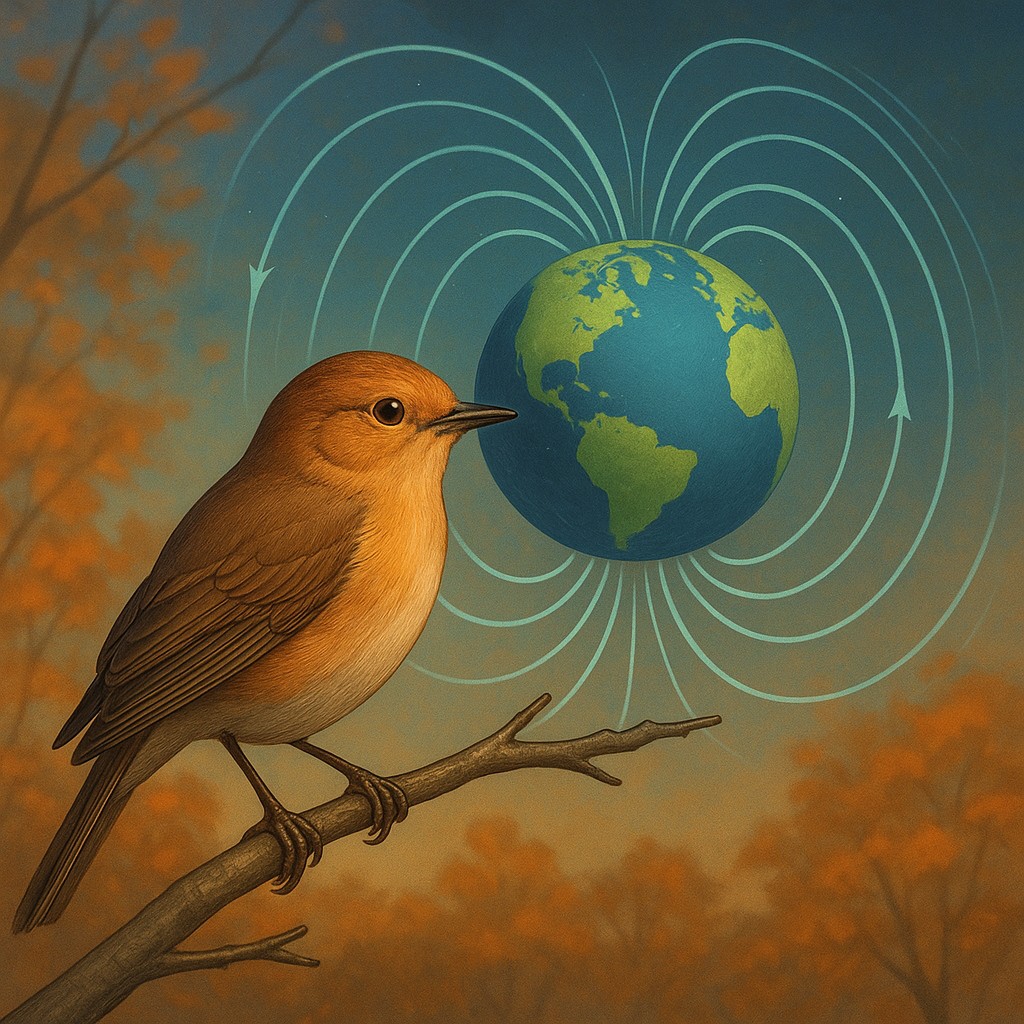
Imagine for a moment that you are a tiny songbird, weighing no more than a pocketful of change, perched on a branch in the biting autumn air of northern Canada. Your internal clock is ticking, and a deep, ancient impulse tells you it is time to leave your forest home for the lush rainforests of South America. You have no map, no smartphone, and no visual landmarks to guide you across thousands of miles of open ocean and strange lands. Yet, you take off into the night sky, flying with the precision of a high-tech military drone, arriving at the exact same cluster of trees you visited the year before.
This incredible feat of endurance is not just a matter of strong wings and stubbornness. It is a mystery that has puzzled biologists and physicists for decades. While humans rely on outside tools like GPS satellites and compasses, birds possess an internal navigation system that is far more advanced. Instead of just feeling their way through the world, they actually perceive the invisible fabric of the Earth’s magnetic field through a series of complex chemical reactions happening right inside their eyes. This hidden sense, known as magnetoreception, is one of the most fascinating links between biology and quantum physics ever found in nature.
The Earth's Invisible Landscape
To understand how a bird finds its way, we first have to appreciate the invisible world they live in. The Earth is essentially a giant bar magnet, with magnetic field lines flowing from the southern hemisphere toward the north. These lines do not just sit still; they curve and dip at different angles depending on where you are on the globe. At the equator, the field lines run parallel to the ground, while at the poles, they dive straight down into the Earth. This creates a predictable grid of information covering the entire planet, providing a constant stream of data for any creature capable of "reading" it.
For a long time, scientists thought birds might have tiny bits of magnetite - a magnetic mineral - tucked away in their beaks or brains. The theory was that these microscopic magnets would act like a literal compass needle, tugging on the bird's nerves as they moved. While some animals do use magnetite to navigate, it did not fully explain the behavior of migratory birds. Researchers noticed that many birds could only find their way if they had access to specific types of light, particularly blue light. This suggested that their "compass" was not a mechanical tug, but something happening within their vision.
Instead of a physical needle, birds seem to have a chemical sensor finely tuned to the tilt of the Earth’s magnetic field. This distinction is vital because it allows the bird to determine not just which way is "North," but also their latitude based on the angle of these lines. It is the difference between having a simple compass and a full topographic map. They are not just following a direction; they are seeing a layered map of the world that exists beyond human perception, turning an invisible magnetic field into a visual guide.
Quantum Secrets Inside the Eye
The secret to this biological magic is a protein called cryptochrome, found in the retinas of many migratory birds. Cryptochrome was first discovered in plants, where it helps set internal clocks by responding to blue light. In birds, however, it has evolved into a high-tech sensor. When a particle of blue light - called a photon - enters the bird's eye and hits a cryptochrome molecule, it knocks an electron away from its usual spot. This creates what scientists call a "radical pair," which is just a way of saying two molecules that each have a lonely, unpaired electron.
This is where things get truly strange and enter the world of quantum mechanics. These two electrons are "entangled," meaning their fates are linked together across space. In this state, the pair is incredibly sensitive to outside forces, including the Earth’s very weak magnetic field. The field determines whether the pair stays in one chemical state or shifts into another. This is more than just a chemistry fact; the specific chemical path the bird's eye takes depends entirely on which state these electrons choose.
Depending on how the bird angles its head relative to the Earth’s magnetic field, different amounts of these chemical signals are produced across the retina. This creates a pattern of light and dark spots over the bird's field of vision. High-tech aircraft often use a "Head-Up Display" (HUD), which projects flight data onto the windshield so the pilot can see speed and altitude without looking away from the sky. Scientists believe birds experience something similar. As they fly, they likely see a faint, see-through layer of shadows and highlights that indicates magnetic North, allowing them to "see" the field lines as clearly as we see a paved road.
Comparing Navigation Technologies
To appreciate the elegance of this bird's-eye system, it helps to see how it compares to the tools humans have built. While we rely on massive satellite networks and rare metals, the bird achieves the same result with a few specialized proteins and the light of the moon and stars.
| Feature |
Human GPS |
Avian Quantum Compass |
| Power Source |
Lithium batteries and solar panels |
Blue light from the sky and body energy |
| Guidance Method |
Radio signals from orbiting satellites |
Quantum entanglement of electrons in the eye |
| Hardware |
Silicon chips and copper wiring |
Biological proteins and eye nerves |
| Vulnerability |
Signal loss in tunnels or solar storms |
Disrupted by high-frequency radio noise |
| Visual Output |
A glowing screen or voice prompts |
A visual layer or "HUD" in their field of vision |
As you can see, the biological version is remarkably efficient. It needs no outside infrastructure and works as long as there is a sliver of light to trigger the reaction. Even more impressive is that this system is self-repairing. While a cracked smartphone screen might leave you lost in a strange city, a bird's eye is constantly rebuilding its proteins, ensuring its natural GPS is always calibrated and ready for the next leg of the trip.
Overcoming Environmental Interference
If birds use such a delicate quantum process to navigate, you might wonder why they do not get lost every time they fly past a power line or a radio tower. The truth is that human activity can actually affect them. Studies show that "electronic noise" or electrosmog - the weak radiation given off by our gadgets and power grids - can temporarily confuse a bird's internal compass. If a bird is kept in a cage shielded from this noise, it can orient itself perfectly, but once the noise is introduced, it may struggle to find the right way.
However, birds are not one-trick ponies. Their survival depends on several backup systems they use alongside their quantum compass. They are master multitaskers who combine their magnetic sense with other cues in nature. They use the sun's position during the day, the patterns of the stars at night, and even an incredibly sharp sense of smell to identify specific places. Some researchers believe birds can even "hear" the low-frequency rumble of ocean waves crashing against distant shores, giving them a sound-based map of the continent.
This built-in redundancy is why we do not see flocks of birds crashing into buildings every time a microwave is turned on. They are constantly checking their quantum data against the physical world. If the magnetic signal becomes fuzzy due to human interference, they switch their focus to the stars or familiar landmarks like rivers and mountains. This ability to combine different streams of data makes them the most successful navigators on Earth, capable of crossing the Sahara Desert or the Pacific Ocean with pinpoint accuracy.
The Mystery of Night Flight
One of the most impressive parts of this system is that it works mainly for birds that travel at night. You might think a light-dependent system would be useless after sunset, but the sky is never truly dark. There is enough blue light from the moon and stars to keep the proteins in the bird's eye active. In fact, flying at night has a huge advantage: the air is cooler and more stable, and there are far fewer predators waiting to snatch a tired traveler out of the sky.
Because the quantum reaction in the eye is so sensitive, it does not need the glaring brightness of the midday sun. It only needs enough light particles to trigger that first electron jump. Evolution has polished these proteins to be incredibly efficient at capturing whatever little light is available. This allows birds to keep their "magnetic vision" through the night, ensuring they stay on course even when the ground below is a black void. It is a testament to nature’s engineering that a single molecule can turn a few stray bits of starlight into a reliable map of the entire planet.
Addressing Common Myths about Bird Intelligence
For a long time, the phrase "bird brain" was used as an insult, suggesting birds were simple creatures driven only by basic instincts. However, studying how they navigate has completely flipped that idea. We now know that birds perform complex "calculations" that we are only just beginning to simulate with supercomputers. They are not flying blindly; they are making constant adjustments based on wind speed, air pressure, and their shifting magnetic map.
Another common myth is that birds are born with an "address" already programmed into their heads. While they have the biological hardware for navigation, young birds often have to learn the specifics of their route. First-time travelers are much more likely to be blown off course by a storm than experienced adults. Older birds have refined their "mental map" over several years, blending their quantum compass with memories of real-world landmarks. This shows that bird navigation is a beautiful mix of natural-born brilliance and hard-earned experience.
- Birds do not just follow a "scent" of the north; they see the field.
- Migratory paths are not fixed lines but wide corridors shaped by weather.
- Not all birds use the same primary sense; some rely more on landmarks than others.
- The quantum process happens in the eye, not the brain or the beak.
By clearing up these myths, we can see birds for what they truly are: advanced biological explorers. They are not mindless drones programmed to go from Point A to Point B. They are active participants in their journey, using a set of senses we can barely imagine to cross the globe. Understanding their quantum connection to the Earth does not take away the wonder of their flight; it only makes the sight of a flock of geese overhead feel even more like a miracle of modern physics.
Protecting the Ancient Travelers
The discovery that birds rely on quantum reactions in their eyes has big implications for how we protect them. Since we know that electronic noise and light pollution can interfere with their navigation, we can take steps to reduce our impact. Many cities have started "Lights Out" programs during peak migration seasons to keep birds from getting confused by the glow of skyscrapers. By understanding the science of their journey, we can make sure the skies remain a clear, readable map for the millions of birds that navigate them twice a year.
Next time you see a small bird flitting about your backyard, take a moment to look at it with new respect. Inside that tiny head is a sensor so advanced it makes our best technology look like a toy. It is a living bridge between the world of subatomic particles and the vast reaches of our planet. That bird is proof that the universe is far more interconnected than it seems, and that sometimes, the secrets to the world’s biggest mysteries are hidden in the smallest, most delicate places. May their journey inspire you to look at the world with wonder, knowing that even in the dark, there are invisible paths waiting to be discovered.