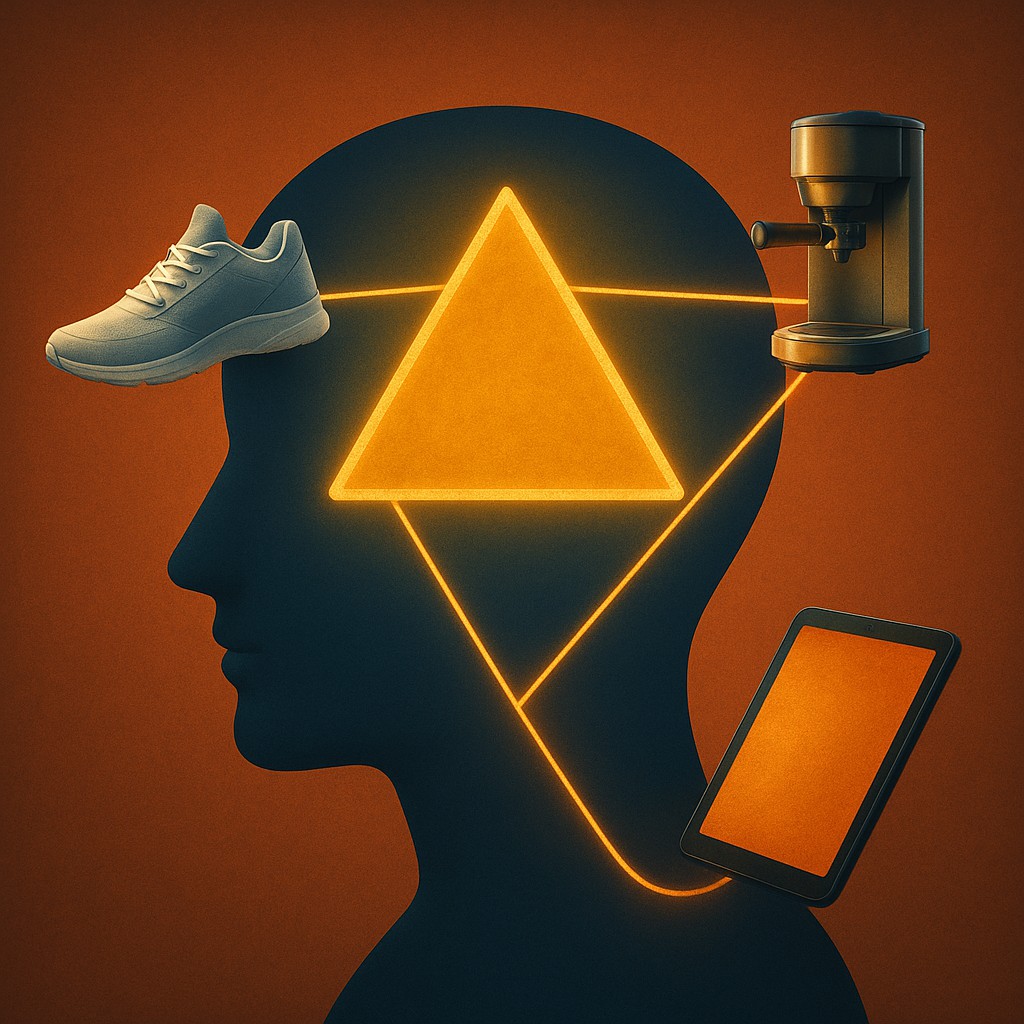
Have you ever found yourself staring at a pair of sneakers or a sleek new kitchen gadget that you didn't even know existed five minutes ago, only to suddenly feel like your life is incomplete without it? We like to tell ourselves that our tastes are our own, that we are the architects of our preferences, and that some inner compass simply knows what it likes. We imagine our desires as straight lines moving from our hearts directly to the things we want. However, more often than not, our desires are actually triangles. We don't want an object for what it is; we want it because someone else wants it, or because someone we admire already has it. This isn't just a quirk of shopping habits. It is a core pillar of human psychology known as Mimetic Desire.
This concept, pioneered by the French scholar René Girard, suggests that humans are essentially copycats when it comes to wanting. Unlike biological needs like hunger or thirst, which are hardwired and straightforward, our social desires are learned through imitation. We look to "models" to show us what is worth our time. When we see a colleague chasing a specific promotion or a friend obsessing over a niche travel destination, our brains receive a signal that these things are inherently valuable. We don't just mimic their clothes or their speech; we imitate their very appetite for life. Understanding this mechanism is like finally seeing the invisible strings that pull us through the marketplace and our social circles. It allows us to take back control in a world designed to keep us wanting more.
The Triangular Nature of Wanting
The traditional view of desire suggests a simple relationship between a subject (you) and an object (that fancy vintage watch). René Girard argued that this model is a lie we tell ourselves to feel independent. In reality, there is a third point to this relationship: the Model. This creates a triangle where your desire for the watch is actually filtered through the person you saw wearing it or the person you know wants it. The model acts as a navigator for your internal compass. They "frame" the object as valuable. Without that framing, you might have walked right past it without a second glance. This is why advertising rarely focuses on technical specs and instead highlights the lifestyle of the person using the product. They aren't selling you a phone; they are selling you the model's desirability.
This process is mostly unconscious, which makes it particularly powerful. You don't wake up and think, "I will now imitate my neighbor's desire for a perfect lawn." Instead, you see their dedication and the subtle respect they get from others, and suddenly, your own lawn looks like a personal failure. The model has "colonized" your desire. This isn't necessarily a bad thing; it is the same mechanism that allows us to share culture and get along. If we didn't imitate the desires of those around us, we would have no shared values. We would be a collection of isolated individuals with no way to coordinate our efforts or understand what success looks like in our community.
Why Proximity Fuels the Fire
One of the most surprising parts of mimetic desire is that it is strongest when the model is someone close to us. While we might admire a billionaire or a movie star, they are what Girard called "External Mediators." They live in a different world, so there is no real chance of us competing with them. Wanting a private jet because a celebrity has one is a "soft" desire; it doesn't cause much personal pain because the distance is too great. However, "Internal Mediators" are the people in our actual lives: friends, siblings, coworkers, and peers. These are the people we can actually compete with, and this is where mimetic desire becomes intense.
When a peer wants something, it feels achievable, which makes the desire much more urgent and painful. If your best friend starts a successful podcast, you don't just feel happy for them; you might feel a sudden, burning need to start your own creative project. This happens because you see them as an equal. Their pursuit of success or fame signals that these things are keys to a higher status that you should also have. Because you share the same social space, you are often chasing the same limited resources, which turns the "model" into a "rival." This shift from imitation to rivalry is the source of most human conflict. It stems not from our differences, but from the fact that we have become too much alike in what we want.
| Feature |
External Mediation (The Hero) |
Internal Mediation (The Peer) |
| Model Proximity |
Distant, legendary, or unreachable. |
Close, familiar, and relatable. |
| Level of Conflict |
Low; there is no competition. |
High; you are fighting for the same space. |
| Emotional Tone |
Inspiration and distant admiration. |
Envy, jealousy, and intense rivalry. |
| Impact on Identity |
Provides a North Star for values. |
Can lead to obsession and "copycat" behavior. |
| Resource Type |
Abundant or theoretical. |
Often scarce or "non-sharable." |
The Trap of Mimetic Rivalry
When two people want the same thing mimetically, they often stop caring about the object itself and become obsessed with "winning" against the other person. Think about a high-stakes auction or two tech companies fighting over a patent. At a certain point, the price far exceeds the actual value of the item. They are no longer buying a patent; they are trying to stop the other person from having it. This is the dark side of imitation. It leads to a "mimetic crisis" where the original goal is forgotten, and the only thing that matters is status relative to the rival. This is why the most bitter feuds often happen between people with very similar backgrounds and interests.
The irony of mimetic rivalry is that it forces us to lose our individuality just to be "better" than someone else. In trying to beat our rival at their own game, we end up playing a game we might not have even liked. We see this in "keeping up with the Joneses," where families go into debt for houses and cars they don't need, simply because their neighbors have them. They aren't chasing happiness; they are trying to get rid of the feeling of being "less than" their model. To break free, you must recognize that the "value" of the object is often an illusion created by the competition itself. If the rival disappeared, the desire for the object would often vanish with them.
Transforming Mimetic Energy into Growth
While mimetic desire can lead to conflict, it is also the engine of human excellence. Without it, we wouldn't see the rapid progress of science or sports. When Roger Bannister broke the four-minute mile, he became a model for others. Suddenly, runners all over the world began breaking that record too. Their desire to achieve that goal was fueled by seeing that it was possible for someone like them. In this context, mimetic desire acts as "social proof" that expands what we think is possible. The key is to choose our models intentionally rather than letting them be chosen for us by social media feeds or our surroundings.
To use this power, we can seek out "Positive Models" who have qualities we genuinely want to build, like patience, wisdom, or skill. Instead of fighting over status or stuff, we can admire someone's character. Character is a "sharable" resource. If I become more patient because I admire your patience, it doesn't take any patience away from you. In fact, it adds to the total amount of patience in the world. By shifting our focus from "having" what others have to "being" like the best people we know, we turn a source of conflict into a map for personal growth.
Curating Your Desires for a Better Life
Living with an awareness of mimetic desire doesn't mean you stop wanting things; it means you become a "sophisticated wanter." You start to ask: "Is this my desire, or am I just borrowing it?" When you feel a pang of envy or a rush of consumerist lust, take a moment to look for the triangle. Who is the model? Why am I looking at them? Often, just identifying the model is enough to break the spell. You realize you don't actually want a luxury yacht; you just want the freedom and ease that the person on the yacht seems to have. Once you find that underlying value, you can find more authentic ways to chase it that don't involve an expensive boat or a bitter rivalry.
In the digital age, our models are picked by algorithms designed to trigger our mimetic impulses. Every "like" and "share" tells our brains that a lifestyle is desirable. By becoming aware of these invisible forces, we can start to prune our social circles and our digital habits. We can choose to spend time with people whose desires are healthy and grounded. We can stop competing in games that aren't worth winning and start investing in "thick" goals - desires rooted in our deepest values and our unique contributions to the world.
The journey toward self-awareness is largely about sorting through the attic of our minds and realizing how much of the "stuff" there was left behind by other people. It is liberating to know that you don't have to want what everyone else wants. You can step out of the frantic race for the same toys and titles and instead craft a life built on "intentional desire." As you become more confident in your own path, you might even become a model for others - not a model of what to own, but a model of how to live with purpose, clarity, and an independent heart. This is the ultimate victory over the mimetic trap: becoming so authentically yourself that you inspire others to find their own truth, too.