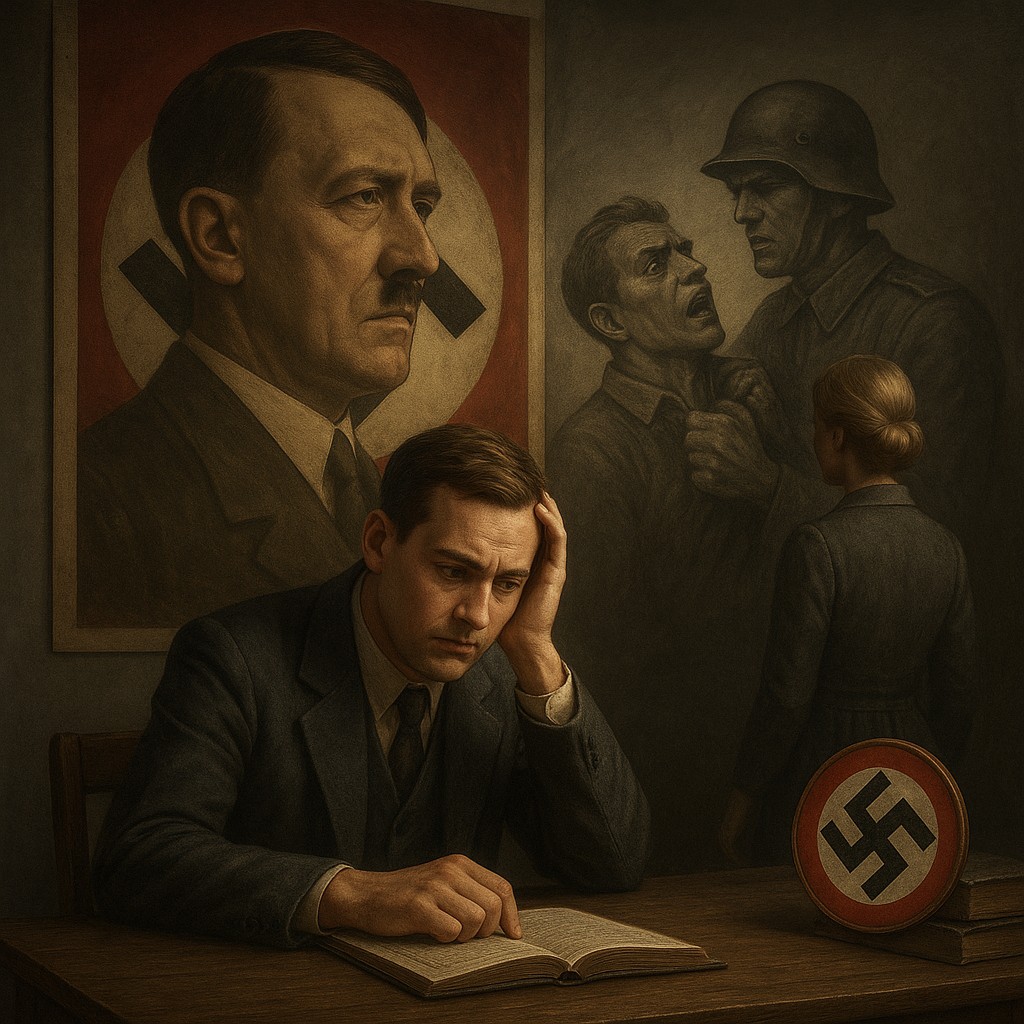
When we look back at the jagged terrain of the 20th century, the Holocaust and the rise of the Nazi Party loom like a dark, unfathomable range of mountains. It’s comforting to imagine that the people who lived through it were somehow different from us - biologically, morally - that they were mustache-twirling villains who woke up each morning eager to do harm. But the far more chilling truth is that most Germans in the 1930s and ’40s didn’t see themselves as the villains. They saw themselves as heroes of their own story, victims of a harsh world who were finally seizing control of their fate.
To understand how an advanced, educated society could fall into such darkness, we need to look past the monsters in history books and focus on ordinary people - neighbors, shopkeepers, schoolteachers. These were folks worn down by exhaustion, hunger, and shame after World War I. They didn’t sign up for gas chambers or world domination from day one. Instead, they were drawn in by promises of stability, dignity, and a return to glory. By the time the full horror of the regime became clear, the state’s machinery had made resistance nearly impossible, and the walls of propaganda had risen so high that few could see the smoke rising from the camps.
The Psychological Hook of a Nation in Crisis
To grasp why people followed Hitler, we must first see the ruin he stepped into. After World War I, Germany was broken. They had lost the war, their economy was in freefall - bread could cost a billion marks - and the national spirit was crushed by a peace treaty many called humiliating. When people are desperate, they don’t turn to politicians who talk compromise. They want a savior. The Nazis didn’t start by preaching genocide. They started with jobs, bread, and the idea that Germans were special, superior, no matter what the rest of the world said.
This tapped into a deep human tendency known as "in-group bias." By casting Germans as members of an elite, chosen people - the so-called "Aryan" race - the Nazis created a powerful sense of belonging. But that sense comes at a cost: the need for an "out-group." If your group is the best, someone else must be to blame when things go wrong. The Nazis offered a clear list of scapegoats - Jews above all, but also communists, Roma people, and the disabled. By framing these groups as the source of Germany’s troubles, they made removing them seem not like cruelty, but like self-defense.
The pull was subtle. It started with small compromises. Maybe you didn’t like the harsh speeches, but hey, you finally had a job. Maybe you hated the street violence, but at least the trains ran on time and crime had dropped. This is the "boiling frog" effect: drop a frog in boiling water, it jumps out. But place it in warm water and slowly turn up the heat, and it stays until it’s too late. The German people were in that pot, and the temperature was rising, inch by inch.
The Art of Making Evil Look Like Virtue
The Nazis were experts at rebranding cruelty. They never called murder “murder” or atrocity “atrocity.” Instead, they used cold, bureaucratic language that made horror sound like routine office work. Historians call this “euphemisms.” When the government spoke of “resettlement in the East,” it sounded like a dull housing program. “The Final Solution to the Jewish Question” sounded like solving a math problem, not wiping out millions. This language let ordinary people distance themselves from what was really happening.
Propaganda, run by Joseph Goebbels, made sure every news report, film, and poster reinforced the idea that Germans were the good guys. If you only hear that your country is under attack by secret enemies, and that your leader is the only one standing between you and ruin, your moral sense starts to bend. You begin to accept harsh actions as “unfortunate but necessary.” This is called “moral decoupling” - people could still see themselves as kind parents or helpful neighbors, even as they supported a brutal regime.
| Social Strategy |
How it Functioned |
The Intended Psychological Result |
| Gleichschaltung |
Bringing all clubs, schools, and media under Nazi control. |
Eliminating outside views or dissent. |
| Strength Through Joy |
Offering workers cheap vacations and leisure programs. |
Building loyalty and a sense of debt to the state. |
| The Hitler Myth |
Portraying Hitler as a selfless, god-like figure devoted only to Germany. |
Making criticism feel like betrayal of the nation. |
| Public Shaming |
Using “Stürmer” displays to mock enemies in public squares. |
Turning cruelty into a shared, accepted act. |
The Cowardice of Silence and the Price of Dissent
One question keeps coming up: “Why didn’t they just say no?” The answer is fear - and social pressure. Once the Nazis gained power, they gutted the justice system. The Gestapo, the secret police, encouraged people to spy on their neighbors. Speak out, and you didn’t just risk a nasty comment - you disappeared. Your family could suffer. In a world where your child’s teacher might report you for a joke made at dinner, silence became a way to survive.
But it wasn’t just fear of the police. It was fear of being left out. Humans are social creatures, and we deeply want to fit in. Psychologists call this the “Asch Conformity” effect. When everyone around you is wearing a swastika armband and shouting “Heil Hitler,” the mental effort to stay silent or refuse is enormous. Many joined in not because they were true believers, but because they didn’t want to be the odd one out. Over time, acting like a Nazi often led people to think like Nazis, as their minds worked to ease the tension between their actions and their values.
This created something called “internal emigration.” People withdrew into private life, ignoring politics and missing neighbors, telling themselves that as long as they weren’t pulling the trigger, they were still good people. They focused on their gardens, books, and jobs - while their taxes and silence helped run a killing machine. They weren’t blind to what was happening. They practiced “willful blindness” - knowing enough to know they didn’t want to know more.
The Normalization of the Abnormal
How do you get a doctor to torture prisoners or a clerk to log deaths in a camp? It happens by turning evil into a job. The Nazis didn’t ask people to be “evil.” They asked them to be “efficient.” They broke the Holocaust into thousands of tiny, specialized tasks. One person booked train schedules. Another ordered poisons. A third typed victim lists. Because no single person handled the whole process, many felt their role was harmless - just “doing their duty.”
This is what philosopher Hannah Arendt called the “banality of evil.” She noticed that many who carried out atrocities weren’t madmen. They were dull bureaucrats climbing the career ladder. They didn’t see victims as people - just as “units” or “cargo.” When a human becomes a number on a form, the weight of their death fades. Dehumanization was key. Years of propaganda had conditioned Germans to see their victims as pests or disease - something to be “cleaned up.”
By mid-war, the horrors were an open secret. While housewives in Munich might not have known the full details of gas chambers, they knew Jewish neighbors had vanished and weren’t coming back. They knew the East meant violence. Yet the human mind is skilled at “compartmentalization.” People told themselves the victims were spies, or that “war is hell.” They chose the lie because the truth was too heavy to bear while dodging bombs falling on their own cities.
Breaking the Spell of the Collective Ego
When the war ended and Allied forces revealed the horrors of the death camps, many Germans reacted with shock and disbelief. They claimed they’d been “tricked.” But the truth is, the trick only worked because they wanted to believe it. They craved power. They wanted someone to blame. They wanted to feel part of something greater. The idea that they were the good guys was a comfort blanket - one that let them sleep at night while the world burned.
The lesson here isn’t that Germans were uniquely evil. It’s that the risk of this kind of “moral sleepwalking” lives in every society. It starts when we stop seeing individuals and start seeing only groups. When we value order more than justice. When we believe our cause is so righteous that any action is justified. The people of that time weren’t all monsters. They were ordinary humans who failed a moral test - choosing the comfort of the crowd over the hard path of truth.
Learning this dark chapter isn’t about memorizing dates and names. It’s about building an inner alarm system. By recognizing the tactics the Nazis used - dehumanization, euphemisms, playing the victim - we can spot them today. We learn that being a “good person” isn’t a one-time achievement. It’s a choice you make every day, especially when it’s hard. Real courage isn’t shouting with the crowd. It’s having the strength to stand still when everyone else is marching toward a cliff.