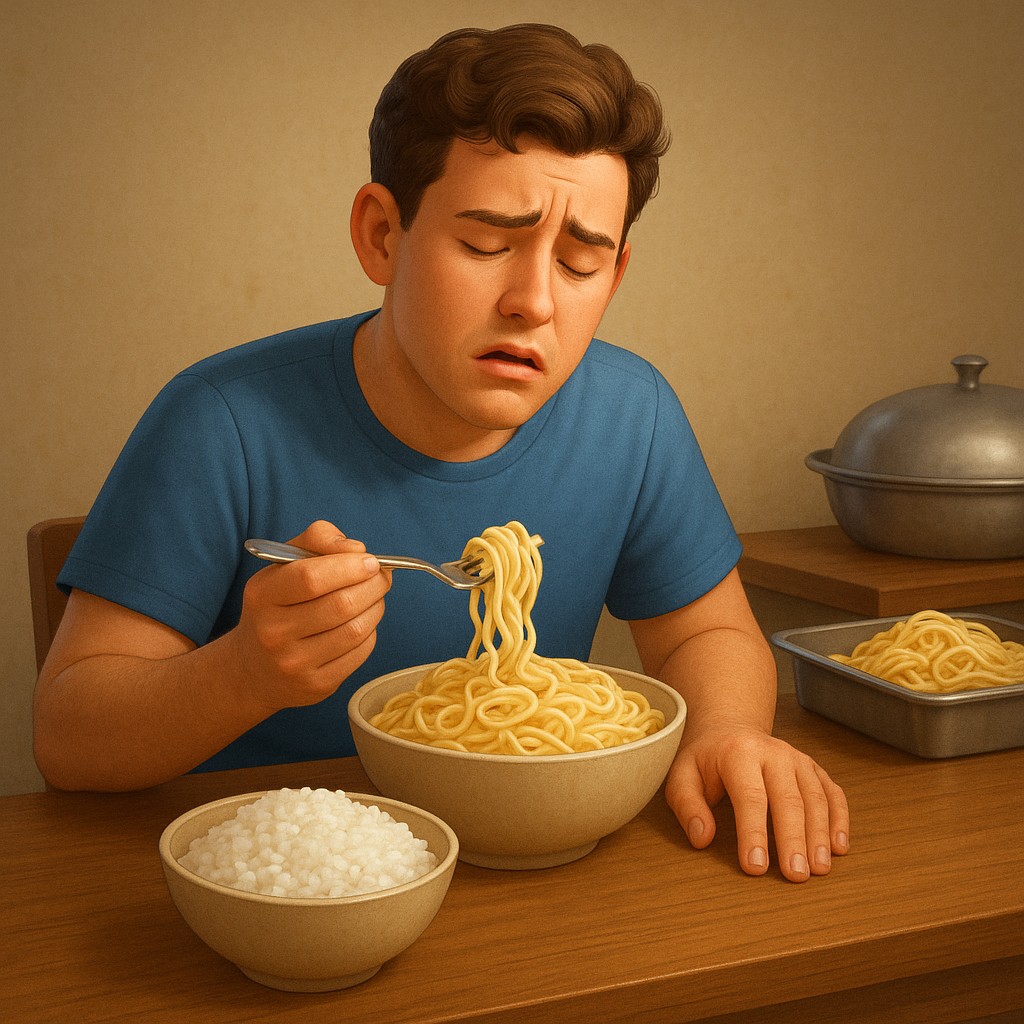
Imagine you are at an all-you-can-eat buffet with a strange catch: the kitchen has run out of almost everything except plain white rice and buttered noodles. You are hungry, specifically for the hearty, grounding satisfaction of a roast chicken or a piece of grilled salmon. You start eating the noodles, waiting for that "click" in your brain that says, "Okay, we’re done now." But the click never comes. You eat one bowl, then two, then three. You feel physically full, perhaps even uncomfortably bloated, yet the signal to stop hunting for food remains stubbornly silent. You are experiencing a biological glitch, a mismatch between what your body needs and what your environment is providing.
This frustration isn't caused by a lack of willpower; it is the result of a sophisticated biological directive known as the Protein Leverage Hypothesis. For decades, the conversation around weight gain and nutrition has focused almost exclusively on calories, the raw mathematical energy value of food. Yet, this approach often fails to explain why some foods make us feel like bottomless pits while others leave us deeply satisfied. Modern nutrition researchers, led by biologists David Raubenheimer and Stephen Simpson, have discovered that our bodies do not just track total energy. Instead, we have distinct appetites for different nutrients, and the craving for protein is the most powerful of them all. This biological "leverage" means your brain will continue to drive you toward more food until you hit a specific, non-negotiable target for nitrogen, the fundamental building block of life.
The Hidden Math of Our Biological Quota
To understand why we overeat, we first have to understand what the body is actually looking for when we open the fridge. While we often think of food as fuel, it is more accurately a construction kit. Our tissues, enzymes, and hormones are built from amino acids, which we obtain by breaking down protein. Unlike fat or carbohydrates, which the body can store in vast quantities for later use, we do not have a dedicated storage tank for extra protein. We have a daily requirement to replace what is lost through basic metabolic wear and tear. Because this requirement is so critical for survival, evolution has equipped us with an internal sensor that monitors our nitrogen levels with the precision of a master accountant.
The "leverage" in the hypothesis refers to the mathematical relationship between protein and the other two main nutrients, fats and carbohydrates. If your body requires 100 grams of protein today to function and your diet is 20 percent protein, you will need to consume a total of 500 grams of food to hit your goal. However, if you eat a diet dominated by ultra-processed foods where the protein has been "diluted" down to 10 percent, you are forced to consume 1,000 grams of food to get that same 100 grams of protein. In this scenario, the drive to reach your protein quota coerces you into eating an extra 500 grams of fats and sugars that you didn't actually need for energy.
In the wild, this mechanism was a survival strategy. Protein is often the hardest nutrient to find, so the brain prioritizes it. If you find a protein source mixed with fiber or complex carbs, your body tells you to keep eating until you have secured enough building blocks. In the 21st century, however, the food industry has mastered the art of "protein dilution." By filling snacks with cheap vegetable oils and refined starches, they create products that are delicious but nutritionally hollow. Your body senses the lack of nitrogen and keeps your appetite switched on, even as your fat cells scream that they are already stuffed with excess energy.
The Spectrum of Satisfaction and Nutrient Density
Not all calories are created equal when it comes to silencing the hunger alarm. This is why a 400-calorie steak feels fundamentally different in your stomach than a 400-calorie bag of pretzels. To visualize how different foods interact with the protein leverage effect, we can look at the "Protein-to-Energy" ratio (P:E). Foods with a high P:E ratio provide plenty of building blocks with relatively little "energy overhead." Conversely, low P:E foods force you to process a mountain of energy just to find a molehill of protein.
| Food Category |
Typical Protein Percentage |
Appetite Impact |
Effect on Calorie Intake |
| Lean Meats & Fish |
70% - 90% |
Very High |
Quickly shuts down hunger; low calorie surplus. |
| Whole Eggs & Dairy |
20% - 35% |
High |
Strong satisfaction; moderate energy density. |
| Legumes & Beans |
15% - 25% |
Moderate |
Good satisfaction, but carries a heavy carb load. |
| Ultra-Processed Snacks |
5% - 10% |
Very Low |
Hunger remains active; drives heavy overeating. |
| Sugary Drinks & Oils |
0% |
None |
No satisfaction; calories are "invisible" to protein sensors. |
When you prioritize foods at the top of this table, you are effectively hacking your brain's appetite control center. You reach your nitrogen quota early in the meal, which triggers the release of fullness hormones like PYY and GLP-1. These hormones act as a biological brake system, making the thought of another bite unappealing. On the other hand, if you start your day with a low-protein breakfast like toast and jam, you are setting yourself up for a protein deficit that your brain will try to close for the rest of the day. You might find yourself wandering back to the pantry at 10:00 PM, not because you lack discipline, but because your body is still searching for the nitrogen it was promised at 8:00 AM.
Why Ultra-Processing Exploits Hunger
The most fascinating, and perhaps most concerning, aspect of protein leverage is how it explains the success of the ultra-processed food industry. Engineers in food laboratories are not just trying to make food taste good; they are, perhaps unintentionally, exploiting our protein cravings. By taking whole ingredients and stripping away the fiber and protein, they create "hyper-palatable" foods that are easy to eat quickly. Because these foods are so low in protein, the "stop" signal in our brain is delayed. This allows us to consume massive amounts of energy before we even realize we are full.
A famous study by the National Institutes of Health (NIH) put this to the test. They housed participants in a clinical setting and gave one group an ultra-processed diet and the other a whole-foods diet. Crucially, both diets were matched for total calories, sugar, fat, and fiber. However, the ultra-processed diet was slightly lower in protein percentage. The result? The participants on the ultra-processed diet spontaneously ate about 500 calories more per day than those on the whole-food diet. They weren't told to eat more; they just naturally did because their bodies were waiting for a nutritional target that the processed food failed to provide.
This creates a vicious cycle. Because refined fats and carbs are the cheapest ingredients for manufacturers, they are used to bulk up products. This dilutes the protein, which triggers the consumer's appetite, which leads to more sales. From a biological perspective, we are like a construction crew that has been sent a thousand crates of wallpaper but no bricks. We keep opening crates, hoping the next one will have the bricks we need to finish the job, while the wallpaper piles up uselessly around us in the form of stored body fat.
The "Goldilocks Zone" of Protein
If protein is the key to feeling full, does that mean we should eat nothing but chicken breast and egg whites? Not quite. Biology rarely rewards extremes, and protein leverage is no exception. While increasing protein density is a powerful tool for weight management, there is a ceiling to its benefits. Once you have met your daily nitrogen requirement and provided enough for muscle repair, any additional protein you eat must be converted into glucose or fat to be used as energy. This process, known as gluconeogenesis, is metabolically demanding and somewhat inefficient compared to using fats or carbs directly for fuel.
Furthermore, eating an exclusively high-protein diet can be taxing on the body if it isn't balanced with other nutrients. The goal isn't necessarily to maximize protein to the exclusion of all else, but rather to reach a "protein threshold" that allows your appetite to switch off naturally. For most people, this means aiming for roughly 25 to 30 percent of their daily calories from protein. At this level, the leverage works in your favor. You feel full, your energy levels stay stable, and you avoid the "starvation mode" that often accompanies low-calorie diets. When you provide the bricks first, the body is much more relaxed about how much wallpaper (energy) it actually needs.
Common myths often suggest that high protein intake is dangerous for the kidneys or bones. However, for healthy individuals, these concerns have largely been debunked by modern sports science. The real danger isn't too much protein, but rather too little protein density. When we ignore the leverage effect, we find ourselves in a constant battle with our own biology. By understanding that hunger is a signal for specific nutrients rather than just empty volume, we can move away from the "eat less, move more" mantra and toward a more sophisticated strategy: eat better to eat less.
Reclaiming Control Through Nutrient Density
The beauty of the Protein Leverage Hypothesis is that it offers a clear, practical framework for navigating a world of endless food choices. Instead of looking at a menu and calculating how many minutes you'll need to spend on a treadmill to burn off a meal, you can ask a much simpler question: "Does this meal provide the building blocks my body is looking for?" When you prioritize the protein "anchor" on your plate, the rest of the meal naturally falls into place. You find that you simply don't want the extra bread or the second helping of dessert because the chemical signals for hunger have been successfully deactivated.
This shift in perspective is incredibly empowering. It moves the conversation from one of restriction and willpower to one of fulfillment and biological harmony. When you meet your body's most basic requirements, it stops fighting you. You are no longer a victim of the leverage that forces you to overeat, but rather the master of a system that knows exactly when it has had enough. By choosing foods rich in the nitrogen your cells crave, you heal the rift between your appetite and your actual energy needs.
Try thinking of your meals not as a tally of caloric sins, but as a series of nutritional deliveries. Every time you sit down to eat, you have the opportunity to satisfy the biological accountant living in your brain. When you provide high-quality protein, you are giving your body the "okay" to stop searching and start building. This simple adjustment, looking for the bricks before the wallpaper, can transform your relationship with food from a constant struggle into a smooth, self-regulating process that honors your biology rather than working against it.