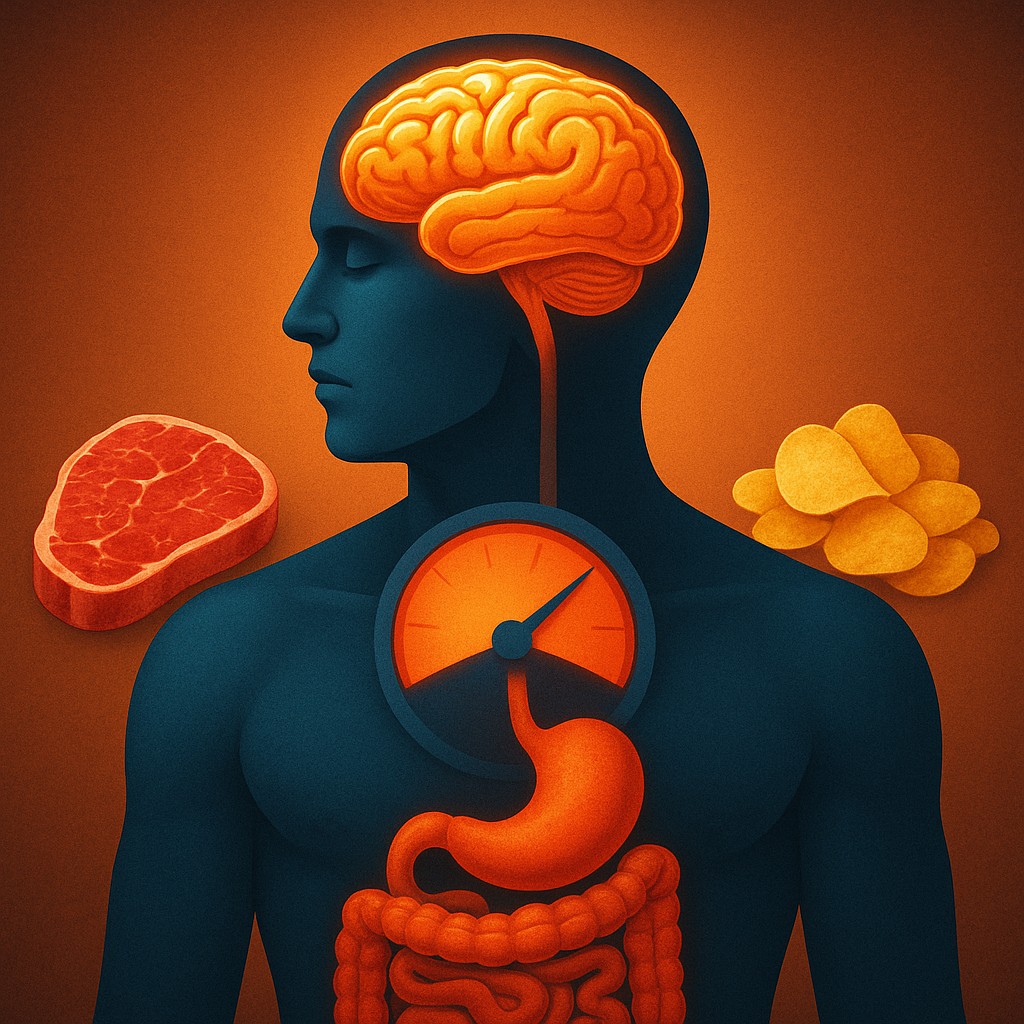
Think of yourself as a biological machine built for survival and refined by millions of years of evolution. Your main job is to keep your structure intact, repair your tissues, and keep your internal systems running smoothly. To do this, your brain follows a strict "shopping list" of nutrients it needs every day. While we usually think of hunger as a simple craving for "food" or "calories," our internal chemistry is much pickier. Your body isn't just counting calories; it is searching for specific building blocks called amino acids.
When you sit down to eat, your brain scans your plate for protein. If that protein is missing or watered down by a sea of processed carbs and fats, your biology doesn't just give up. Instead, it keeps the "hunger" light flashing on your dashboard until you have eaten enough protein to hit your daily goal. This drive is so strong that it can trick you into eating hundreds of extra calories just to find the one thing your body actually needs. This is the world of Protein Leverage: a concept that explains why you might feel starving after a bag of chips but perfectly full after a small steak.
The Biological Search for Amino Acids
The Protein Leverage Hypothesis suggests that humans, like many other animals, prioritize protein above all else. We have a set protein target, and we will keep eating until we hit it, regardless of how many calories from fats and sugars we have to swallow along the way. Imagine you are building a LEGO castle and need fifty blue bricks for the walls. If you buy a box of random pieces that only has two blue bricks, you would have to buy twenty-five boxes to finish the job. By the time you are done, you would have a mountain of useless red and yellow bricks taking up space in your house.
In this scenario, the blue bricks are protein and the extra junk bricks are the excess calories from fats and carbs. When your diet is "protein-diluted," you are essentially buying those inefficient boxes of random parts. Your body keeps signaling you to eat because it is still two blue bricks short of a finished castle. This isn't a lack of willpower; it is a biological command. Research shows that when the percentage of protein in a diet drops, people end up eating more total energy. We overeat calories simply to avoid running low on nitrogen-rich proteins.
This system likely evolved as a safety net. For most of human history, finding enough protein was difficult. Our ancestors didn't have protein shakes or grocery store chickens on every corner. To make sure we didn't waste away, our brains developed an intense hunger for protein. However, in a modern world full of ultra-processed snacks, this ancient survival trick has become a weakness. We are surrounded by foods designed to be low in protein and high in calories, which keeps our hunger system stuck in the "on" position.
How Ultra-Processed Foods Trick Your Appetite
Today’s food landscape is a minefield for your protein-sensing system. Food companies have mastered "protein dilution" by mixing refined flour, vegetable oils, and sugars to create products that taste great but offer little nutrition. When you eat a croissant or sugary cereal, you get a massive burst of energy with almost no protein. Your stomach might feel full for a moment, but your brain’s amino acid sensors remain unsatisfied.
This leads to "hidden hunger." You might feel stuffed but find yourself back in the kitchen twenty minutes later looking for a snack. This isn't because you need more fuel; you already have plenty of energy from the fats and carbs you just ate. It’s because you haven't hit your protein threshold. This creates a loop: the more low-protein processed food you eat, the more your body pulls the hunger lever, leading you to eat even more of the same junk. It is a great way to sell snacks, but a terrible way to stay healthy.
To see how much this matters, look at the protein density of different foods. If you tried to get 30 grams of protein from spinach, you would have to eat a mountain of leaves. If you tried to get it from donuts, you would eat thousands of calories before you hit your goal. The table below shows how "expensive" it is to meet your protein needs depending on what you choose.
| Food Item |
Typical Serving Size |
Protein (g) |
Calories to Hit 30g Protein |
| Chicken Breast |
100g |
31g |
~165 kcal |
| Plain Greek Yogurt |
170g |
17g |
~180 kcal |
| Eggs |
1 Large |
6g |
~350 kcal |
| Black Beans |
1 Cup |
15g |
~450 kcal |
| Peanut Butter |
2 Tbsp |
8g |
~715 kcal |
| Potato Chips |
1 Small Bag |
2g |
~2,250 kcal |
Starting Your Day with Metabolic Peace
You can use Protein Leverage to your advantage by eating a "satiety anchor" for your first meal. Most people today eat very little protein for breakfast (bagels or cereal) and save most of their protein for dinner. This is a recipe for disaster. By starting the day with a protein deficit, you fight an uphill battle against your biology all afternoon. You are telling your brain, "We haven't found our building blocks yet," which keeps your appetite on high alert.
If you flip the script and eat a high-protein breakfast, your appetite changes. By hitting a good chunk of your protein goal early, you "satisfy the lever" before you even leave the house. Studies show that people who eat protein in the morning naturally eat fewer calories at lunch and dinner. They don't need willpower; they simply aren't as hungry. Their brain knows the "blue bricks" have arrived, so it stops sending out emergency hunger signals.
This doesn't mean you need a giant feast every morning. It just means choosing protein-dense foods. Swapping toast for a few eggs, or a granola bar for Greek yogurt, changes your chemical signaling for the rest of the day. It stabilizes your blood sugar and prevents the mid-afternoon crash that leads to mindless snacking.
Fullness Is a Team Effort
While protein is the most important factor in feeling full, it isn't the only one. If you ate nothing but lean chicken all day, you would hit your protein goal, but you might still feel unsatisfied because your stomach feels empty. This is where fiber and hydration come in.
Fiber works through "gastric distension," which is a fancy way of saying it physically stretches the stomach. This sends a signal through the vagus nerve to the brain saying, "We are physically full, stop eating." While protein satisfies your chemical needs, fiber satisfies your physical need for volume. Together, they work as a team. Think of protein as the hardware and fiber as the software of your internal fullness system.
Hydration is the third, often forgotten, piece of the puzzle. The brain is not very good at telling the difference between being slightly thirsty and slightly hungry. Because many foods contain water, the brain sometimes triggers hunger when it actually just wants a glass of water. By combining protein, fiber, and plenty of water, you create a "satiety triad" that makes overeating almost impossible. It is about working with your body rather than fighting your cravings.
Myths and Fine Details
Like any scientific idea, Protein Leverage is sometimes misunderstood. One common myth is that "more is always better." While you need to hit a certain threshold to turn off hunger, eating three times that amount won't make you three times as full. Once your body has enough amino acids for daily maintenance, the effect levels off. After that point, extra protein is just used for energy or stored as fat, like any other calorie. The goal is to hit your target, not to win an eating contest.
Another mistake is thinking that carbs and fats are "bad." That isn't true. Carbs are your body’s favorite fuel for exercise and brain power, and fats are essential for hormones. The problem isn't the carbs and fats themselves, but the ratio. When there is too much fat and sugar compared to protein, the leverage effect forces you to overeat. The goal is to be "protein-adequate," not "protein-only."
Finally, everyone’s protein needs are a little different. Your muscle mass, activity level, and age all matter. An athlete needs more protein than someone who sits at a desk, and older adults often need more protein to keep their muscles strong. If you find yourself constantly grazing even after a "healthy" low-protein meal, your body might be telling you that you haven't hit its specific threshold yet.
Empowering Your Internal Architect
Understanding Protein Leverage is like getting an owner's manual for your body. It turns hunger from a frustrating enemy into a logical signal. Instead of seeing your appetite as something to ignore, you can see it as a guide asking for the right materials to do its job. When you stop focusing on "eating less" and start focusing on "prioritizing the right things," the struggle with calories often disappears on its own.
You have the power to influence your biology with every bite. By centering your meals around protein and adding fiber and water, you give your body exactly what it needs to build a healthy version of you. This isn't about restriction; it's about satisfaction. Once you meet your biological need for amino acids, you free up your mind to focus on what really matters in life, rather than being distracted by constant hunger.