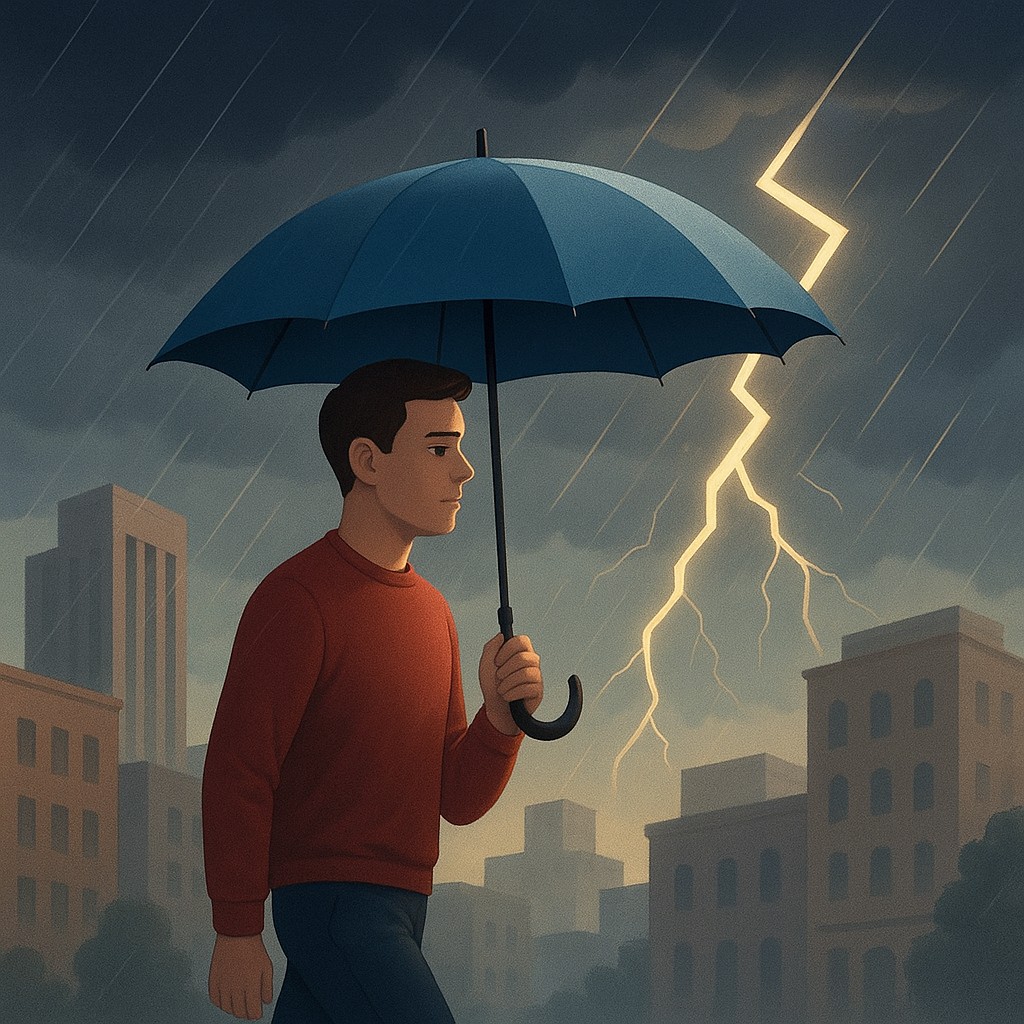
Imagine for a moment that you own a magical umbrella. This umbrella comes with a specific, slightly annoying rule: you must carry it open above your head every single day, even when the sun is shining and the sky is clear. In exchange for this chore, the magic guarantees that no one in your entire city will ever be struck by lightning.
To you, the individual, the deal feels like a scam. You have to squeeze through doorways and deal with a tired arm just to protect yourself from a bolt of electricity that, statistically, was never going to hit you anyway. But for the city as a whole, the result is a miracle: lightning deaths drop to zero. This is the core of a strange, counter-intuitive reality that quietely governs much of our modern world.
The tension between what helps the group and what feels useful to the person is one of the biggest hurdles in human cooperation. We are naturally wired to respond to immediate, visible threats, like a lion in the grass or a car swerving into our lane. We are much less equipped to handle abstract, statistical benefits that require us to change our behavior for a payoff we might never actually notice. When public health measures work perfectly, the result is a "non-event." Nothing happens. No one gets sick, no one crashes through a windshield, and no one loses a limb to a preventable disease. Because we cannot see the "nothing" we achieved, we often resent the very rules that kept the "something" from happening in the first place.
The Invisible Shield of the Many
In 1981, an epidemiologist named Geoffrey Rose noticed something peculiar about how we try to save lives. He realized that if you only focus on "high-risk" people, such as those with dangerously high blood pressure, you only save a small slice of the population. This is because most people fall into "moderate" or "low-risk" categories. Even though any single person in the low-risk group is unlikely to face a disaster, there are millions of them. Statistically, more bad things happen to the massive "low-risk" group than to the tiny "high-risk" group simply because there are so many more of them. This realization shifted the focus of medicine from treating the sick to preventing the healthy from getting sick.
When we apply a rule to everyone, like adding folic acid to flour or fluoride to water, we are using a population-level strategy. For the average person, the fluoride in a single glass of water provides a tiny, almost invisible benefit to their teeth today. However, across a nation of 300 million people, those tiny benefits add up to millions of avoided cavities and billions of dollars saved in surgery. The paradox is that the individual feels "forced" to consume something they didn't ask for, even though they belong to the group that benefits most in total. It is a masterpiece of collective logic that fails the "what's in it for me right now" test.
When Success Looks Like Boredom
The hardest part of this phenomenon, known as the Prevention Paradox, is that success is silent. Think about the massive effort to fix the "Y2K" computer bug at the turn of the millennium. Programmers worked around the clock for years to ensure that older computer systems wouldn't crash when the date changed from 1999 to 2000. When the clock struck midnight and the world didn't end, many people mocked the specialists, claiming the whole thing was a hoax. In reality, the "nothing" that happened was the direct result of immense hard work. Prevention, by its very nature, erases any evidence that it was necessary.
This "silence of success" creates a political nightmare. If a government spends millions on a dam and no flood occurs for fifty years, citizens might complain about "wasted" money spent on maintenance. They forget that the absence of a flood is exactly what they paid for. In public health, this often leads to the "satiation effect," where people become bored with safety. We stop fearing measles because we don't see people with measles anymore, so we start to think the vaccine is unnecessary. We forget that the only reason the disease is gone is that the vaccine is doing its job. We essentially become victims of our own safety.
Finding Value in the Micro-Benefit
To understand why we participate in these collective efforts, it helps to look at the math of risk versus the reality of daily life. For most of us, wearing a seatbelt feels like a minor, repetitive task that never "pays off." You might drive for forty years, clicking that belt into place every day, and never get into a serious accident. In that scenario, the seatbelt "failed" to do anything useful for you personally. However, the table below shows how these small, individual actions change the world for everyone else.
| Action Taken |
Individual Experience |
Population Result |
The "Paradox" Feeling |
| Wearing a Seatbelt |
Slight discomfort; no change in daily life. |
Thousands of lives saved every year across the country. |
"I've never been in a crash, so why do I need this?" |
| Getting Vaccinated |
A sore arm for a day; avoiding a rare disease. |
Herd immunity (when enough people are immune that a disease stops spreading). |
"I don't see anyone getting sick, so the risk is fake." |
| Lowering Salt Intake |
Food tastes slightly different; no immediate health change. |
Mass reduction in strokes and heart attacks nationwide. |
"My blood pressure is fine, so let me eat my fries." |
| Water Fluoridation |
No noticeable difference in water taste or quality. |
Millions of children avoid painful tooth decay and infections. |
"The government shouldn't put things in my water." |
As the table shows, there is a constant gap between the "Individual Experience" and the "Population Result." This gap is where skepticism grows. We are creatures of habit who value our personal freedom. When a rule asks us to give up a tiny bit of that freedom, like wearing a mask or limiting water use during a drought, we look for a personal return. When that return isn't immediate, we feel as though our rights are being ignored for no reason. Overcoming this requires a mental shift from "Will this save me today?" to "Is this part of the infrastructure that keeps us all safe?"
Correcting the "Zero Risk" Illusion
A common misunderstanding that fuels resistance is the confusion between "low risk" and "zero risk." When a doctor says your risk of a heart attack is only 2%, you might feel invincible. But 2% is not zero. If you live for eighty years, a 2% annual risk adds up to something much more significant. Furthermore, even if your individual risk is low, if you are part of a group of 100,000 people with that same 2% risk, that means 2,000 people in your group will have a heart attack this year. Statistics are cold; they don't care which specific people make up those 2,000 cases. Prevention strategies are designed to protect those 2,000 people, but since we don't know who they are in advance, we have to treat everyone.
Another myth is that "one size fits all" rules are a sign of lazy thinking. People often argue that public health rules should be "targeted," meaning only people at high risk should follow them. While this sounds logical, it is often impossible in practice. We can't always predict who will be in a car accident or who will have a bad reaction to a virus. By the time we identify the "high-risk" person, the disaster has often already happened. Treating everyone as if they are at risk is the only way to catch the people who would otherwise fall through the cracks. It is a social safety net; it has to be wide to work, even if most of the net never catches a single person.
The Psychology of Cooperation
Human beings are remarkably good at cooperating when a threat is visible. If a neighbor’s house is on fire, people will rush out with buckets of water. The danger is hot, bright, and immediate. But prevention is the equivalent of asking everyone to check their smoke detector batteries once a month. It’s boring, it’s invisible, and it doesn't make you feel like a hero. To get people to value prevention, we have to change the story. We have to start seeing "nothing happening" as a triumph rather than the default. We have to celebrate the lack of tragedies as a hard-won victory.
This requires maturity. It means acknowledging that our personal inconvenience is a small price to pay for a resilient society. When we wear a seatbelt, get a flu shot, or follow building codes, we aren't just protecting ourselves; we are contributing to a massive, invisible wall that protects the vulnerable and the unlucky. We are participating in a grand insurance policy where the premiums are paid in small daily habits and the payout is a longer, healthier life for people we will never even meet. It turns out that the most heroic thing you can do is often something very small, very boring, and very consistent.
Embracing the Quiet Victory
The next time you feel frustrated by a seemingly "useless" safety regulation, take a moment to look at the bigger picture. You are part of a vast experiment in collective survival. The Prevention Paradox is only a paradox because we focus on "I" instead of "We." When we zoom out, the logic is clear. We do the small things so that the big things don't happen. We accept a tiny bit of friction in our lives so that society can run smoothly for everyone.
Understanding this trade-off is a lesson in empathy and foresight. By recognizing that "low risk" is not "zero risk" and that "no news is good news," we become better neighbors. So, keep carrying that metaphorical umbrella. Keep clicking your seatbelt. Keep trusting the quiet work of prevention. In a world full of sudden disasters, the most beautiful thing we can create is a day where absolutely nothing goes wrong.