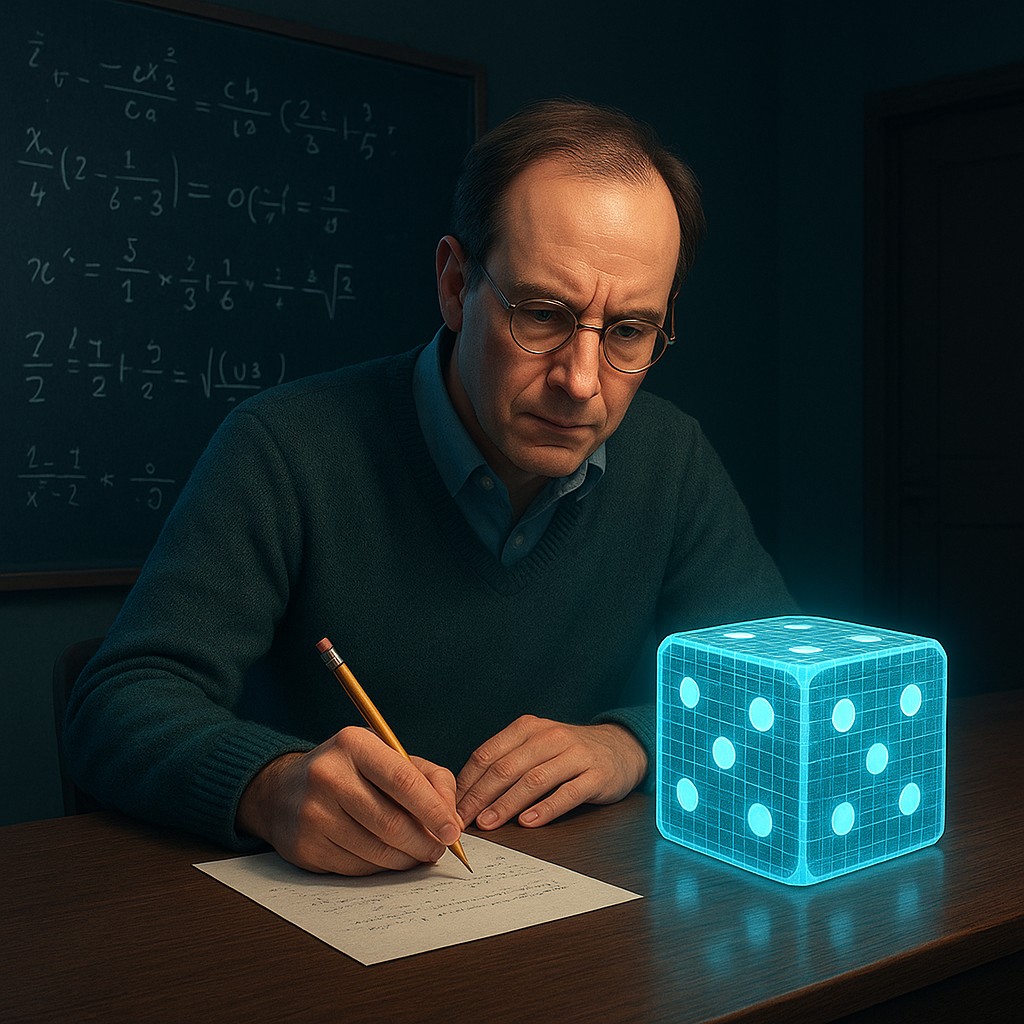
Imagine you are in a locked room with a brilliant, tireless mathematician. You ask him to give you a random number between one and one hundred. He pauses, performs complex long division in his head, and shouts, "forty-two." You are satisfied. However, if you leave the room, return five minutes later, and ask the exact same question, he will perform the exact same math and give you "forty-two" again. If you ask him a thousand times, you will get the same result every single time.
This happens because the mathematician follows a strict internal logic - a set of rules that dictates exactly how he reaches an answer. As long as the starting conditions are the same, the outcome is guaranteed. This reveals the fundamental "crisis" of computer science: computers are the most disciplined mathematicians in history, yet they are utterly incapable of being spontaneous.
In the digital world, we rely on randomness for almost everything that keeps our lives private and secure. When you log into your bank account, send an encrypted message, or play an online card game, you trust that the "dice" the machine rolls are truly unpredictable. Yet, at its core, a computer is a deterministic machine. It is a collection of switches that are either on or off, governed by code that says "if this happens, then do that." If you give a piece of software the same input, it must produce the same output, or the computer is considered broken. This creates a fascinating paradox: How do we get a machine built on absolute logic to behave with absolute unpredictability? To solve this, we have to stop looking at the code and start looking at the chaotic, vibrating physical universe the computer lives in.
Caught in the Loop of Logic
To understand the problem, we first have to look at how most software handles randomness. If you have ever written a simple program to "pick a random number," you likely used what is called a Pseudorandom Number Generator (PRNG). These are not actually random; they are mathematical formulas that produce a long, complex sequence of numbers that only look random to a person.
They start with a value called a "seed." If you know the seed and the formula, you can predict every single number the computer will ever generate. It is like a massive, circular track of numbers millions of miles long. If you jump on at mile ten today, you will see a specific sequence. If you jump on at mile ten tomorrow, you will see the exact same sequence.
In casual gaming or basic simulations, this is perfectly fine. If a character in a video game turns left instead of right because of a PRNG, it doesn’t matter if that choice was theoretically predictable. However, for security, this is a disaster. If a hacker discovers the seed your computer used to create an encryption key, they can recreate that key perfectly. They don’t need to break into your house; they just need to run the same math you did. This is why "good enough" randomness is the enemy of high-stakes privacy. We need a way to break the cycle of logic and introduce something that no amount of math can ever anticipate.
Eavesdropping on the Chaos of Electrons
The solution to this trap lies in the hardware, not the software. While code is predictable, the physical world is a messy, noisy place. Even at a microscopic level, things are constantly jittering. Inside your computer's motherboard - specifically within the processor or a dedicated chip called a Hardware Random Number Generator (HRNG) - there are components designed to listen to this noise.
One of the most common sources of this "true" randomness is thermal noise. Electrons moving through a resistor, a component that limits electrical flow, do not move in a smooth, perfectly steady stream. Because of heat, they bounce around and vibrate in tiny, unpredictable ways. This electronic "shiver" is known as Brownian motion on a microscopic scale.
By measuring the tiny changes in voltage caused by this heat, the hardware can capture a signal that is genuinely chaotic. It is effectively "sampling" the universe. This jitter is then converted into a string of zeros and ones. Because this noise is produced by the fundamental laws of physics and the movement of subatomic particles, it does not follow a mathematical script. There is no seed to steal because the seed is the state of the universe at that exact microsecond. This process is how we harvest "entropy" - a scientific term for disorder - and inject it into our sterile, logical machines.
The Journey from Heat to High-Security Keys
Once the hardware has captured this raw electronic noise, it isn’t immediately ready to be used as a password. Raw entropy is often "biased," meaning it might produce slightly more ones than zeros, or it might have patterns based on the frequency of the electricity in your walls. To fix this, the computer runs the raw noise through a process called "whitening" or "distillation." This cleans the chaotic signal into an even distribution of bits, ensuring that every number has an exactly equal chance of appearing.
This high-quality randomness is then funneled into an "entropy pool" within the operating system. Think of this pool as a digital reservoir of pure chaos. When a program needs to create an encryption key to protect your credit card information, it dips a bucket into this pool. By mixing this physical entropy with mathematical algorithms, the computer creates a Cryptographically Secure Pseudorandom Number Generator (CSPRNG).
This hybrid approach provides the best of both worlds: the speed of mathematics and the unpredictability of the physical world. It ensures that even if a genius mathematician spends a billion years trying to find a pattern, they will find nothing but silence.
Distinguishing Between the Digital Dice
It is helpful to see the clear distinctions between the types of randomness we encounter in computing. Not all random numbers are created equal, and using the wrong one for the wrong job can lead to anything from a predictable game to a total security collapse.
| Feature |
Pseudorandom (PRNG) |
True Random (TRNG/Hardware) |
| Source |
Mathematical Algorithms |
Physical Phenomena (Heat, Light) |
| Predictability |
High (if the seed is known) |
Virtually Impossible |
| Speed |
Extremely Fast |
Slower (limited by physics) |
| Primary Use |
Video Games, Simulations |
Encryption, Secure Keys, Gambling |
| Example |
Math.random() in Javascript |
Intel Secure Key (RDRAND) |
The Art of Mechanical Spontaneity
Beyond thermal noise, engineers have come up with creative ways to find chaos in the wild. Some systems monitor the precise timing of a user's keystrokes or the erratic movements of a mouse, arguing that human behavior is chaotic enough to provide a seed. While this works for personal computers, it isn't enough for massive servers that need to generate millions of keys a second without a human around.
This led to famous solutions like Cloudflare’s "LavaRand" system. In their headquarters, they have a wall of actual lava lamps. A camera films the swirling, rising, and falling blobs of wax, which follow the complex laws of fluid dynamics. The camera's feed is converted into data and fed into their servers' entropy pools.
While lava lamps are more visually impressive, most modern devices rely on the "ring oscillator" method. This involves a series of electronic gates that flip back and forth at incredibly high speeds. Because of tiny variations in the hardware and environment, the exact time it takes for these gates to flip drifts by fractions of a second. This "jitter" is harvested as entropy. Whether it is the heat of a resistor, the drift of an oscillator, or the swirl of a lava lamp, the goal is the same: to find a crack in the computer's perfect logic and let the unpredictable nature of reality flow in. This is the bridge between the digital and the physical, ensuring that while our machines are predictable, our secrets remain anything but.
The Modern Guardian of Private Life
The next time you see a small padlock icon in your browser's address bar, or you use a fingerprint to unlock an encrypted chat, take a moment to appreciate the microscopic chaos making it possible. We often think of computers as cold, sterile environments of pure data, but for them to truly serve and protect us, they must remain tied to the messy, vibrating world of physics. We have effectively turned the "weakness" of hardware - its sensitivity to heat and environmental noise - into its greatest strength.
By capturing the jitter of electrons and the shiver of atoms, we have given our logical machines the one thing they could never create on their own: a sense of surprise. This marriage of rigid logic and fluid chaos is what allows our digital civilization to function with trust. You are no longer just using a calculator; you are using a device that listens to the heartbeat of the universe to keep your world secure. Embrace the noise, for it is the only thing standing between your private data and the predictable reach of those who would try to calculate it away.