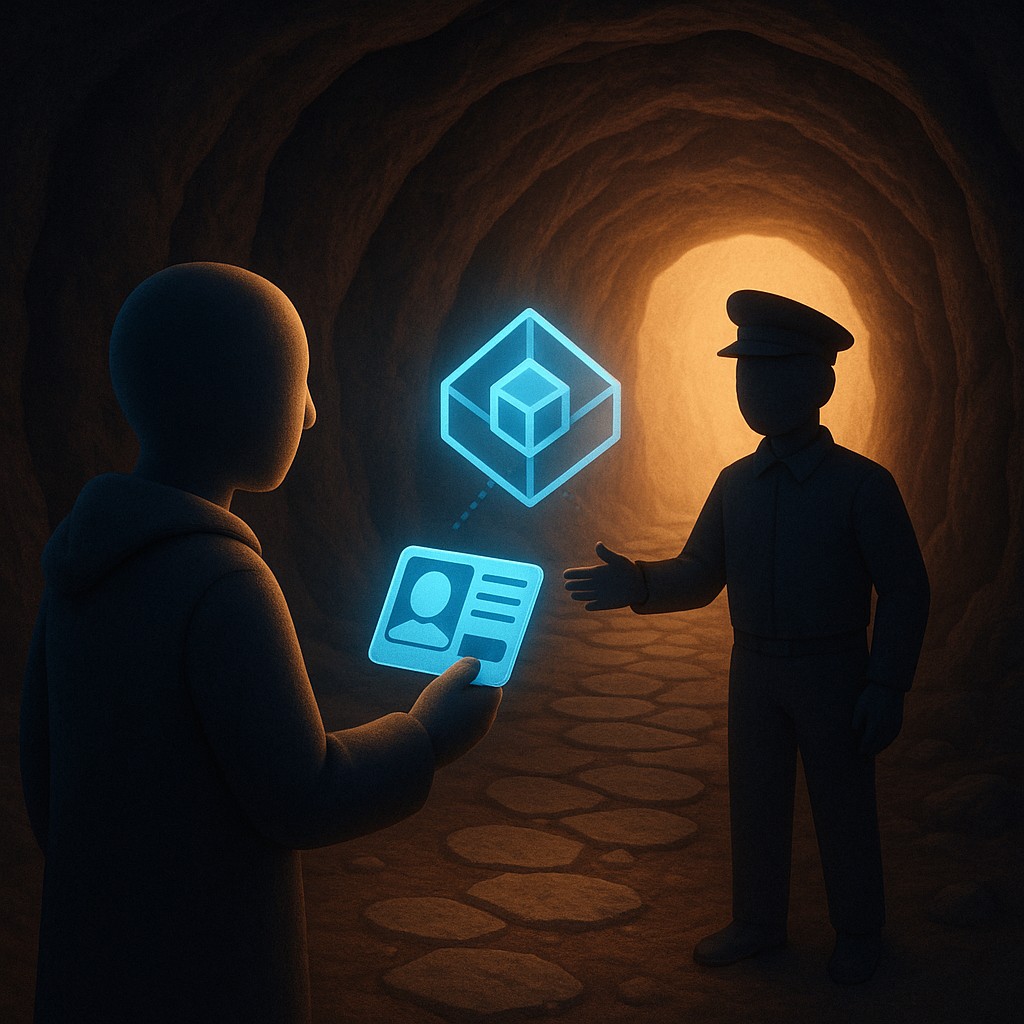
In the physical world, proving who you are usually requires a heavy-handed exchange of information. To enter a venue with an age restriction, you hand over a plastic card that reveals your full legal name, home address, height, eye color, and exact date of birth. The security guard only needs to know one binary fact - whether your birth year makes you older than 21 - yet they walk away with a mental snapshot of your entire personal life. This is the fundamental paradox of modern privacy: to prove we are trustworthy, we are forced to be vulnerable, scattering bits of our personal data across thousands of databases that we can no longer control or protect.
Imagine instead a world where you could prove you have enough money in your bank account for a mortgage without revealing your balance, or prove you are a citizen of a country without showing your passport. This sounds like digital magic, or perhaps a bold lie, but it is actually the foundation of a revolutionary field of cryptography known as Zero-Knowledge Proofs (ZKPs). At its heart, this technology allows one party (the Prover) to convince another party (the Verifier) that a specific statement is true without revealing a single piece of the underlying data that makes it true. It is the ultimate "need to know" system for the digital age, shifting the burden of proof from sharing data to sharing mathematical certainty.
The Cave, the Path, and the Secret Word
To understand how math can prove a secret without telling it, we often look to a classic parable known as the Ali Baba Cave. Imagine a circular cave with one entrance and a giant limestone wall in the middle, splitting the path into two forks, Path A and Path B. At the very back of the cave, where the two paths would normally meet, there is a heavy iron door that can only be opened by a secret magic password. Peggy (the Prover) claims she knows the password, but she does not want to say it out loud because Victor (the Verifier) might steal it. To prove she knows it, Peggy enters the cave while Victor stays outside so he cannot see which path she takes.
Victor then walks to the entrance and shouts a random path name, such as "Come out of Path B!" If Peggy truly knows the magic word, she can open the door at the back and exit through Path B, regardless of whether she initially entered through A or B. If she was lying and did not know the word, she would be trapped on whichever side she originally chose. If she chose Path A and Victor yelled "Path B," she would be stuck. She might get lucky once by guessing what Victor will ask, but if they repeat this process forty times, the odds of her "guessing" correctly every single time without knowing the password are less than one in a trillion. This is the core of a Zero-Knowledge Proof: through repeated interaction and randomness, Peggy provides statistical proof of her knowledge without ever whispering the secret word to Victor.
The Three Pillars of Mathematical Certainty
For a protocol to officially count as a Zero-Knowledge Proof, it must satisfy three strict rules that ensure the system is both honest and private.
The first is Completeness. This means that if the statement is true and both parties follow the rules, the Verifier will definitely be convinced. In our cave example, if Peggy actually knows the password, she will always be able to exit the correct door as Victor requests. The system is designed to work perfectly for honest people, ensuring that truth is always recognizable and never accidentally rejected.
The second pillar is Soundness, which protects the Verifier from being cheated. Soundness ensures that if the statement is false, a lying Prover has almost zero chance of tricking the Verifier. While a lucky liar might pass one or two rounds of questioning, the mathematical probability of failing grows with every additional "challenge" the Verifier issues. This creates a "trustless" environment because the Verifier does not need to trust Peggy's character; they only need to trust the laws of probability. If the math says the odds of cheating are lower than the odds of a meteor hitting the building, the Verifier can proceed with confidence.
The final pillar is Zero-Knowledge itself. This requires that if the statement is true, the Verifier learns absolutely nothing other than the fact that the statement is true. They do not learn the password, they do not learn how the door works, and they do not even get a hint. After the interaction, the Verifier is in the exact same state of knowledge as before, except for one new piece of verified information. This protects the Prover’s control over their own data, ensuring that "proof" does not inadvertently become a "leak."
Different Flavors of Hidden Truths
As researchers moved from theoretical caves to actual computer code, they developed different types of Zero-Knowledge systems to handle various digital tasks. Some require back-and-forth communication, while others are "non-interactive," meaning the Prover can send a single piece of data and the Verifier can check it immediately without asking further questions. These systems have become incredibly efficient, allowing complex proofs to be squeezed into tiny packages that can be verified in milliseconds.
| Feature |
Interactive ZKP |
Non-Interactive ZKP (zk-SNARKs) |
| Communication |
Requires multiple rounds of back-and-forth. |
Single proof sent from Prover to Verifier. |
| Speed |
Can be slower due to network delays. |
Extremely fast verification for the Verifier. |
| Proof Size |
Larger, as it involves a history of interaction. |
Small and "succinct," taking up very little space. |
| Setup |
Usually requires no special initial conditions. |
Often requires a "Trusted Setup" phase. |
| Privacy |
High privacy, but requires both parties online. |
High privacy and works even if Prover is offline. |
The most common modern version is the zk-SNARK. The "succinct" part is vital because it means the proof is much smaller than the actual data it represents, making it perfect for blockchains or mobile apps where storage is limited. These proofs allow a computer to say, "I have processed ten thousand transactions and the math is perfect," and provide a tiny piece of evidence that anyone can verify instantly without re-calculating those ten thousand transactions themselves.
Beyond Cryptography into the Real World
The implications of Zero-Knowledge Proofs extend far beyond digital currencies and secret caves. In cybersecurity, ZKPs could end the era of password breaches. Today, when you log into a website, you send your password to their server, which checks it against a database. If a hacker steals that database, they have your password. With ZKPs, you could prove you know your password without ever sending it to the server. The server would only receive a proof that you have the right credentials, meaning there would be no "secret" stored on the server for a hacker to steal.
We are also seeing a massive shift in how we handle identity and legal compliance. Financial institutions are exploring "Private KYC" (Know Your Customer) systems, where a user can prove they are not on a sanctions list or that they have a high enough credit score without revealing their name or their specific assets. In healthcare, researchers could run statistical analysis on patient records to find the effectiveness of a new drug while using ZKPs to ensure that no individual patient's private medical data is ever exposed. It turns the data into a "black box" that provides answers without revealing its contents.
Even in supply chains and ethical sourcing, ZKPs offer a way to verify claims without compromising trade secrets. A manufacturer could prove that their raw materials were sourced from a conflict-free zone by providing a cryptographic proof of the origin certificates, without revealing who their specific suppliers are or what prices they paid. This creates a transparent world where we can trust labels because they are backed by verifiable math rather than just a marketing promise.
Separation of Knowledge and Truth
It is important to address one common misunderstanding: a Zero-Knowledge Proof does not automatically prove that the secret itself is "The Truth" in a cosmic sense. It only verifies that the Prover possesses a piece of information that satisfies a specific mathematical requirement. If a government issues a digital ID with an incorrect birth date, the ZKP will perfectly prove that the person is "over 21" based on that incorrect data. The ZKP is the messenger of the proof, not the original source of the fact.
This is a case of "Garbage In, Garbage Out." If the underlying database is flawed, the proof will be a perfect verification of a lie. Therefore, ZKPs are most effective when combined with reputable digital signatures from trusted entities like banks, hospitals, or governments. The ZKP ensures that once a piece of information is deemed "official," you can use it to interact with the world without ever having to expose the original sensitive record again. It protects the privacy of the data, but the accuracy still relies on the original issuer.
A Future Built on Mathematical Trust
There is a subtle irony in the fact that the most secure way to share information is to not share it at all. As we move further into a century defined by data breaches, identity theft, and the erosion of digital boundaries, Zero-Knowledge Proofs offer a graceful exit from our current privacy nightmare. We are transitioning from a society that asks for "your data, please" to one that asks for "the proof, please." This shift respects individual freedom while providing the certainty required for a global economy to function.
The beauty of this technology lies in its ability to reconcile two opposite goals: total transparency and total privacy. It allows us to build systems that are completely honest and auditable, yet leave the individual components of those systems hidden. Your personal details are not the "price" you have to pay for access. Through the elegant dance of math and cryptography, we can participate in the world, prove our worth, and keep our secrets all at once. The future is not about knowing everything about everyone; it is about knowing just enough to trust, and letting the math handle the rest.