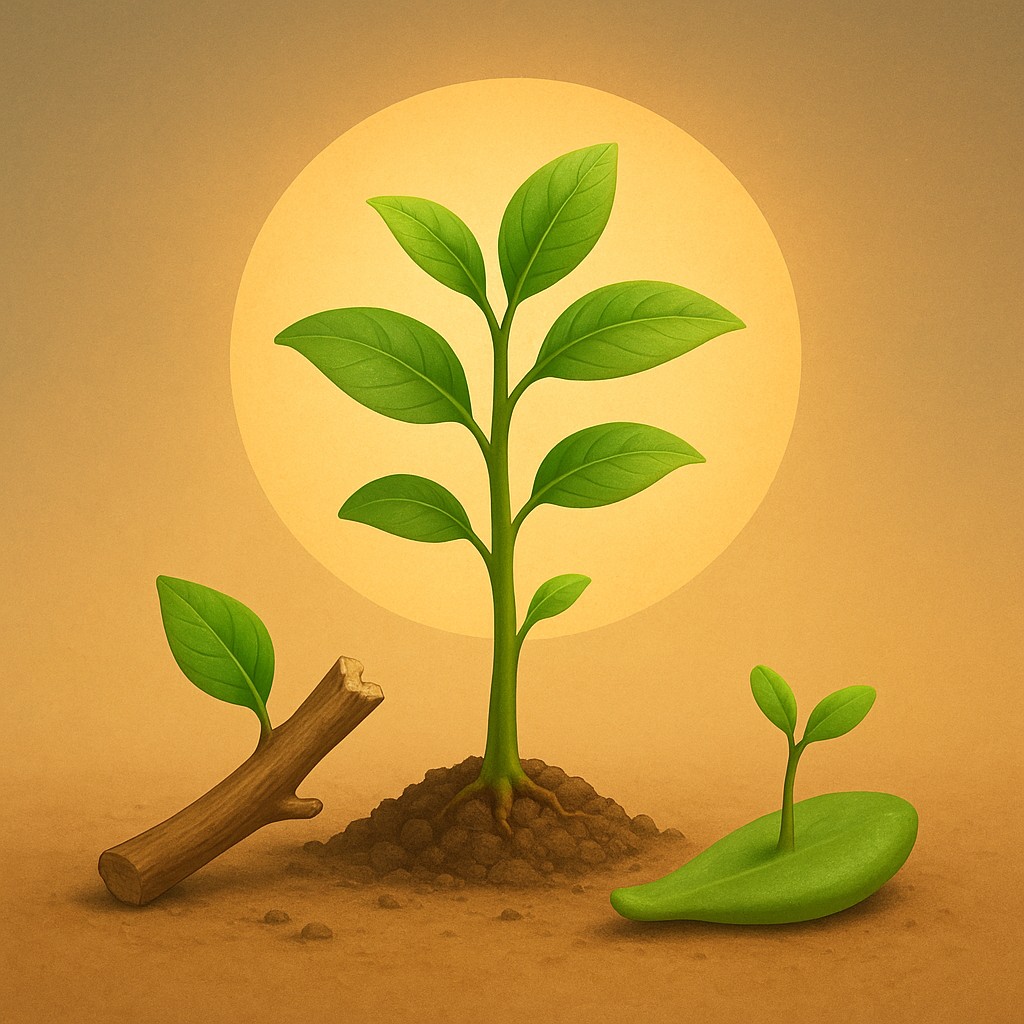
If you accidentally snap a leg off a plastic chair, you are left with a broken chair and a useless piece of scrap. If a hungry deer nibbles the arm off a human, that person is in serious trouble, and the arm certainly isn't going to grow into a second human. But if that same deer chomps a branch off a willow tree or a leaf off a succulent, something remarkable happens.
The discarded piece, given a bit of damp soil and some peace, doesn't just sit there. It grows. It develops roots where it once had bark, pushes out new leaves, and eventually becomes a perfect, genetically identical twin of the parent plant.
This ability is one of the most profound differences between the plant and animal kingdoms. While we spend our lives locked into the bodies we were born with, plants are masters of the ultimate biological "undo" button. They possess a cellular superpower called totipotency. This allows a single, specialized cell to discard its current job description and rewrite its entire destiny. It is the reason you can turn one supermarket basil plant into a forest of herbs, and it is the mechanism that allows woodlands to recover from devastating storms.
The Biological Blueprint of Eternal Youth
To understand why a leaf can become a grandmother, we have to look at how cells decide what they want to be when they grow up. In the animal kingdom, cells are like specialized professionals. During embryonic development, your cells "differentiate," a process where they choose a career path, such as becoming a nerve cell, a muscle fiber, or a red blood cell. Once an animal cell has specialized, it generally loses the ability to do anything else. A heart cell stays a heart cell until the day it dies; it cannot decide to become a lung cell just because the body is short on oxygen.
Plants, however, play by different rules. While they also have specialized tissues like the epidermis (skin) or the xylem (the internal plumbing), many of their cells remain "totipotent." This word comes from the Latin totus, meaning entire, and potentia, meaning power. It literally means these cells have the "power of the whole." Even after a cell has become part of a leaf, it keeps the complete instruction manual to build the entire plant from scratch. It’s as if every brick in your house held the blueprints, the tools, and the supplies necessary to build a second, identical house next door.
This flexibility is more than just a party trick; it is a vital survival strategy. Because plants cannot run away from predators or fires, they have evolved a modular growth system. If a cow eats the top of a wildflower, the remaining cells at the wound can sense the change. They "de-differentiate," reverting to a state similar to stem cells, and then re-specialize into whatever the plant needs next. This fluid identity makes plants nearly indestructible in ways animals simply cannot match.
Taking Orders from Chemical Messengers
If every plant cell has the potential to be anything, what keeps a tree from accidentally growing a leaf where its roots should be? The answer lies in a delicate, invisible tug-of-war between plant hormones. In the world of plant propagation, the two most important players are Auxin and Cytokinin. These chemical messengers act like a management team, sending signals that tell the cells exactly which part of the blueprint to read.
Auxin is typically produced in the "apical" parts of the plant, such as the growing tips of stems. It naturally flows downward, and when it reaches the base, it signals the plant to grow roots. If you take a cutting, the flow of Auxin is interrupted and begins to pool at the cut. This high concentration of Auxin tells the cells at the wound, "We’re missing a bottom half! Stop being stem cells and start being root cells." On the flip side, Cytokinin is produced in the roots and travels upward, signaling the plant to grow shoots and leaves.
Gardeners and scientists have learned to manipulate this ratio to clone plants with high precision. By dipping a cutting into "rooting hormone" (usually a synthetic version of Auxin), we are essentially shouting instructions at the plant's cells, forcing them to activate their root-building DNA. This chemical conversation makes the transition from a leaf to a whole organism possible. Without these signals, the cells would simply sit there, unsure of which direction to grow.
A Comparison of Growth Strategies
To truly appreciate the uniqueness of plant cloning, it helps to see how it compares to the way most other life forms handle reproduction and repair. The following table highlights the differences between the "locked-in" development of most animals and the "modular" development of plants.
| Feature |
Animal Development (Most Species) |
Plant Development (Cloning/Propagating) |
| Cellular Identity |
Specialized and permanent; cells rarely change roles. |
Flexible and totipotent; cells can revert and re-specialized. |
| Reproduction |
Primarily sexual; requires two sets of DNA to create a new individual. |
Can be asexual; one individual can create identical copies. |
| Genetic Makeup |
Result of genetic mixing; offspring are unique individuals. |
Clones are genetically identical to the parent (natural "Xeroxes"). |
| Response to Injury |
Scarring and limited repair; lost limbs generally don't regrow. |
Regrowth and regeneration; lost parts can become new individuals. |
| Growth Pattern |
Determinant; animals reach a final size and shape. |
Indeterminate; plants can keep growing and adding modules indefinitely. |
The Master Gardener’s Toolkit
Because of totipotency, humans have developed several ways to "hack" plants to grow more of what we love. The most common method is the simple cutting. Whether it’s a stem from a rose bush or a leaf from a snake plant, the principle is the same: you isolate a group of cells and give them the environment they need to reset. For some plants, just placing a leaf in a jar of water is enough. The water provides hydration, while the lack of "root signals" from the missing bottom half triggers the hormonal shift.
Another fascinating method is "layering." This is when a gardener bends a living branch down until it touches the soil. By pinning it there and perhaps nicking the bark to trigger a stress response, they encourage the branch to grow roots while it is still attached to the mother plant. Once the roots are established, the branch is cut, and a new, independent clone is born. This is a "safety-first" approach, as the parent plant provides nutrients to the clone until it is ready to survive on its own.
In high-tech laboratories, scientists take this even further with "tissue culture." They can take a tiny cluster of cells, or even a single cell, and place it in a petri dish filled with a nutrient-rich jelly (agar) laced with specific hormones. By carefully adjusting the balance of Auxin and Cytokinin, they can force those cells to multiply into a blob of unspecialized tissue called a "callus." Then, with a quick change of the hormone recipe, they signal that callus to sprout hundreds of tiny plantlets. This allows for the mass production of millions of identical orchids or bananas in a fraction of the time natural growth would take.
The Achilles Heel of the Genetic Monoculture
While cloning sounds like a biological free lunch, it comes with a significant ecological price tag. In nature, sexual reproduction (the mixing of DNA from two parents) exists for a very good reason: diversity. When plants swap pollen, they create offspring with slight variations in their genetic code. Some might be better at resisting drought, while others might have a natural toolkit for fighting off a specific fungus. This diversity ensures that even if a new disease sweeps through a forest, at least a few individuals will likely survive.
Cloning throws that safety net out the window. When you propagate a plant through cuttings, you are creating a "monoculture." If you have a garden full of 100 rose bushes all cloned from the same mother plant, they are essentially the same individual living in 100 different pots. They share the exact same weaknesses. If a specific mold or fungus evolves to bypass the defenses of your original plant, it will find every single one of your clones equally defenseless.
We saw the devastating effects of this with the Gros Michel banana. In the early 20th century, this was the standard banana sold worldwide. Every Gros Michel was a clone. When a soil fungus called Panama Disease emerged, it wiped out plantations globally because the plants had no genetic variation to offer resistance. We eventually replaced it with the Cavendish banana, which is also a clone and is currently facing a similar threat from a new strain of the same disease. Cloning gives us consistency, but it robs us of resilience.
Transforming Misconceptions into Understanding
A common myth about plant cloning is that you can clone "anything from anything." While totipotency is widespread, not every plant is equally willing to cooperate. Some plants, like succulents or willow trees, are incredibly easy to clone because their cells are "primed" for regeneration. Others, like many old hardwood trees or evergreens, are much more stubborn. Their cells are more "deeply" specialized, meaning it takes much more specific environmental cues or laboratory interventions to convince them to return to a stem-cell state.
Another misconception is that a clone won't age. People sometimes think that by taking a cutting from a 100-year-old tree, they are resetting the biological clock. While the cutting will grow new roots and leaves, it actually retains some of the chemical markers of its parent’s age. This is why some clones from very old plants might not be as vigorous as a seedling or may flower prematurely. You are getting a genetic twin, but that twin carries the "wear and tear" of the parent's history in its cellular makeup.
Finally, it is a mistake to think that cloning is purely a human invention. Plants have been cloning themselves since long before people ever picked up a spade. Strawberry plants send out "runners" (horizontal stems) that root and create new plants. Aspen trees create massive underground root systems that send up "clones" of the main tree, resulting in entire forests that are technically one single organism. Humans didn't invent cloning; we simply learned to speak the language of the plant's own internal repair manual.
Embracing the Resilience of the Green World
Learning about totipotency changes the way you look at a garden or a forest trail. You stop seeing plants as static, fragile objects and start seeing them as dynamic systems capable of incredible reinvention. Every leaf is not just a solar panel, but a potential forest. Every stem is not just a support pillar, but a biological backup drive. This modular, flexible approach to life is what has allowed plants to colonize nearly every corner of our planet, surviving ice ages, volcanic eruptions, and hungry animals.
The next time you find yourself with a broken stem or a fallen leaf, don't be so quick to toss it in the compost. Remember the silent potential residing within those cells. By providing a little water, the right light, and perhaps a touch of rooting hormone, you can participate in one of nature's most spectacular miracles. Cloning is a reminder that in the natural world, an ending is often just a disguised beginning, and the power to start over is written into the very DNA of the life around us.