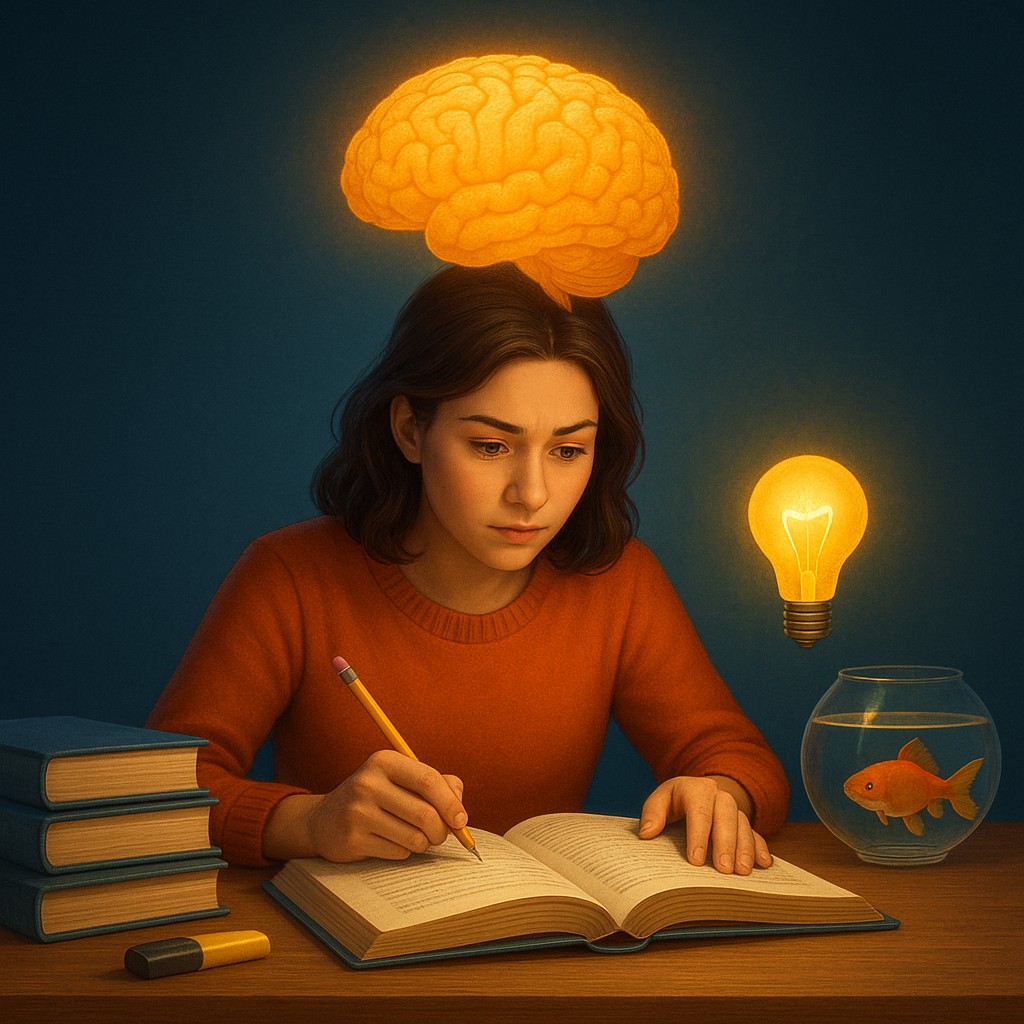
Have you ever spent hours hunched over a textbook, diligently highlighting every third sentence in neon yellow, only to realize an hour later that you couldn't explain the main idea to a goldfish? It is a frustratingly common experience that feels like a betrayal of your own hard work. You put in the time, your eyes physically traveled across every page, and yet the information seemed to evaporate the moment you closed the cover. This happens because the human brain is remarkably good at ignoring anything it considers "background noise," and unfortunately, passive reading usually falls into that category.
The secret to why some people have a "steel trap" memory while others struggle to remember their own zip code often comes down to how they interact with information. When you simply consume content, your brain stays in a low-power state. It assumes that since the information is right there in front of you, it doesn't need to do the heavy lifting of storing it. To truly lock a concept into your long-term memory, you have to trick your brain into believing the information is vital for survival. You do this by making the brain "work" for the answer, a psychological powerhouse known as the Generation Effect.
Exploring the Mechanics of the Active Mind
At its core, the Generation Effect is the observation that people remember information much better when they produce it from their own minds rather than simply "catching" it like a baseball thrown by someone else. Imagine two scenarios. In the first, you are given a list of synonyms like "Hot - Fast." In the second, you are given "Hot - F___" and asked to fill in the blank yourself. Research consistently shows that the person who had to pause, think, and come up with the word "Fire" or "Fast" will remember that connection far better than the person who just read the pair. This happens because the act of generating the word forces your brain to use complex neural processes that passive reading completely skips.
When you create an idea, you are essentially building a bridge from your existing knowledge to a new concept. This bridge-building involves searching your mental archives, selecting the right pieces of data, and assembling them into a clear thought. This effort signals to your hippocampus, the brain’s librarian, that this specific piece of information is important enough to be filed in the "permanent collection" rather than the "recycling bin." It turns learning from a spectator sport into an active event where you are the star athlete.
Furthermore, this effect creates multiple "retrieval cues," or mental shortcuts, in your mind. If you just read a definition, you have one weak path leading back to that information. If you explain that definition using your own metaphor, relate it to a personal story, and then use it to solve a problem, you have created a web of pathways. If one path fails, your brain can take a detour through another connection you built. This redundancy is what makes knowledge feel like something you own rather than something you are just borrowing for a few minutes.
Comparing Passive Consumption to Active Production
To understand why traditional studying often fails, it helps to look at the differences between how we usually treat information and how we should treat it if we want it to stick. Many students and professionals fall into the trap of "fluency," the mistaken belief that because a text is easy to read, it will be easy to remember. Just because you understand what an author is saying while you are looking at the page does not mean you have moved that information into your own brain. Below is a breakdown of how different approaches impact your mental "muscle."
| Learning Method |
Mental Effort Level |
Primary Action |
Long-Term Retention |
| Highlighting Text |
Very Low |
Recognizing keywords |
Poor (The "Illusion of Learning") |
| Rereading Notes |
Low |
Familiarity with words |
Moderate-Low (Very inefficient) |
| Reading Flashcards |
Medium |
Recognizing the right answer |
Moderate (Better than rereading) |
| Self-Quizzing |
High |
Recalling from memory |
Excellent (Strengthens memory paths) |
| Teaching Others |
Very High |
Organizing and explaining |
Superior (Maximum brain workout) |
As the table shows, there is a direct link between how much your brain "sweats" and how much it remembers. Highlighting is often a form of "productive procrastination," where you feel like you are working, but your brain is actually on autopilot. On the other hand, teaching a concept to a friend or even an object like a rubber duck forces you to face gaps in your logic. If you cannot explain it, you do not understand it. The Generation Effect turns those "Aha!" moments of realization into permanent parts of your mind.
The Art of the Mental Workout
Using the Generation Effect does not require a complete lifestyle change, but it does require a shift in your habits. Instead of reading a chapter and then closing the book, try the "Read, Recite, Review" method. After every few pages, close the book and try to write down the three most important points in your own words. You will likely find this surprisingly difficult at first. That struggle is the sound of your brain actually learning. When you force your mind to rebuild a concept without looking at the original source, you are performing a "stress test" on your memory, which makes it stronger for the future.
Another powerful tool is the use of "intentional gaps." If you are taking notes, leave yourself questions rather than just statements. Instead of writing "The mitochondria is the powerhouse of the cell," write "What is the primary function of the mitochondria?" During your next study session, do not look at the answer until you have tried to answer it yourself. This minor friction creates a "generation moment." By the time you confirm the answer, your brain is "primed" and hungry for the information, making the learning process much more effective than if you had simply read the fact again.
You can also use this at work. After a meeting, instead of just filing away the shared notes, take five minutes to write a summary of the key takeaways and how they affect your specific projects. This changes the data from "the company's goals" into "my action items" and triggers the Generation Effect. You are no longer a passive recipient of corporate data; you are the architect of your own work plan. This ownership makes the details of the meeting far more likely to stick when you are in the middle of a busy workday.
Avoiding the Trap of Confident Errors
There is one major warning regarding the Generation Effect: your brain is a bit too good at its job. If you come up with an incorrect answer and believe it is true, your brain will lock that error into your memory with the same strength it uses for correct facts. This is why the "generation" phase must always be followed by a "verification" phase. If you are practicing math problems and consistently use the wrong formula, you are effectively training yourself to be wrong. The brain does not have a built-in "truth filter"; it only has an "effort filter."
To prevent this, make sure your learning loop is tight. Generate the information, then immediately check it against a reliable source. If you were wrong, do not just say "Oh, I knew that" and move on. That is a lie your brain tells to protect your ego. Instead, look at why you were wrong, fix the logic, and then try to generate the correct version again. This cycle of generation, feedback, and correction is the gold standard for mastering high-level skills, used by everyone from grandmaster chess players to surgeons.
Precision matters just as much as effort. If you are summarizing a complex political theory, do not just "kind of" get it. Push yourself to be as accurate as possible. The more specific your summary is, the more useful it will be later. Think of your memory as a filing system; if you label a folder "Stuff," you will never find anything. If you label it "18th Century Economic Trends in Europe," you have a much better chance of finding exactly what you need when the pressure is on.
Building a Culture of Active Discovery
In an era of instant gratification and endless scrolling, the Generation Effect is your secret weapon for building deep knowledge. We live in a world that encourages us to be passive consumers of "content" rather than active creators of "knowledge." Every time you choose to summarize a podcast rather than just letting it play in the background, or every time you solve a problem by hand instead of looking up the solution, you are choosing to be a more capable, informed version of yourself. You are telling your brain that your thoughts have value and that the world around you is worth understanding deeply.
The beauty of this mechanism is that it grows with you. As you get better at generating information, the initial strain starts to feel less like a chore and more like a satisfying mental exercise. You will start to notice patterns in how you think, and you will find that you can pick up new skills faster than you ever thought possible. Learning is not something that happens to you; it is something you do. Embrace the friction, lean into the struggle of creation, and watch as your mind transforms from a leaky bucket into a powerful engine of discovery. By working for your knowledge, you ensure that your knowledge works for you.