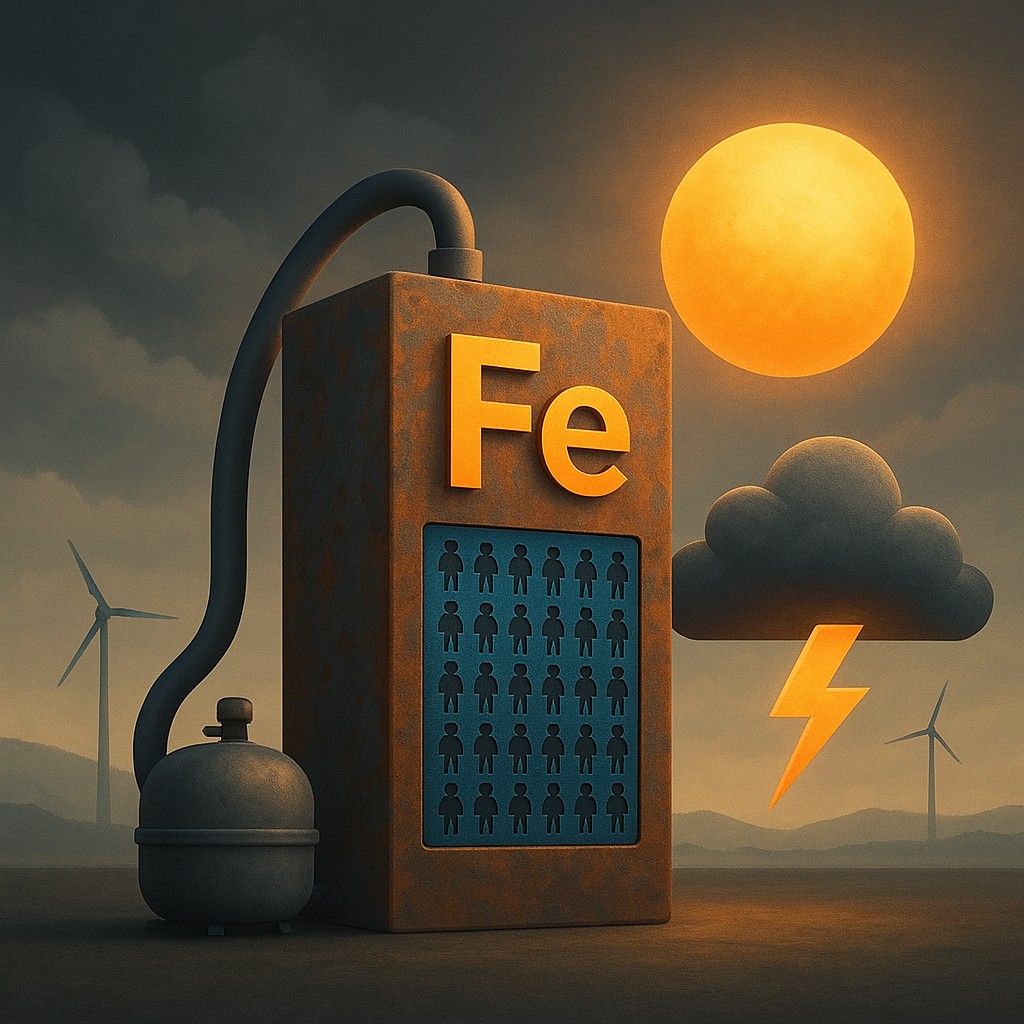
Imagine for a moment that you are a grid operator in a world powered entirely by the sun and the wind. For three days, a massive, slow-moving high-pressure system has settled over the region, stalling every wind turbine from the coast to the plains. To make matters worse, a thick blanket of winter clouds has turned the afternoon sun into nothing more than a dull gray glow. Your city is humming along, heaters are blowing, and ovens are roasting, but your primary fuel sources have essentially gone on vacation. In the energy industry, this is the nightmare scenario known as a dunkelflaute, a German word meaning "dark doldrums," where renewable energy production drops to near zero for days at a time.
To solve this, we usually look toward the giant lithium-ion batteries that power our phones and electric vehicles. These batteries are wonderful at reacting in milliseconds to balance minor flickers in the grid, but they have a fatal flaw when it comes to the long haul. Using lithium-ion to power a city for four straight days would be like trying to run your entire house off thousands of expensive laptop batteries duct-taped together. It would be far too expensive, and the materials required would strip the earth bare. This is where the world is turning toward a solution that sounds less like high-tech wizardry and more like a backyard science experiment gone right: the iron-air battery, a device that literally breathes in the atmosphere to create electricity through the power of rust.
The Chemistry of Reversible Decay
At the heart of this technology is a process that every car owner and bridge engineer usually spends their life trying to prevent. Rust is the natural tendency of iron to return to a more stable state, called an oxide, when exposed to oxygen and moisture. Usually, we see this as a destructive force that eats away at car fenders and garden tools. However, in an iron-air battery, rust is actually a form of stored potential. When the battery sends energy to the grid, it takes in oxygen from the surrounding air and applies it to a stack of iron pellets submerged in a water-based liquid, or electrolyte. This chemical reaction creates iron oxide and, more importantly, releases a steady stream of electrons that can be funneled into the electrical grid.
The real magic happens when you want to charge the battery back up. When there is an excess of solar power on a bright Tuesday afternoon, that surplus electricity is pumped back into the system. The current forces the oxygen out of the iron oxide, turning the rust back into solid, metallic iron. This cycle can be repeated thousands of times without the materials breaking down. It is a closed-loop system of reversible decay, where the "fuel" is just one of the most common metals on the planet and the air we breathe. Unlike lithium-ion batteries, which require complex mixtures of cobalt, nickel, and manganese, the iron-air system relies on ingredients that are dirt cheap and available in almost every country on Earth.
Weighing the Heavyweights of Storage
To understand why iron-air is gaining such massive traction among energy providers, we have to look at the economic gap between short-term and long-term storage. Lithium-ion batteries excel at "shifting" energy across a four-hour window, such as storing noon-time solar for the evening commute. But as you try to extend that storage time to twenty, fifty, or one hundred hours, the cost of lithium scales up quickly and painfully. Iron-air batteries, by contrast, use a "decoupled" design. If you want more storage capacity in an iron-air system, you do not necessarily need more expensive electronics; you mostly just need more iron. This allows the cost of storage to drop to about one-tenth the price of lithium-ion systems for long-term uses.
| Feature |
Lithium-Ion Batteries |
Iron-Air Batteries |
| Primary Use Case |
Quick response (1-4 hours) |
Long-term (up to 100 hours) |
| Core Materials |
Lithium, Cobalt, Nickel |
Iron, Oxygen, Water |
| Energy Density |
Very High (small and light) |
Low (heavy and bulky) |
| Estimated Cost |
$150 - $200 per kWh |
$20 - $30 per kWh |
| Environmental Risk |
High (fire risk, mining impact) |
Low (non-flammable, abundant) |
| Typical Application |
Electric Vehicles, Smartphones |
Grid-scale Power Plants |
The table above highlights the fundamental trade-off of this technology. While iron-air batteries are champions of cost and duration, they are the heavyweights of the battery world in the literal sense. Iron is dense, and the systems required to manage the air intake and water-based liquids are bulky. You will never see an iron-air battery in a Tesla or an iPhone because they are simply too big and slow to respond to the rapid acceleration needs of a car. They are destined to stay exactly where they are built, serving as the stationary lungs of the power grid, breathing in and out over the course of an entire week.
Breathing New Life into Old Coal Plants
One of the most poetic aspects of the iron-air revolution is where these batteries are being installed. Many energy operators are building these massive storage facilities on the sites of retiring coal-fired power plants. This is a smart move for several reasons, both for logistics and for communities. Coal plants are already connected to the high-voltage power lines that we need to move electricity around. By placing iron-air batteries in these locations, engineers can reuse the existing electrical infrastructure, saving taxpayers and utility companies billions of dollars in new construction costs.
Furthermore, these sites are often located in towns that have long relied on the energy industry for jobs. A "battery plant" using iron-air technology looks and works much more like a traditional industrial factory than a sleek tech laboratory. It involves tanks, pumps, metal handling, and plumbing, skills that are already common in the workforce of a former coal town. This transition allows for a smoother shift into the green energy economy, as the "rust" power plant replaces the "smoke" power plant. Instead of burning carbon and releasing it into the atmosphere, we are capturing oxygen and temporarily storing it in metal pellets, only to release it later when the wind starts blowing again.
Managing Air and Water
While the concept of reversible rusting sounds simple, the engineering behind it is a masterpiece of fluid movement and materials science. Each battery module is roughly the size of a shipping container, but inside, it is a complex hive of activity. The electrolyte, which is a liquid solution that allows particles to move back and forth, must be carefully managed to prevent the buildup of unwanted minerals. One of the main engineering hurdles was the design of the "air electrode," the part that allows the battery to pull oxygen from the atmosphere while keeping out contaminants like carbon dioxide, which can eventually clog the system.
There is also the challenge of energy efficiency, often called "round-trip efficiency." Lithium-ion batteries are remarkably efficient, returning about 90 percent of the energy you put into them. Iron-air batteries are lower on this scale, often lingering around the 40 to 60 percent range. In many industries, that would be a deal-breaker. However, in the world of renewable energy, efficiency is not always the most important number. If you are charging the battery with "curtailment" energy, which is surplus solar power that would have gone to waste because the grid could not handle it, then a 50 percent return is much better than zero. The low cost of the iron itself makes up for the energy lost during the chemical process.
The Foundation of a Reliable Future
By integrating iron-air batteries into our local grids, we are essentially buying a global insurance policy against the unpredictability of nature. For decades, the primary argument against wind and solar was their intermittency, the idea that you "cannot build a civilization on energy that disappears when the sun sets." For a long time, the only answer was to keep a fleet of natural gas plants idling in the background, ready to start up at a moment's notice. Iron-air batteries offer a way to cut that final cord to fossil fuels. They provide the "baseload" stability that was once only possible with coal or nuclear power.
Imagine a future where a week-long blizzard hits the northeast. In the old world, this would mean a massive spike in natural gas prices and a frantic scramble to keep the lights on. In the new world, these massive fields of iron containers quietly begin to rust. They release enough energy to keep hospitals running and homes warm for three, four, or five days straight. When the storm passes and the sky clears, the solar farms roar back to life, the rust is converted back into iron, and the "breathing" cycle begins again. It is a slow, steady, and remarkably humble way to solve one of the greatest technical challenges of our time.
This movement toward long-term storage represents a shift in how we think about technology. We often assume that the next great breakthrough must involve exotic tech or rare elements mined from the deep ocean. The iron-air battery proves that sometimes the answer is right in our junk drawers and tool sheds. By looking at a common nuisance like rust through the lens of chemistry, we have found a way to bridge the gap between a windy day and a calm night. As you look around at the metal objects in your life, remember that the same process trying to eat your old bicycle might just be the very thing that keeps the lights on for the next generation. The future of energy is not just about moving faster and getting smaller; it is about finding beauty in the slow, heavy, and incredibly reliable power of the earth itself.