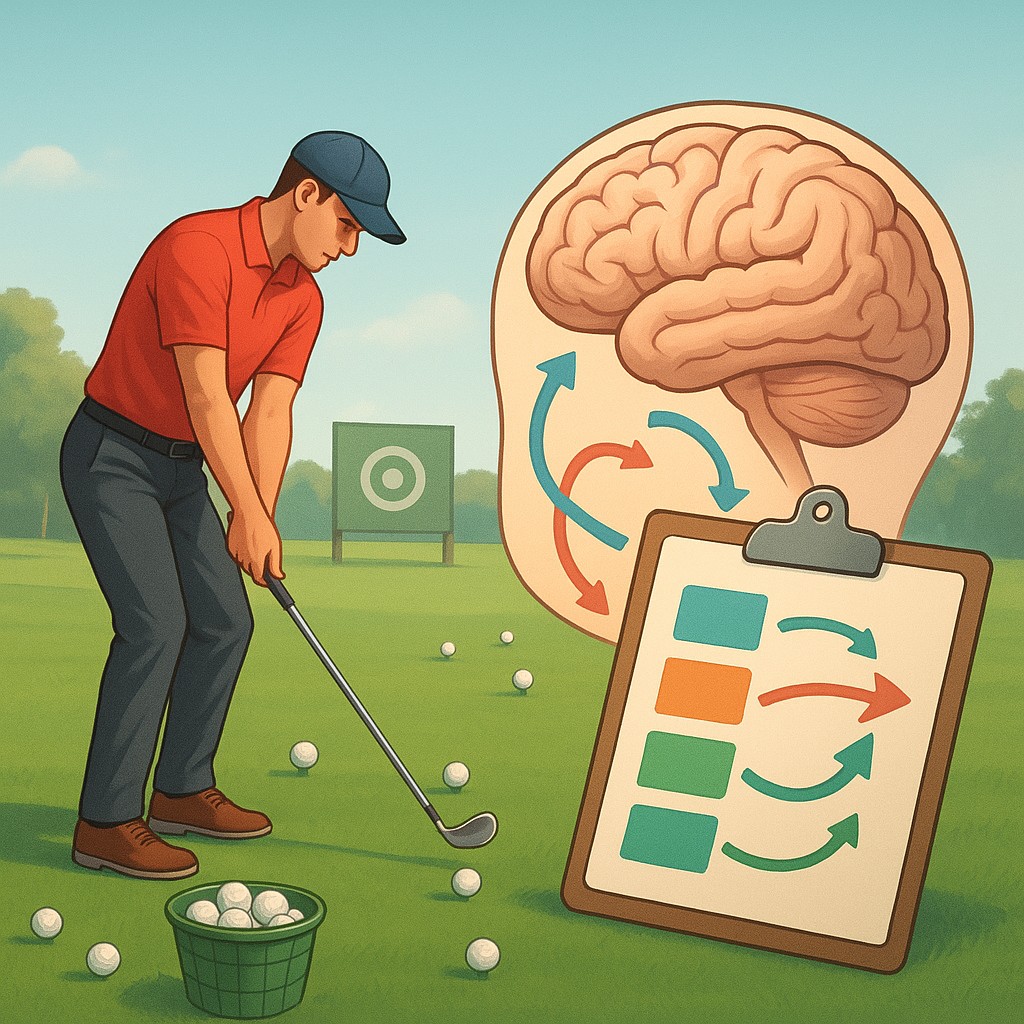
Imagine you are at a driving range, determined to sharpen your golf game. You have a bucket of a hundred balls and decide to spend the next hour hitting nothing but your 7-iron until the swing feels like second nature. By the fiftieth ball, you are hitting the sweet spot every time. You feel like a pro; the rhythm is effortless, and you leave the range feeling incredibly productive. However, when you step onto the actual golf course the following Saturday, that 7-iron swing seems to have vanished into thin air. You shank the ball into the woods, wondering how a skill that felt so solid just days ago could fall apart so quickly. This is the great paradox of learning: the more comfortable a practice session feels, the less likely you are to actually remember what you have learned.
Most of us were taught to learn through "blocked practice," focusing on one single concept or movement until we have it down before moving to the next. It is the educational equivalent of eating a three-course meal by consuming all the steak, then all the potatoes, and finally all the green beans in isolated piles. While this feels efficient because it allows for rapid, short-term improvement, it actually tricks the brain into a state of "fluency" that is nothing more than a temporary illusion. To build knowledge that actually sticks, we have to embrace a much messier, more frustrating, and infinitely more effective strategy known as interleaving. By intentionally mixing up the subjects or skills we are practicing, we force the brain to work harder, ensuring that the neural pathways we build are paved with reinforced concrete rather than shifting sand.
The Illusion of Mastery and the Trap of Repetition
The primary reason blocked practice is so seductive is that it makes us feel smart in the moment. When you solve ten multiplication problems involving fractions in a row, the first two problems require effort, but by the third or fourth, your brain stops thinking about the "how" and starts coasting on autopilot. You are no longer learning the underlying logic of the math; you are simply repeating a pattern that is still fresh in your short-term memory. Cognitive scientists often call this the "fluency heuristic." Because the task becomes easy, we assume we have mastered it. In reality, we have just stopped engaging the deep processing centers of the brain because there is no novelty left to trigger them.
Interleaving disrupts this comfort zone by constantly moving the finish line. Instead of doing ten fraction problems followed by ten geometry problems, an interleaved approach would have you bounce between a fraction, a geometry problem, a long division question, and then back to a fraction. This forces your brain to constantly "reload" the necessary rules for each task. You cannot rely on what you did thirty seconds ago because the current challenge requires a completely different mental toolkit. While this is objectively more taxing and leads to more errors during practice, it prevents the brain from falling into a lazy rhythm. The struggle you feel is actually the sound of your synapses firing in a way that builds long-term durability.
Choosing the Right Tool for the Job
One of the most profound benefits of interleaving is that it teaches "discrimination," which is the ability to tell the difference between various types of problems. In a blocked practice scenario, you already know which tool to use before you even see the problem. If a textbook chapter is titled "The Pythagorean Theorem," you know you are going to use $a^2 + b^2 = c^2$ for every single question. The hardest part of real-world application, however, is not just knowing how to use a formula, but knowing which formula to use when a problem is dropped in your lap without a label.
When you interleave your practice, you train your brain to diagnose the situation first. Every time you switch tasks, your brain must ask, "What kind of problem is this, and what is the best strategy to solve it?" This is known as the "discrimination-association" process. In a high-pressure environment, such as a medical emergency or a professional presentation, your ability to quickly identify the nature of a challenge is often more important than your ability to execute the solution itself. Interleaving mirrors the chaos of reality, ensuring that your skills are not just functional in a vacuum, but are adaptable to the unpredictable nature of life outside the classroom or the practice field.
Comparing Blocked and Interleaved Learning
To better understand how these two methods compare, it is helpful to look at how they impact the learning lifecycle from the first try to the final performance.
| Feature |
Blocked Practice (The Traditional Way) |
Interleaved Practice (The Brain-Hacker Way) |
| Structure |
Focuses on one skill at a time (AAA, then BBB, then CCC). |
Mixes related skills together (ABC, BCA, CAB). |
| Immediate Performance |
High; you see rapid improvement right away. |
Lower; you make more mistakes and feel slower. |
| Long-term Retention |
Low; the information fades quickly after practice. |
High; the memory is deeply rooted and durable. |
| Level of Difficulty |
Easy; creates a false sense of "fluency." |
Challenging; creates "desirable difficulty." |
| Real-world Application |
Poor; struggles when the situation changes. |
Exceptional; excels at identifying problem types. |
| Mental Effort |
Decreases as the session continues. |
Remains high throughout the entire session. |
The Mechanics of Loading and Unloading Memories
When we learn something new, our brain creates a temporary sketch of the information. In blocked practice, we keep that sketch on the "desk" of our working memory and just keep looking at it. Interleaving, however, forces us to clear the desk every few minutes. When you switch from practicing a tennis backhand to practicing a serve, your brain has to "unload" the backhand mechanics and "load" the serve mechanics. When you eventually return to the backhand ten minutes later, you have to work to pull that information from your long-term memory because it is no longer sitting on the desk.
This act of retrieval is where the real magic happens. Each time you successfully pull a piece of information back into your conscious mind, you are strengthening the neural pathway associated with it. Think of it like a trail in the woods: if you walk back and forth over the same ten feet a hundred times in a row, you create a small patch of dirt. But if you walk the entire length of the trail once a day for a month, you create a permanent, clear path through the forest. Interleaving essentially forces you to walk the entire path repeatedly, ensuring that the connection between the "problem" and the "strategy" becomes nearly unbreakable over time.
When to Stop Mixing and Start Blocking
While interleaving is a powerhouse for memory, it is not a magic wand that should be used for everything. There is a specific stage in the learning process where blocked practice is actually better: the very beginning. If you have never held a violin before, trying to mix scales, vibrato, and bowing techniques in your first twenty minutes will likely result in total frustration and a very sore neck. Beginners need a certain amount of repetition to understand the basic mechanics and form of a task.
The rule of thumb is to use blocked practice until you have reached a basic level of "functional competence." Once you understand how a move is performed or how a formula works, that is your cue to start mixing things up. Scientific research suggests that interleaving should be applied to tasks that are related but distinct. For example, mixing Spanish vocabulary with French vocabulary is highly effective because it forces you to distinguish between similar-sounding words. However, mixing chemistry problems with basketball free throws is less effective because the two tasks are so different that the brain doesn't have to work hard to tell them apart. The "difficulty" must be "desirable" and relevant to the skills you want to sharpen.
Designing Your Own Interleaved Schedule
To put this into practice, you must be willing to trade the "feel-good" sensation of a smooth practice session for the grit of a challenging one. If you are a student, stop doing your homework subject by subject. Instead, take two problems from math, five minutes of history reading, and a quick set of chemistry flashcards, then rotate. If you are an athlete, don't just shoot fifty three-pointers; shoot a three-pointer, then a layup, then a free throw, and keep changing your position on the court. The goal is to never let your brain get comfortable enough to stop thinking.
You can also apply this to workplace training or professional development. Rather than attending a four-hour seminar on "Conflict Resolution," try spending twenty minutes on conflict resolution, twenty minutes on project management, and twenty minutes on technical skills, rotating through these topics over the course of a week. This "spaced interleaving" is the gold standard for high-performance learning. It effectively defeats the "forgetting curve," a natural phenomenon where our brains discard information that isn't regularly retrieved. By interleaving your learning, you are sending a clear signal to your body that this information is vital, varied, and worth keeping forever.
The journey to true mastery is rarely a straight line; it is a winding, overlapping path that requires us to be comfortable with being uncomfortable. By choosing to interleave your practice, you are respecting how your brain actually functions rather than how it feels. It takes courage to choose the harder way, to embrace mistakes, and to welcome the frustration of a "slow" session. Yet, the reward for this effort is a reservoir of knowledge and skill that won't fail you when the pressure is on. Start mixing your tasks today, and watch as your temporary gains transform into lifelong expertise.