Think of the entire electrical grid as a massive, high-stakes orchestra. For over a century, this orchestra was easy to conduct because it only had a few, very loud instruments: giant coal, gas, and nuclear power plants. When the audience (the public) wanted more music, the conductor simply signaled the percussion section to hit the drums harder. It was a one-way conversation where supply followed demand with brute force.
However, as we swap those reliable but dirty drums for the flickering melodies of wind and solar power, the orchestra has become unpredictable. Sometimes the wind section stops playing entirely in the middle of a symphony, and the solar players go home the moment the sun sets - right when the audience is cheering for an encore.
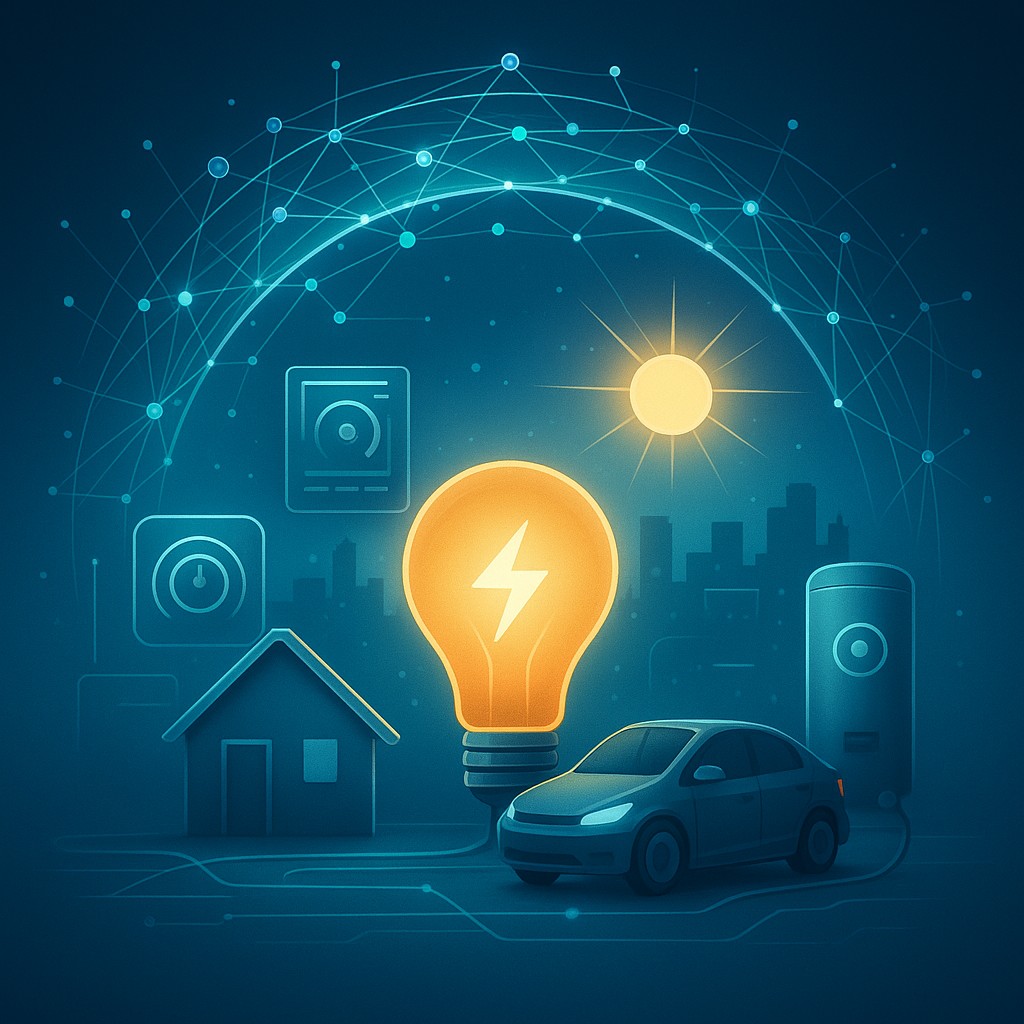
To keep the lights on without firing up ancient, soot-belching backup generators, engineers have developed a radical new solution. Instead of building another massive power plant, they are linking thousands of tiny "smart" instruments already sitting in our homes. Your electric vehicle, your smart thermostat, and even your water heater are being recruited into a synchronized digital choir. This is the birth of the Virtual Power Plant (VPP), a software-driven system that treats a million small actions as one giant, reliable surge of energy. It is a shift from a world where we simply consume power to one where our homes become active, intelligent parts of a living network.
The Invisible Architecture of Distributed Energy
To understand a Virtual Power Plant, you first have to visualize what it is replacing. In the traditional model, electricity is generated at a central hub and pushed out to the edges of the map. This is inefficient because about 5% of that energy is lost just traveling through the wires, and the system must be built to handle "peak" moments that only happen a few times a year. It is like building a forty-lane highway just to handle the traffic on the Wednesday before Thanksgiving, while the rest of the year thirty-eight of those lanes sit empty and expensive.
A VPP flips this structure on its head. It uses Distributed Energy Resources (DERs), which are small-scale units of power generation or storage located at the "edge" of the grid, like a home battery. When a cloud passes over a massive solar farm and its power output drops, the VPP software sends out a lightning-fast signal to thousands of participating homes. In an instant, a thousand home batteries discharge a tiny bit of stored solar power, and five thousand smart thermostats nudge their target temperature up by a single degree. To the grid operator, this looks exactly like a large power plant just turned on, but in reality, it was the collective whisper of a city’s worth of appliances.
The magic of the VPP lies in its aggregation - the act of grouping many small parts into a whole. A single smart fridge saving twenty watts of power is a rounding error, but a million fridges doing it simultaneously is twenty megawatts. This is essentially a "software-defined" power plant. It has no smokestacks, no turbines, and no physical footprint beyond the devices people already own. It exists entirely in the digital layer of the grid, using high-speed internet and complex math to balance the scales of supply and demand in real time.
Shifting From Generation to Flexibility
The most common misconception about the energy crisis is that we simply don't have enough "stuff" making electricity. In reality, we often have plenty of energy; we just have it at the wrong time or in the wrong place. This is what engineers call the "flexibility" problem. For example, California often produces so much solar power during the day that it actually has to pay neighboring states to take it. Then, at 7:00 PM when everyone gets home and plugs in their EVs, the sun goes down and the state has to scramble to find power.
A VPP solves this by turning our consumption into a flexible tool. Instead of just "using" power, we "shift" power. If your electric vehicle knows it doesn't need to be fully charged until 7:00 AM, the VPP software can pause its charging during the evening peak and resume it at 2:00 AM when electricity is cheap and abundant. You still get to work on time with a full battery, but the grid didn't have to struggle to serve you. This turns the demand side of the equation into a shock absorber for the supply side.
| Feature |
Traditional Power Plant |
Virtual Power Plant (VPP) |
| Physical Assets |
Large turbines, boilers, cooling towers |
Smart thermostats, EV chargers, home batteries |
| Response Time |
Minutes to hours (depending on fuel) |
Milliseconds to seconds (digital speed) |
| Carbon Impact |
Usually high (fossil fuels) |
Very low (uses existing clean energy) |
| Cost to Build |
Billions of dollars in infrastructure |
Millions in software and local incentives |
| Resilience |
Centralized (one failure can cause blackouts) |
Decentralized (no single point of failure) |
The Economics of Voluntary Synchrony
You might wonder why anyone would let a utility company "reach into" their home to tweak their thermostat or pause their car charger. The answer is a mixture of community spirit and cold, hard cash. Energy operators aren't doing this by force; they are doing it through a value exchange. In many regions, homeowners are paid a monthly fee just for being part of the VPP, and they receive pulse payments whenever their device is actually used to help the grid. It is a form of passive income generated by your own appliances.
This economic shift turns the consumer into what experts call a "prosumer" - a person who both produces and consumes energy. By participating in a VPP, you are essentially renting out the flexibility of your lifestyle. If you don't mind your house being 73 degrees instead of 72 for twenty minutes during a heatwave, you can effectively lower your annual energy bill. This creates a more democratic energy market where the profits of grid stability are distributed among thousands of households rather than a few massive corporations.
Privacy and control are the biggest hurdles to widespread adoption, but the technology is designed to be "opt-in." A homeowner can set strict rules, such as "never let my battery drop below 20%" or "do not adjust my temperature if it is over 90 degrees outside." The software respects these boundaries, using only the "excess" flexibility that the user has volunteered. This ensures that the collective benefit of the grid never comes at the cost of individual comfort or safety.
Preventing a Chain Reaction of Failure
To appreciate how important VPPs are, we have to look at the physics of grid stability. The electrical grid must maintain a very specific frequency (60 Hz in the US, 50 Hz in Europe) to function. If demand exceeds supply even by a small amount, the frequency drops. If it drops too low, sensitive equipment starts to break, which can lead to a cascading failure where an entire region goes dark. In the old days, the only way to "catch" a falling frequency was to keep massive, spinning metal turbines on standby, which is expensive and wasteful.
VPPs are the digital parachutes of the modern grid. Because they are powered by electronics and software, they can react with sub-second precision. When a sensor detects a frequency dip, the VPP can command ten thousand home batteries to inject power into the grid faster than a human could blink. This "fast frequency response" is often more effective at stabilizing the grid than traditional stone and steel power plants. It is the difference between trying to stop a falling boulder with your hands versus using a sophisticated magnetic braking system.
Furthermore, VPPs provide local resilience. During a major storm that knocks out a main power line, a neighborhood equipped with a VPP can theoretically "island" itself. The local solar panels and batteries can work together via the VPP software to keep the streetlights and essential services running even if the rest of the state is in the dark. This transforms the grid from a fragile glass ornament into a tough, self-healing web.
The Future of the Intelligent Household
As we move toward a fully electrified future, the number of devices capable of joining a VPP is set to explode. We are moving toward a world where every heat pump, clothes dryer, and induction stove is "grid-aware." In this scenario, the grid no longer moves at the speed of a slow, manual switchboard, but at the speed of the internet. We are building a giant, distributed computer whose primary job is to ensure that energy is never wasted and that no one is left in the cold.
This evolution represents a fundamental change in our relationship with technology. Our machines are no longer just tools that serve our immediate whims; they are becoming responsible citizens of a larger ecosystem. When your car waits until midnight to charge, it isn't just saving you money; it is protecting your neighbor's access to electricity and reducing the need for a new gas plant in your county. It is a rare example of a technological advancement where the most sophisticated solution is also the one that helps the community the most.
The transition to a VPP-heavy grid is more than a technical upgrade; it is an invitation to participate in the heartbeat of your city. By allowing our homes to talk to the grid, we are closing the gap between what we need and what the planet can provide. It is a future where the "power plant" isn't a distant, smoke-belching fortress safe behind a fence, but a quiet, intelligent hum living right inside our own walls, working together to keep the world bright and balanced.